
Nick Goold
The Average Directional Movement Index (ADMI), often referred to as ADX, is a widely used technical indicator for measuring trend strength in the forex market. Rather than focusing on direction alone, it helps traders understand whether a trend is strong enough to trade or too weak to rely on.
This makes it especially useful for traders who want to avoid low-quality setups and focus only on markets where momentum is clear.
What the ADMI Indicator Measures
The ADMI indicator is made up of three components that work together to describe market behavior.
- ADX – measures the strength of the trend
- +DI – shows bullish pressure
- -DI – shows bearish pressure
The ADX does not tell you direction. Instead, it shows how strong the current move is. The +DI and -DI lines help identify whether buyers or sellers are in control.
This combination allows traders to understand both the direction and the quality of a trend.
How to Read ADX and DI Lines
Reading the ADMI indicator becomes simple once you focus on a few key relationships.
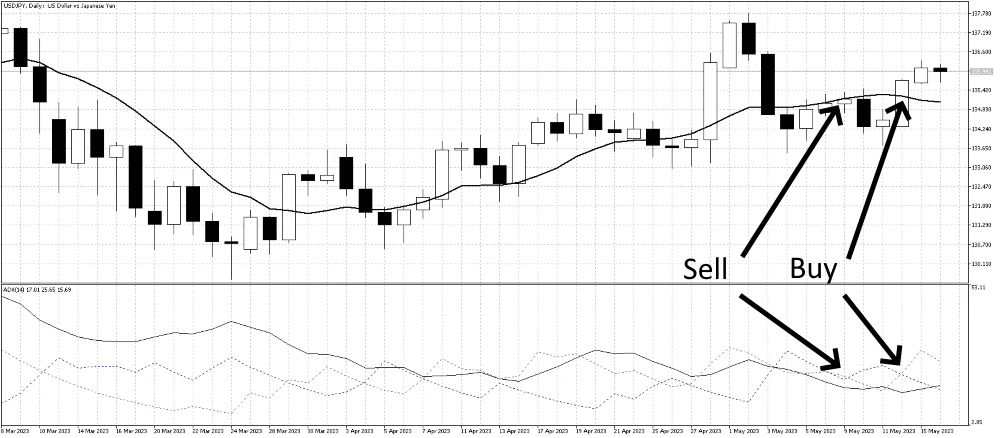
When the ADX rises above 25, it suggests that a trend is developing. As the value increases, the strength of the trend improves. When ADX moves above 50, the market is often in a strong directional move.
The +DI and -DI lines provide direction. When +DI crosses above -DI, buyers are gaining control. When -DI crosses above +DI, sellers are taking over. These crossover signals become more meaningful when they occur alongside a rising ADX, as this confirms that the move has strength behind it.
Using ADMI to Identify Trading Opportunities
The ADMI indicator is most effective when used to filter trades rather than generate signals on its own. A practical approach is to first check the ADX. If it is below 20, the market is likely ranging, and trend strategies become less reliable. When ADX rises above 25, conditions improve for trend-based trading.
Once a trend is confirmed, traders can use DI crossovers to identify potential entries. This keeps the strategy simple and focused on momentum.
Entry and Exit Strategy with ADMI
A basic ADMI strategy follows a structured process rather than reacting to every signal.
For entries, traders often look for:
- ADX rising above 25 to confirm trend strength
- +DI crossing above -DI for long trades
- -DI crossing above +DI for short trades
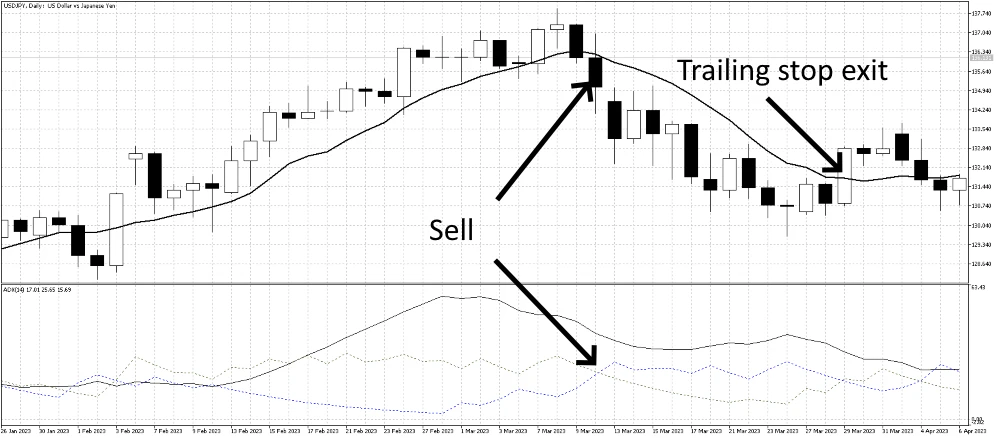
For exits, attention shifts back to the ADX line. When ADX begins to fall, it suggests that the trend is losing strength. This can be a signal to reduce risk or take profits.
Managing Risk with ADMI
Risk management remains essential, even when the trend appears strong. Stops can be placed based on market structure. For example, below recent lows in an uptrend or above recent highs in a downtrend. This keeps risk aligned with actual price behavior.
Targets can be set at key resistance or support levels rather than fixed distances. In strong trends, trailing stops can help capture larger moves without exiting too early. The goal is to stay in strong trends while protecting against sudden reversals.
Combining ADMI with Other Tools
The ADMI works best when combined with simple tools rather than used in isolation. Adding support and resistance levels, or a short-term moving average like the 10 SMA, can improve timing and reduce false signals.
For example, a DI crossover near a key support level in an uptrend is more meaningful than the same signal in the middle of a range. This approach keeps the strategy simple while improving decision quality.
Strengths of the ADMI Indicator
The ADMI is valuable because it focuses on trend quality, not just direction.
It helps traders:
- Avoid trading in weak or ranging markets
- Focus on strong trends with momentum
- Stay in trades longer when conditions remain favorable
This makes it particularly useful for trend-following strategies.
Limitations to Consider
The ADMI is based on past price data, so signals can lag behind current market conditions. This means traders may enter slightly later than the start of a move. It can also produce false signals during choppy markets where trends are not clearly established. In these environments, DI crossovers may occur frequently without follow-through.
Understanding when not to use the indicator is just as important as knowing when to use it.
Building Consistency with ADMI
The ADMI is not about predicting the market. It is about selecting the right conditions to trade. By focusing only on strong trends, aligning entries with momentum, and managing risk carefully, traders can build a more consistent approach.
With practice, the ADMI becomes a filter that helps remove low-quality trades and keeps attention on opportunities where the market is moving with purpose.