
Nick Goold
The bullish flag pattern is a continuation pattern commonly used in forex, indices, and stock trading. It appears after a strong upward move and signals that the market may continue higher after a short pause. This pattern reflects a simple idea. Buyers push the market up aggressively, then pause to take profits. Once that pause ends, buying pressure can return and continue the trend.
Understanding how to identify and trade bullish flags can help you enter trends more effectively, rather than chasing price after large moves.
What Is a Bullish Flag Pattern
A bullish flag forms in two main parts. The first is a strong upward move known as the flagpole. The second is a consolidation phase where price moves sideways or slightly lower.
This consolidation usually happens in a tight range, showing that selling pressure is limited. When the market breaks above the upper boundary of this range, it often signals the continuation of the uptrend. The key idea is that the market is not reversing. It is simply pausing before potentially moving higher again.
Understanding the Flagpole and Consolidation
The flagpole represents strong buying momentum. It is usually steep and formed over a short period, indicating aggressive demand in the market. Before the flagpole, there is often a quieter phase where price builds gradually. This creates the foundation for the breakout move.
The consolidation phase that follows is where the market slows down. Price may drift lower or move sideways, but the pullback is usually controlled and does not retrace the entire move. This behavior suggests that sellers are not strong enough to reverse the trend.
How to Identify a Valid Bullish Flag
Not every consolidation after a rally is a bullish flag. The structure and context are important.
A stronger setup usually includes:
- A clear and sharp upward move forming the flagpole
- A tight consolidation channel with lower volatility
- A breakout above the upper trend line of the flag
The cleaner the structure, the more reliable the pattern tends to be. Messy or wide consolidations often lead to weaker signals.
Bullish Flag Examples in Different Markets
These patterns appear across different asset classes, including indices and currency pairs.
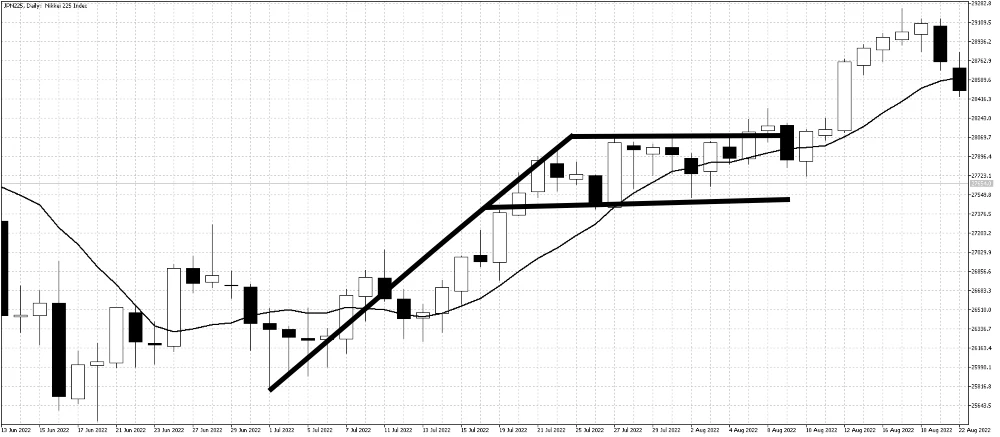
In the Nikkei example, price moved quickly higher before entering a short consolidation phase. Once resistance was broken, the uptrend continued.
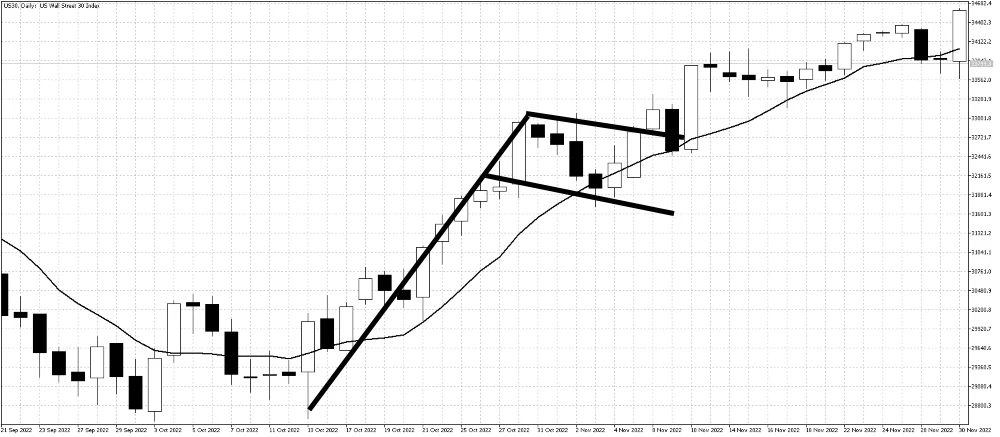
The Dow Jones showed a similar structure. After a recovery move, the market paused before breaking higher again as confidence returned.
In forex, USD/JPY formed multiple bullish flags during strong trends, especially when driven by macro factors such as interest rate differences.
Entry Timing and Trade Approach
The most common entry is on a break above the upper trend line of the flag. This signals that buyers are regaining control. Some traders wait for a strong breakout candle, while others look for a retest of the breakout level before entering. It is important to avoid entering too early during the consolidation phase, as the pattern is not confirmed until the breakout occurs.
Setting Targets and Managing the Trade
There are different ways to manage trades once the breakout happens. One approach is to target nearby resistance levels or previous highs. This is simple and works well in structured markets.
Another approach is to use a trailing stop. As the market moves higher, the stop-loss level is adjusted upward, allowing profits to run in strong trends. In trending markets, this second method can capture larger moves, but it requires patience and discipline.
Stop Loss Placement and Risk Control
Risk management is essential when trading bullish flags. Not all patterns lead to continuation. A common approach is to place the stop loss below the consolidation area or the lower boundary of the flag. This level represents the point where the pattern structure fails.
If price breaks below this level, it suggests that the market is no longer holding the pattern and may reverse. It is also important not to add to losing positions. If the setup fails, exiting early helps protect capital.
Market Context and Confirmation
A bullish flag works best when it aligns with the broader market trend. Trading against the larger direction reduces the probability of success.
Combining the pattern with other factors can improve reliability, such as:
- Trend direction on higher timeframes
- Key support and resistance levels
- Fundamental drivers such as interest rates or economic data
Understanding why the market is moving can provide additional confidence in the setup.
Think in Risk and Reward, Not Win Rate
Like many trend-following strategies, bullish flags do not need a high win rate to be effective. Some trades will fail, especially in changing market conditions. What matters is how losses and profits are managed. Keeping losses controlled while allowing winning trades to develop creates long-term consistency.
This requires discipline. Traders must trust their analysis, follow their rules, and avoid reacting emotionally to short-term outcomes. With practice, the bullish flag becomes easier to recognize. Over time, it can become a reliable way to participate in strong trends without chasing price.