
Nick Goold
Understanding Technical Indicators in Trading
Technical indicators are tools traders use to analyze price behavior and make more informed trading decisions. They are based on mathematical calculations using price data and, in some cases, trading volume. When applied to a chart, they help highlight trends, momentum, volatility, and potential turning points in the market.
Rather than predicting the future, technical indicators provide context. They help traders understand what the market is currently doing and whether conditions are strengthening or weakening. This makes them useful across all markets, including forex, indices, and commodities.
Most indicators fall into two broad categories, and understanding the difference between them is important when building a trading strategy.
Lagging vs Leading Indicators
Lagging indicators are based on past price data and react more slowly to market changes. They are often used to confirm trends rather than predict them. Moving averages and the Parabolic SAR are common examples. These tools help traders stay aligned with the overall direction of the market but may signal entries later.
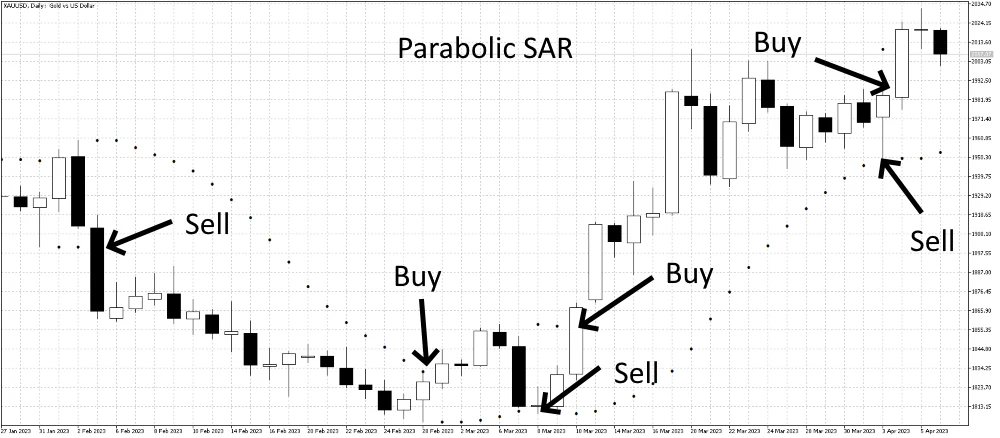
Leading indicators, on the other hand, are designed to signal potential changes before they fully develop. Indicators such as the RSI and Stochastic Oscillator attempt to identify overbought and oversold conditions, giving traders early warnings of possible reversals.
Neither type is better on its own. Lagging indicators provide stability and confirmation, while leading indicators offer earlier signals. Combining both can create a more balanced view of the market.
Why Using a Single Indicator Is Not Enough
Relying on one indicator alone can lead to incomplete analysis. Markets are influenced by many factors, and a single tool rarely captures the full picture. This is why traders often experience false signals when using only one indicator.
For example, a trend indicator might suggest a strong move, while a momentum indicator shows weakening strength. Without combining both, a trader may enter at the wrong time or in the wrong direction. A more practical approach is to use a small number of indicators that complement each other. This reduces noise while improving decision-making.
How Combining Indicators Improves Accuracy
Combining indicators allows traders to confirm signals before entering a trade. Instead of reacting to a single signal, traders look for alignment between different tools. This approach increases confidence and helps filter out weaker setups.
One common example is combining a trend indicator with a momentum indicator. A trader might use the MACD to identify a potential trend change and then use the RSI to confirm whether the market is overbought or oversold.
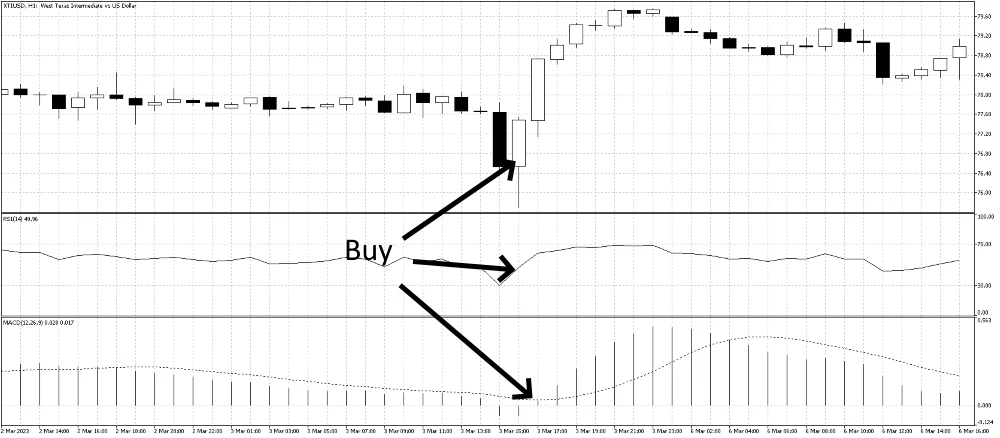
If both indicators point in the same direction, the trade setup becomes stronger. If they conflict, it may be better to wait. This simple process can significantly improve consistency over time.
- Use trend indicators to define direction
- Use momentum indicators to refine entry timing
- Avoid adding too many indicators that provide similar signals
The goal is not to create a complex system but to build a clear and repeatable process.
The Role of Convergence in Trading Decisions
Convergence occurs when multiple indicators provide the same signal at the same time. This is one of the most important concepts when combining technical tools. For example, if the MACD shows a bullish crossover, the RSI is rising from oversold levels, and the Stochastic Oscillator is also turning higher, this alignment suggests that momentum is shifting. This does not guarantee a successful trade, but it increases the probability compared to relying on a single signal.
The same idea applies to continuation setups. If volatility indicators, trend indicators, and price action all support the same direction, traders have a clearer framework to act. However, it is important to stay selective. Not every signal needs to be traded. Waiting for strong convergence often leads to fewer trades but better quality setups.
Common Mistakes When Combining Indicators
One of the most common mistakes is using too many indicators that measure the same thing. For example, combining several momentum indicators does not add value and can create confusion. Another issue is ignoring market context. Indicators should support what price is already showing, not replace it. Traders who focus only on indicators without considering trend, structure, or news events often struggle with consistency.
Keeping the approach simple usually leads to better results. A few well-chosen tools used consistently are more effective than a complex system that changes frequently.
The Importance of Risk Management
Even when using multiple indicators, not every trade will be successful. What matters more is how trades are managed. Traders who focus on risk and reward rather than win rate tend to perform better over time.
A well-structured strategy allows for small losses and larger gains when trades work. Combining indicators helps improve entry quality, but long-term success depends on discipline, risk control, and consistent execution. By using indicators as part of a broader plan rather than relying on them alone, traders can make more balanced decisions and reduce unnecessary risk.