
Nick Goold
The Stochastic Oscillator is a popular momentum indicator that helps traders identify when a market may be overbought or oversold. It is widely used in forex trading because it provides a simple way to understand whether price is stretched relative to its recent range.
Unlike trend indicators, the Stochastic Oscillator focuses on momentum. It compares the latest closing price to a recent high–low range and shows whether buyers or sellers are currently in control. This makes it especially useful in markets that are moving sideways, where price tends to rotate between support and resistance.
Understanding How the Stochastic Oscillator Works
The indicator moves between 0 and 100 and is usually calculated using a 14-period setting. The main idea is simple. In an uptrend, prices tend to close near the highs of the range. In a downtrend, prices tend to close near the lows.
The Stochastic Oscillator is made up of two lines. The %K line reacts quickly to price changes and shows the current momentum. The %D line is a smoothed version of %K and helps traders see the broader direction more clearly.
Rather than focusing on the formula, most traders concentrate on how the lines behave around key levels and how they interact with price structure.
How to Read Overbought and Oversold Conditions
The most common way to use the Stochastic Oscillator is to identify overbought and oversold conditions. Readings above 80 suggest the market may be overbought, while readings below 20 indicate it may be oversold.
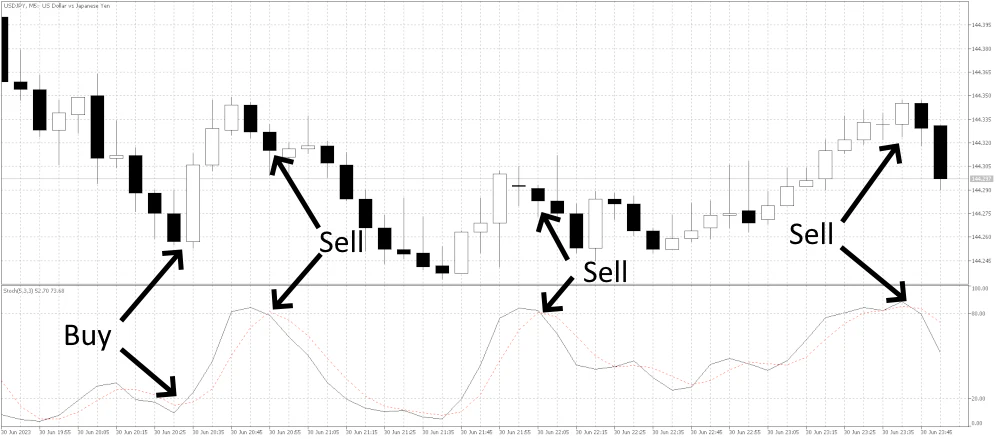
These levels do not mean the market will immediately reverse. In strong trends, the indicator can remain in these zones for longer than expected. This is why experienced traders combine these signals with price action and key levels rather than trading them blindly.
A more practical approach is to wait for the indicator to move out of these zones. For example, instead of selling immediately when the indicator is above 80, traders may wait for it to turn lower and confirm that momentum is weakening.
Using Divergence to Spot Potential Reversals
Divergence is one of the more advanced ways to use the Stochastic Oscillator. It occurs when price and momentum are no longer moving in the same direction.
A bullish divergence forms when price makes a lower low, but the indicator forms a higher low. This suggests that selling pressure is weakening. A bearish divergence occurs when price makes a higher high, but the indicator makes a lower high, signaling that buying momentum may be fading.
While divergence can be powerful, it works best when combined with support and resistance levels or major market events. On its own, it should not be treated as a guaranteed reversal signal.
Best Market Conditions for the Stochastic Oscillator
The Stochastic Oscillator performs best in range-bound markets where price moves between clear highs and lows. In these conditions, overbought and oversold signals tend to be more reliable and easier to trade.
- Most effective in sideways markets with clear support and resistance
- Less reliable in strong trends where momentum remains one-sided
- Useful across different timeframes, from intraday to longer-term charts
In trending markets, traders often adjust their approach. Instead of trading both directions, they may only take signals in the direction of the trend. For example, in an uptrend, they may focus on oversold signals and ignore overbought conditions.
Combining the Stochastic Oscillator with Other Tools
The Stochastic Oscillator becomes more effective when used alongside other simple tools. Moving averages are commonly used to define trend direction, while support and resistance levels help identify where price is likely to react.
For example, if the market is in an uptrend and price pulls back to a support level while the Stochastic moves below 20, this combination provides a more structured trading idea than using the indicator alone.
This approach reduces false signals and helps traders stay aligned with the broader market direction.
Strengths and Limitations to Be Aware Of
The main advantage of the Stochastic Oscillator is its simplicity. It clearly highlights potential turning points and can be applied across different markets without complex adjustments.
However, it also has limitations. One of the most common issues is false signals during strong trends. The indicator may show overbought or oversold conditions, but price continues moving in the same direction.
It is also a lagging indicator, meaning it reacts to price rather than predicting it. This can lead to delayed entries, especially in fast-moving markets.
Understanding these limitations is important. Traders who treat the indicator as a guide rather than a signal generator tend to use it more effectively.
Focus on Risk and Reward Over Win Rate
The Stochastic Oscillator does not guarantee a high win rate, and it should not be used with that expectation. What matters more is how trades are managed once a signal appears. In many cases, traders may have a moderate win rate but remain profitable by ensuring their winning trades are larger than their losses. This is especially important when using indicators that can produce false signals.
Using stop losses, waiting for confirmation, and staying patient are all part of applying the indicator effectively. Over time, consistent execution matters far more than trying to predict every market move.