
Nick Goold
The Elliott Wave Theory is a widely used approach in forex trading that focuses on how markets move in repeating patterns. These patterns are driven by crowd psychology, which shifts between optimism and pessimism over time. By understanding these cycles, traders attempt to identify where the market is within a trend and what may come next.
Although the concept can seem complex at first, the core idea is simple. Markets do not move randomly. Instead, they tend to move in waves that reflect how traders react to price, news, and expectations.
Understanding the basics of Elliott Wave Theory
The foundation of the theory is that price moves in two types of waves: impulse waves and corrective waves. Impulse waves move in the direction of the main trend, while corrective waves move against it.
In a typical cycle, the market forms five waves in the direction of the trend, followed by three waves that correct that move. This creates a repeating structure that traders use to analyze price behavior.
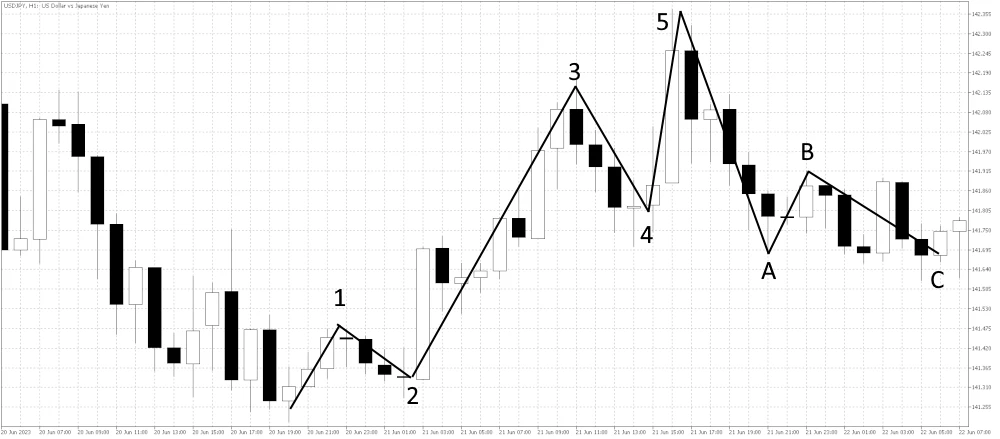
This pattern reflects how market participants behave. Early in a trend, only a few traders are involved. As the trend develops, more participants join, pushing price further. Eventually, sentiment becomes stretched, and a correction begins.
How Fibonacci ratios fit into wave analysis
Elliott Wave Theory often uses Fibonacci ratios to measure how far waves may move. These ratios help traders estimate potential retracement and extension levels. For example, Wave 2 often retraces a portion of Wave 1, while Wave 3 tends to extend strongly in the direction of the trend. Later waves also follow common retracement patterns, which can help traders anticipate possible turning points.
These relationships are not exact rules but provide a framework for understanding market structure. When combined with price action, they can help traders plan entries and exits more effectively.
Using Elliott Wave in trading
Applying Elliott Wave Theory in real markets involves identifying where the current price sits within the wave structure. This process is known as wave counting. Wave counting helps traders understand whether the market is trending or correcting. This can guide decisions on whether to follow the trend or wait for a better entry.
Traders often use this approach for:
- Identifying the direction of the main trend
- Finding potential entry points during pullbacks
- Estimating price targets based on wave extensions
For example, if a trader identifies that the market is in a strong third wave, they may look to join the trend rather than trade against it. If the market appears to be in a corrective phase, they may wait for confirmation before entering.
Strengths of Elliott Wave analysis
One of the main advantages of this approach is that it provides structure. Instead of reacting to every price movement, traders can place price action within a broader context. It also helps with timing. Recognizing early stages of a trend allows traders to enter before the move becomes obvious to the majority of the market.
Another benefit is risk management. Because wave structures have invalidation points, traders can define where their analysis is wrong and manage risk accordingly. This makes it possible to combine Elliott Wave with other tools, such as support and resistance or moving averages, to build a more complete trading plan.
Limitations and challenges
Despite its strengths, Elliott Wave Theory is not easy to apply consistently. One of the biggest challenges is subjectivity. Different traders may label waves differently, leading to different conclusions about the same chart.
The theory also requires time and experience to understand properly. Without practice, it can be difficult to identify wave structures in real time, especially in fast-moving markets.
It is also less effective in certain conditions. During ranging or low-volatility markets, wave structures can become unclear, making analysis less reliable. For this reason, many traders use Elliott Wave as part of a broader strategy rather than relying on it alone.
How to approach Elliott Wave as a trader
For most traders, the best way to use Elliott Wave Theory is as a guide rather than a strict rule. Focus on understanding the overall structure of the market rather than trying to label every small movement.
Start with higher timeframes to identify the main trend, then move to lower timeframes to refine entries. This helps reduce noise and improves clarity. It is also important to stay flexible. If the market does not follow your expected wave structure, adjust your view rather than forcing the analysis to fit.
With time, traders can develop a more intuitive understanding of how markets move in waves. This can improve timing, confidence, and overall decision-making when trading trends.