
Nick Goold
The Head and Shoulders pattern is one of the most widely recognized formations in technical analysis, but its real value goes beyond its appearance. It reflects a shift in market control, where a strong trend begins to weaken and eventually reverses.
Many traders learn to identify the pattern visually, but the more important skill is understanding what is happening beneath the surface. The pattern shows how momentum fades, how buyers or sellers lose control, and how the opposite side begins to take over. :contentReference[oaicite:0]{index=0}
When used correctly, it provides a structured way to identify potential reversals, plan entries, and manage risk with more clarity.
Understanding the Structure Behind the Pattern
The Head and Shoulders pattern forms during the later stage of a trend. It signals that the market is no longer moving with the same strength as before.
In an uptrend, price pushes higher, forming the left shoulder. After a pullback, it makes another push to a new high, forming the head. However, this second push often lacks the same strength, even if the price reaches a higher level.
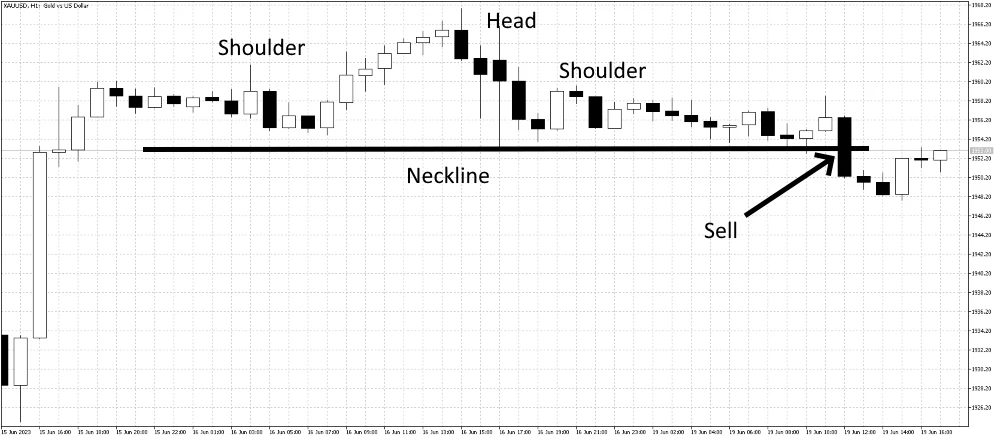
The final move creates the right shoulder, where price attempts to move higher again but fails to reach the previous high. This is often the first clear sign that the trend is losing strength.
The neckline connects the lows between these peaks. It acts as a key level because it represents the last support holding the trend together. Once this level breaks, the structure shifts.
What the Pattern Tells You About Market Behavior
The pattern is not just a shape. It reflects a gradual change in control between buyers and sellers.
At the left shoulder, buyers are still in control. At the head, they push price higher, but the move is often less stable. By the time the right shoulder forms, buyers are struggling to continue the trend.
This progression shows that demand is weakening. When price breaks the neckline, it confirms that sellers are now in control. This transition is what traders focus on, rather than simply identifying the pattern visually.
Trading the Neckline Break
The neckline is the most important level in the pattern. It defines the point where the trend is likely to change.
Many traders wait for a clear break of the neckline before entering a trade. This helps avoid entering too early while the pattern is still forming.
A typical approach includes:
- Entering after price closes below the neckline in a top pattern
- Placing a stop above the right shoulder to control risk
- Using the height of the pattern to estimate a target
This creates a structured trade with defined risk and a clear potential outcome.
Some traders also look for a retest of the neckline after the break. This can provide a better entry price, although it requires patience and may not always occur.
Inverse Head and Shoulders and Trend Reversals Upward
The inverse version of the pattern appears after a downtrend and signals a potential move higher.
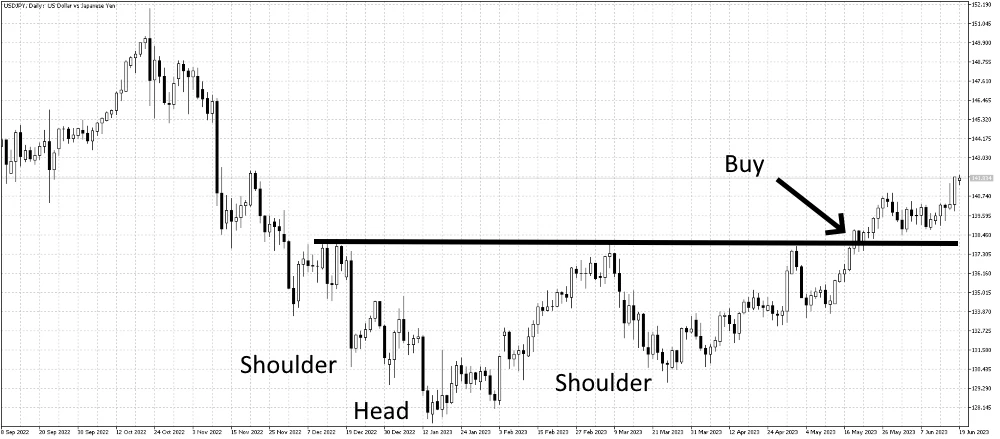
In this case, the market forms a series of lower lows, followed by a higher low at the right shoulder. This suggests that selling pressure is fading.
When price breaks above the neckline, it confirms that buyers are gaining control, creating a potential long opportunity.
The same principles apply: wait for confirmation, define risk, and avoid entering based on anticipation alone.
Common Mistakes When Trading the Pattern
One of the most common mistakes is trying to trade the pattern before it is fully formed. Early entries often lead to losses because the market has not yet confirmed the reversal.
Another issue is forcing the pattern onto unclear price action. Not every set of highs and lows forms a valid Head and Shoulders. If the structure is not clean, confidence and consistency both suffer.
Traders also underestimate how often breakouts fail. Markets do not move in straight lines, and false breaks are part of normal price behavior.
How to Improve the Quality of Your Setups
Rather than looking for more patterns, it is more effective to focus on better ones.
Clear structure is important. The shoulders should be reasonably balanced, and the neckline should be easy to identify. If the pattern looks forced, it is usually better to skip it.
Waiting for confirmation is another key factor. A strong break with momentum is more reliable than a slow or hesitant move.
Some traders also consider the broader context, such as overall trend direction or recent volatility, to decide whether the pattern is likely to perform well.
Managing Trades After Entry
Once in a trade, management becomes more important than the pattern itself.
Price does not always move directly toward the target. There may be pullbacks, pauses, or partial moves. Being prepared for this helps avoid exiting too early or holding on too long.
In some cases, the first breakout fails, but a second attempt leads to a stronger move. Traders who manage risk effectively can stay flexible and take advantage of these situations.
The goal is not to predict every move, but to respond to price in a structured way.
Focus on Risk Control, Not Just Pattern Accuracy
It is easy to focus on how often the Head and Shoulders pattern works, but consistency comes from how trades are managed rather than how they are identified.
Even well-formed patterns can fail, especially in changing market conditions. What matters is keeping losses controlled while allowing profitable trades enough room to develop.
By combining structure, patience, and risk control, the Head and Shoulders pattern becomes a practical tool rather than just a visual signal. It helps traders make more measured decisions and stay focused on process rather than prediction.