
Nick Goold
The term “bull market” is widely used in financial markets, but its exact origin is not entirely clear. One popular explanation is based on how a bull attacks by pushing its horns upward, which reflects rising prices. Another theory suggests the term came from early stock market speculators who tried to push prices higher, a behavior that may have been associated with “bulls.”
Regardless of its origin, a bull market today simply refers to a period where prices are generally rising and sentiment is positive. It applies across all markets, including stocks, commodities, and currencies. For traders, understanding when a bull market is developing is important because it changes how you approach entries, risk, and trade selection.
What is a bull market in forex trading?
In forex, a bull market means the base currency is strengthening against the quote currency. For example, if EUR/USD is rising, it means the euro is gaining value relative to the U.S. dollar.
This type of environment is usually supported by strong fundamentals. It may come from better economic data, higher interest rate expectations, or increased demand for a particular currency. In many cases, multiple factors work together, which is why bull markets can last longer than traders expect.
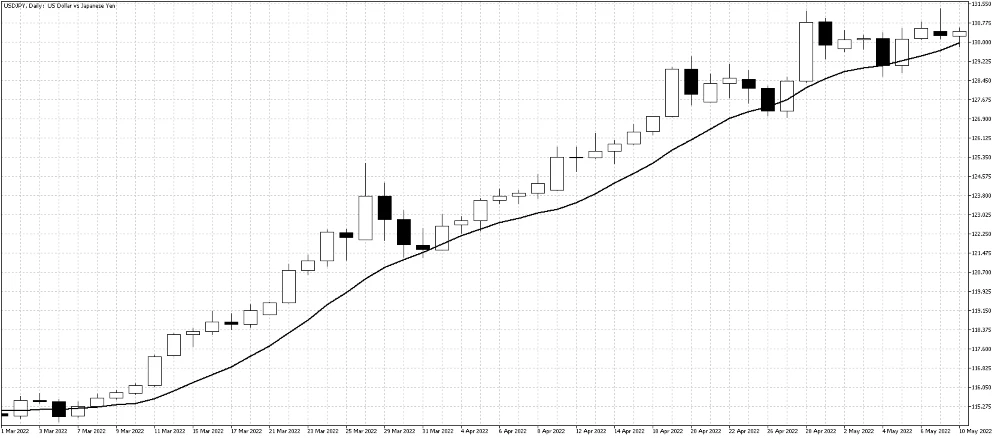
Unlike short-term price moves, a bull market reflects a broader shift in expectations. Traders are not just reacting to one event but are gradually adjusting their positions as confidence builds.
Why bull markets matter for traders
Many traders make the mistake of treating all market conditions the same. In reality, strategies that work in a range often fail in a trending market, and vice versa.
In a bull market, the focus should shift toward buying opportunities rather than trying to sell tops. Price tends to continue in the same direction, and pullbacks often provide better entries than chasing breakouts.
Understanding this helps avoid a common problem where traders repeatedly trade against the trend, expecting reversals that never fully develop.
How to identify a bull market
Recognizing a bull market is not about one signal. It comes from combining price action, technical structure, and broader market context.
Look for a clear uptrend in price
The most direct way to identify a bull market is through price structure. A consistent pattern of higher highs and higher lows indicates that buyers are in control.
Moving averages can help confirm this. When price stays above the average and the average itself is sloping upward, it reflects sustained buying pressure. Shorter-term averages such as the 10-day can help with timing, while longer-term averages like the 50-day or 200-day show the broader trend.
Trendlines are also useful. By connecting higher lows, you can visualize the strength of the trend and identify potential entry points when price pulls back.
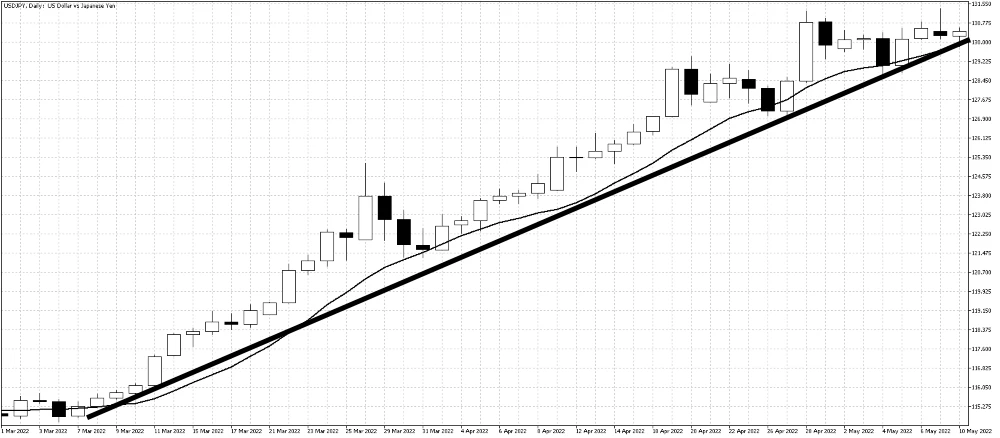
These pullbacks are often where the best trades occur, as they allow you to enter with better risk rather than chasing price after it has already moved.
Use economic context to confirm the trend
Price does not move in isolation. Economic conditions often explain why a bull market is developing.
Stronger economic growth, rising inflation expectations, or higher interest rates can all support a currency. When these factors align, they create a foundation for sustained upward movement.
This is why it is important to follow economic calendars and understand how new data compares to expectations. Markets tend to move not just on the data itself, but on whether it is better or worse than expected.
Watch participation and volume
As trends develop, more traders and institutions tend to get involved. This increased participation often shows up as higher trading volume.
Rising volume alongside rising prices can confirm that a move is supported by real demand rather than being driven by short-term positioning. While volume data in forex is less centralized than in equities, many platforms still provide useful indicators of activity.
Pay attention to market sentiment
Sentiment plays a larger role than many traders realize. In a bull market, the overall tone of the market shifts. News becomes more positive, analysts revise forecasts upward, and traders begin to expect higher prices as the base case.
This does not mean the market will move in a straight line. Pullbacks still happen, and volatility can increase at times. However, the underlying bias remains upward, and that should influence how trades are planned and managed.
Trading approach during a bull market
Once a bull market is identified, the focus should be on aligning with the trend rather than fighting it.
Instead of trying to pick the top, traders can look for:
- Pullbacks toward moving averages or trendlines
- Breakouts that occur after consolidation
- Continuation patterns within the trend
Risk management remains important. Even in strong trends, not every trade will work. However, trading in the direction of the trend increases the probability that your trades align with the broader market flow.
Over time, recognizing these conditions allows for more consistent decision-making. Rather than reacting to every price movement, you begin to focus on the structure behind the move, which leads to better timing and more controlled execution.