
Nick Goold
Fibonacci levels are widely used by traders to identify potential support and resistance areas in forex and other financial markets. Rather than guessing where a pullback might stop, these levels give a structured way to anticipate where price may react.
They are especially useful in trending markets, where price rarely moves in a straight line. Instead, markets move in waves, pulling back before continuing in the same direction. Fibonacci levels help traders identify those pullback zones and plan entries with better timing.
What Are Fibonacci Levels?
Fibonacci levels are based on a mathematical sequence where each number is the sum of the two before it. The sequence starts like this:
0, 1, 1, 2, 3, 5, 8, 13, 21, 34, 55, 89, 144...
As the sequence progresses, the ratio between the numbers becomes consistent. The most important ratio is 1.618, known as the golden ratio. Its inverse, 0.618 or 61.8%, forms the foundation of Fibonacci trading levels.
From these relationships, traders use key retracement levels:
- 23.6%
- 38.2%
- 50.0%
- 61.8%
- 76.4%
These percentages represent how much of a previous move the market may retrace before continuing.
How Fibonacci Levels Work in Forex Trading
Markets move in trends, but even strong trends include pullbacks. Fibonacci levels help traders estimate how deep those pullbacks might go.
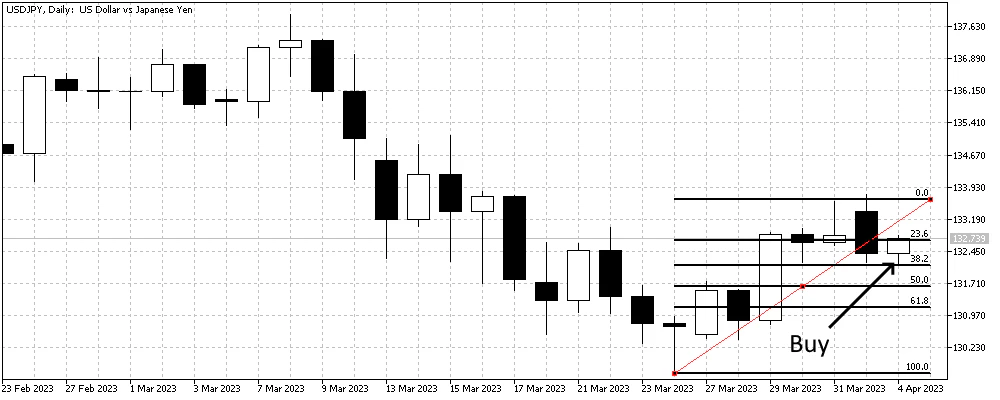
In an uptrend, traders measure from the swing low to the swing high. The Fibonacci levels then highlight potential areas where price may pause or reverse before continuing higher. In a downtrend, the process is reversed.
The most commonly watched levels are 38.2%, 50%, and 61.8%. These are not exact turning points, but zones where reactions often occur.
For example, in a strong trend, price may only retrace to the 38.2% level before continuing. In a slower or weaker trend, the pullback may extend to 50% or even 61.8% before buyers or sellers step back in.
Why Fibonacci Levels Matter to Traders
The effectiveness of Fibonacci levels comes down to behavior. Markets are driven by participants, and many traders around the world watch the same levels. This creates self-reinforcing reactions.
When price approaches a key Fibonacci level, traders begin to act. Some take profits, others enter new positions, and some adjust risk. This clustering of decisions can cause price to slow, reverse, or accelerate.
Fibonacci levels become even more useful when they align with other technical factors, such as:
- Previous support and resistance levels
- Trend lines
- Moving averages like the 10 SMA
When multiple signals come together at the same level, it increases the chance of a meaningful reaction.
Using Fibonacci Levels for Trade Entries
Fibonacci is most practical when used to plan entries during pullbacks rather than chasing price after a move has already happened.
In an uptrend, traders often wait for price to pull back into the 38.2%–61.8% zone before looking for buying opportunities. In a downtrend, the same idea applies in reverse for selling opportunities.
The key is not to assume price will reverse exactly at a level, but to watch how price behaves when it reaches that area. Signs of slowing momentum, rejection candles, or support forming can provide additional confirmation.
Risk Management with Fibonacci
Fibonacci levels also help structure risk more clearly. Instead of placing stops randomly, traders can use the levels to define where their idea is no longer valid.
For example, if price pulls back to the 50% level and a trader enters long, a stop can be placed beyond the 61.8% level. If price moves beyond that level, it suggests the trend may be weakening or changing.
This approach allows traders to:
- Define risk before entering a trade
- Avoid emotional decisions during volatility
- Maintain consistent trade structure
Using Fibonacci in this way helps turn trading into a more controlled process rather than reacting to every market move.
Putting It All Together
Fibonacci levels are not a standalone strategy, but they are a valuable tool for improving timing and structure. They work best when combined with trend analysis and simple price action. Instead of asking where the market will go next, Fibonacci helps answer a more practical question: where is the best place to enter if the trend continues?
By focusing on pullbacks, aligning with the trend, and managing risk around key levels, traders can use Fibonacci to approach the market with more clarity and consistency.