Nick Goold
The bearish flag pattern is a continuation pattern that forms during a downtrend and signals that the market may continue moving lower. It is widely used by forex, index, and commodity traders because it helps identify structured pullbacks within a strong trend rather than trying to predict reversals.
The pattern gets its name from its visual appearance. A sharp downward move creates the “flagpole,” followed by a small upward or sideways consolidation that forms the “flag.” This pause reflects a temporary balance between buyers taking profits and sellers waiting to re-enter. When selling pressure returns, the price often breaks lower and continues the trend.
Understanding the Structure of a Bearish Flag
A bearish flag is built in two clear phases. The first is the impulsive move lower, which shows strong selling momentum. This move is usually driven by fundamentals such as economic data, interest rate expectations, or shifts in risk sentiment.
The second phase is the consolidation. During this period, price moves slightly higher or sideways in a narrow range. This does not indicate a trend reversal, but rather a pause as the market absorbs the previous move. Volume and volatility often decrease during this phase, which is why experienced traders wait patiently for confirmation before entering.
What makes this pattern effective is that it aligns with trend-following behavior. Instead of chasing the initial move, traders look for a controlled pullback and enter when momentum resumes.
How to Trade the Bearish Flag Pattern
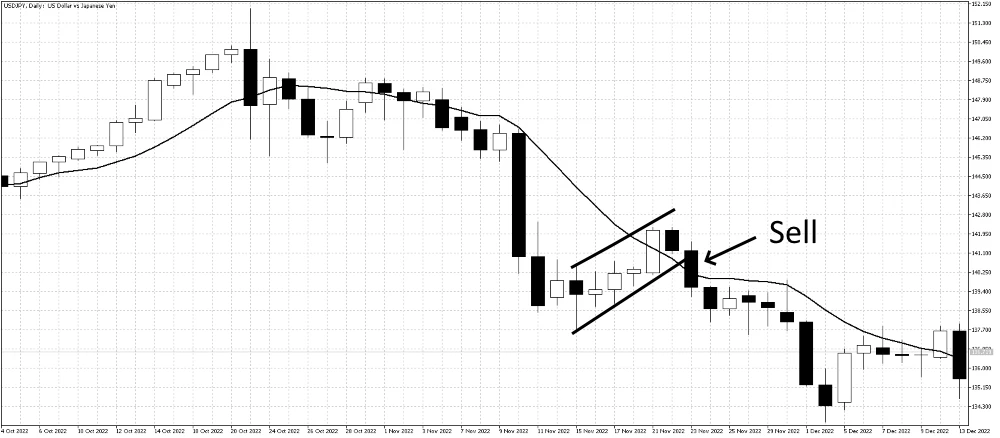
The most common approach is to wait for the price to break below the lower boundary of the flag. This breakdown suggests that sellers have regained control and that the downtrend is likely to continue.
Rather than entering early, traders typically wait for confirmation. This can include a strong bearish candle, increased momentum, or alignment with broader market conditions. Entering too early inside the flag can lead to unnecessary losses if the pattern extends or fails.
- Wait for a clear break below flag support
- Avoid entering during the consolidation phase
- Check higher timeframes for overall trend direction
- Be aware of upcoming news that could change market conditions
While the pattern can appear on any timeframe, it tends to be more reliable on higher timeframes such as the 4-hour or daily charts. This is because more traders are watching these levels, which increases the likelihood of follow-through after the breakout.
Risk Management When Trading Bearish Flags
Managing risk is essential when trading continuation patterns. Even strong setups can fail, especially in changing market conditions or during major news events. A structured approach helps protect capital and maintain consistency.
Stop loss placement depends on your trading style and timeframe. Traders using wider stops often place them above the top of the flag, where the pattern would clearly be invalidated. Short-term traders may prefer tighter stops to maintain better risk control, even if it means being stopped out more frequently.
Profit targets are often based on the size of the flagpole. This provides a logical and consistent way to estimate potential movement rather than relying on guesswork.
- Place stops where the pattern becomes invalid, not where it feels comfortable
- Use the flagpole size to estimate realistic targets
- Aim for risk-reward ratios where potential profit is greater than risk
This approach ensures that even if some trades fail, overall performance can remain positive over time.
Common Mistakes to Avoid
One of the most common mistakes is entering too early, before the breakout is confirmed. This often leads to getting caught in extended consolidation or false moves. Another issue is ignoring the broader market context. A bearish flag forming against a strong higher timeframe uptrend is less reliable. Traders who combine pattern recognition with trend analysis tend to achieve better results.
It is also important not to rely on the pattern alone. Combining it with simple tools such as support and resistance, moving averages, or key news events can improve decision-making without overcomplicating the process.
Trading Psychology and Pattern Discipline
The bearish flag pattern requires a level of judgment, which means different traders may interpret the same chart differently. This can create hesitation, especially after a losing trade. Rather than trying to be perfect, focus on consistency. No pattern works every time, and losses are part of trading. The goal is not to win every trade, but to manage risk and allow profitable setups to perform over time.
Staying patient during the consolidation phase and disciplined during execution is often what separates consistent traders from inconsistent ones. The pattern itself is simple, but success comes from how it is applied in real market conditions.
Focus on Risk Management
The bearish flag is a trend-following setup, which means it may not produce a high win rate. However, when traded correctly, the size of winning trades can be larger than losses. This is what creates long-term profitability.
Instead of focusing on how often you win, focus on how much you win compared to how much you lose. A structured approach to entries, exits, and risk management will reduce stress and improve overall performance.