
Nick Goold
The Adaptive Moving Average (AMA) is a more flexible version of a traditional moving average. It adjusts to market conditions, becoming more responsive when price moves quickly and slowing down when the market is quiet. This helps traders better identify trends and avoid unnecessary noise.
Unlike standard moving averages that use fixed settings, the AMA changes its sensitivity based on volatility. This makes it especially useful in markets that shift between trending and ranging conditions.
What Makes the Adaptive Moving Average Different
Most moving averages apply the same calculation regardless of market conditions. This often leads to lag during fast markets and too many false signals during slow periods.
The AMA solves this by adjusting how quickly it reacts. When price moves clearly in one direction, the AMA speeds up to follow the trend. When price is choppy, it slows down to filter out noise. This ability to adapt helps traders stay aligned with the real market structure rather than reacting to every small movement.
How the Adaptive Moving Average Works
The calculation behind the AMA is more complex than standard indicators, but the concept is straightforward. It measures how efficient price movement is over a period of time and adjusts its responsiveness accordingly.
When price moves smoothly in one direction, the indicator reacts faster. When price moves erratically, it becomes more stable and less sensitive. :contentReference[oaicite:0]{index=0}
This balance between speed and smoothness is what makes the AMA useful across different market conditions.
Using the AMA to Identify Trends
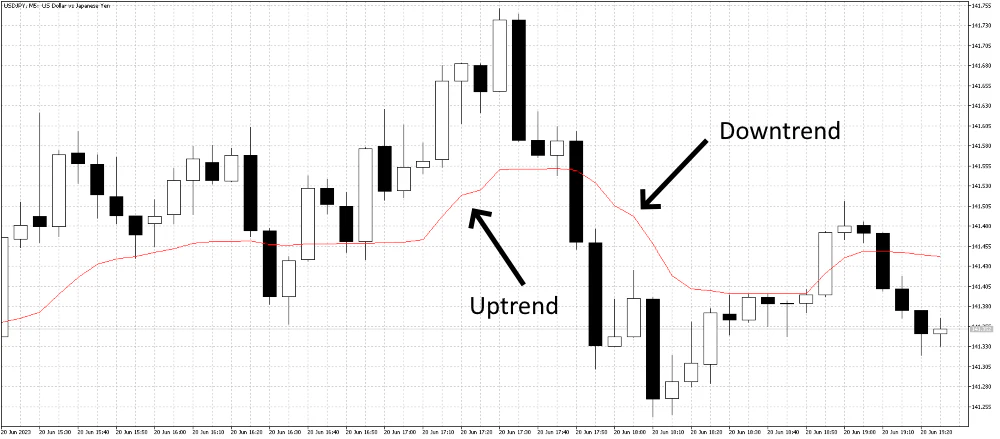
The simplest way to use the AMA is to determine the direction of the trend. When the line is moving upward, the market is generally in an uptrend. When it is sloping downward, the market is in a downtrend.
This gives you a clear directional bias. Instead of trying to trade both sides of the market, you can focus on trading in the direction of the trend, which often improves consistency.
Entry Timing with the Adaptive Moving Average
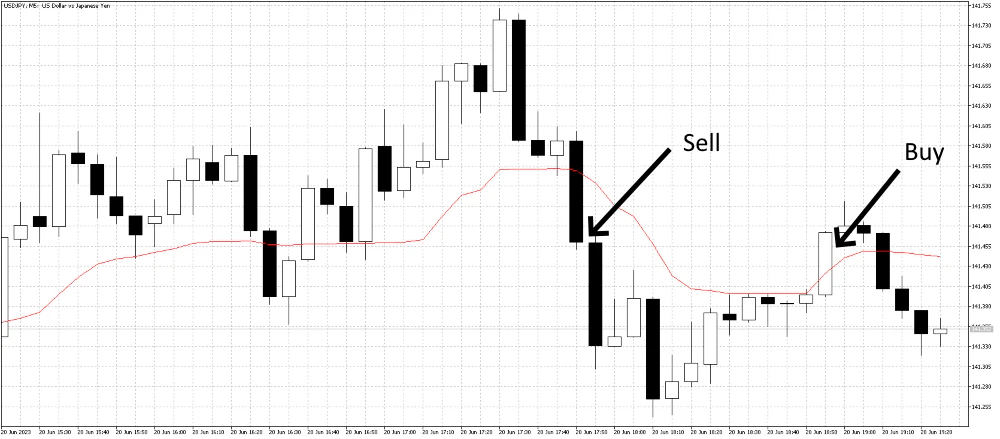
Once you identify the trend, the next step is finding entry points. The AMA can help you time entries in a structured way rather than reacting emotionally to price movement.
There are two common approaches that traders use:
One method is to enter when price crosses the AMA. A move above the line can signal potential strength, while a move below may indicate weakness. This approach works well in trending markets where momentum continues.
Another method is to wait for pullbacks. In an uptrend, price often returns toward the AMA before continuing higher. These pullbacks can provide better entry prices with smaller risk. The same idea applies in a downtrend when price moves back toward the AMA before falling again.
Both approaches aim to align entries with the broader trend while keeping risk controlled.
Managing Trades with the AMA
Having a clear exit plan is just as important as finding a good entry. The AMA can also help manage trades once you are in a position.
If the direction of the AMA changes, it may indicate that the trend is weakening or reversing. This can be a signal to reduce risk or close the trade.
Many traders also combine the AMA with support and resistance levels. For example, entering on a pullback toward the AMA and targeting the next resistance level can create a structured trade with clear risk and reward.
Another practical approach is using a trailing stop. As the market moves in your favor, you can adjust your stop based on recent price structure while keeping the AMA as a guide for overall direction.
Strengths of the Adaptive Moving Average
The main advantage of the AMA is its flexibility. It adjusts to market conditions instead of forcing a fixed view on price.
This provides several practical benefits:
- It responds faster in strong trends while staying stable in sideways markets
- It reduces unnecessary signals during choppy conditions
- It can be adapted to different markets and timeframes
For traders who want a balance between responsiveness and smoothness, the AMA offers a practical solution.
Limitations to Be Aware Of
Despite its advantages, the AMA is not perfect and should not be used in isolation.
Because it is still based on past price data, it can lag during sudden reversals. In fast-moving markets, this delay can affect entry or exit timing.
It can also react to short-term volatility spikes, which may lead to false signals if used without confirmation.
This is why many traders combine the AMA with other tools such as support and resistance or basic price structure. Using multiple factors helps filter out lower-quality setups.
Focus on Profit vs Loss, Not Just Win Rate
Like any strategy, the goal is not simply to win more trades. The objective is to manage risk and capture larger moves when they occur.
The AMA helps by keeping you aligned with the trend and improving entry timing, but results still depend on how you manage trades. A well-timed entry with controlled risk and a clear target will always matter more than how often you are right.
When used with discipline, the Adaptive Moving Average becomes a practical tool for identifying trends, improving entries, and maintaining consistency across different market conditions.