
Nick Goold
The Commodity Channel Index (CCI), developed by Donald Lambert, is a widely used momentum indicator in forex trading. It helps traders identify overbought and oversold conditions, spot potential trend reversals, and understand how far price has moved away from its average.
Rather than focusing only on direction, the CCI measures how extreme price movement is compared to recent history. This makes it especially useful for timing entries and exits in both trending and ranging markets.
What the Commodity Channel Index Shows
The CCI is an oscillator that moves above and below zero. It compares the current price level to an average price over a selected period, showing whether the market is trading at unusually high or low levels.
When the CCI is near zero, price is close to its average. When it moves far away from zero, it suggests price has deviated significantly, which can signal potential trading opportunities.
This makes the CCI useful for identifying both momentum and possible turning points.
Understanding How CCI Works
The CCI is calculated using the typical price, which is the average of the high, low, and closing price. This value is then compared to a moving average, and the difference is adjusted using mean deviation. While the calculation may seem complex, the practical takeaway is simple. The indicator shows how far price is from its normal range.
When price moves too far in one direction, it often slows down, pauses, or reverses. The CCI helps highlight these situations.
Identifying Overbought and Oversold Conditions
One of the most common uses of the CCI is to identify extreme price levels.
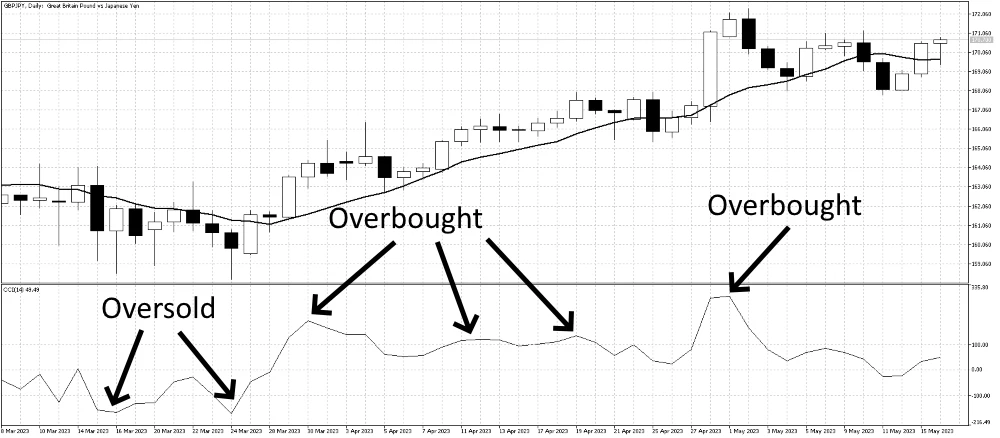
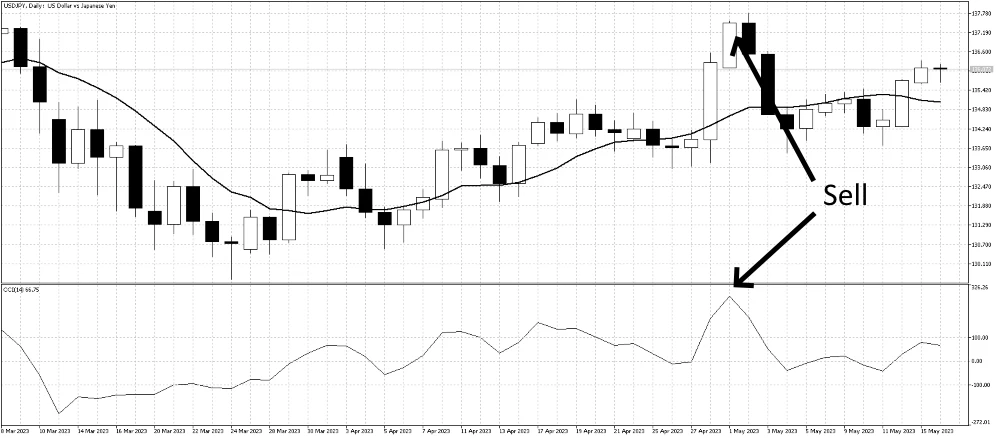
When the CCI rises above +100, it suggests the market may be overbought. This means price has moved up quickly and may begin to slow or pull back. When the CCI falls below -100, it suggests the market may be oversold, indicating that price may be due for a bounce or recovery.
These levels are not signals on their own, but they provide important context about market conditions.
Using the Zero Line for Trend Direction
The zero line on the CCI can also be used to understand trend direction. When the CCI moves above zero, it suggests bullish momentum is building. When it moves below zero, it indicates bearish momentum.
Traders often use this as a confirmation tool rather than a standalone signal. For example, if price is already trending higher, a move above zero can support a continuation trade.
Spotting Divergence for Reversal Signals
Divergence is one of the more advanced ways to use the CCI.
A bullish divergence occurs when price makes a lower low, but the CCI makes a higher low. This suggests that downward momentum is weakening. A bearish divergence occurs when price makes a higher high, but the CCI makes a lower high. This can indicate that upward momentum is fading.
These situations can highlight potential reversal points, but they work best when combined with other forms of analysis.
Practical Ways to Use CCI in Trading
The CCI can be applied in several practical ways depending on market conditions.
- In trending markets, use the zero line to confirm direction and stay aligned with momentum
- In ranging markets, use +100 and -100 levels to identify potential turning points
- Watch for divergence as an early warning of possible reversals
It is important to avoid relying on a single signal. The CCI works best when used alongside price structure, support and resistance, or other indicators.
Using Multiple Timeframes for Better Timing
Looking at the CCI across different timeframes can improve decision-making.
A higher timeframe helps identify the overall trend, while a lower timeframe can be used to refine entries and exits. This approach helps align short-term trades with the broader market direction.
Managing Risk When Using CCI
Risk management remains essential when using any indicator. Stop losses should be placed based on market structure rather than indicator signals alone. For example, placing stops beyond recent highs or lows provides more logical protection.
Take profit levels should reflect current market conditions. In strong trends, larger targets may be possible, while in quieter markets, smaller and quicker profits are more realistic.
Building Consistency with CCI
The CCI is a flexible tool that can support different trading styles, from short-term trading to longer-term analysis. Its strength comes from highlighting extremes and momentum shifts rather than giving exact entry points. By combining it with other analysis and adapting it to market conditions, traders can improve their timing and decision-making.
Like any tool, its effectiveness improves with practice. Testing it across different markets and conditions will help you understand when it works best and how to apply it with confidence.