
Nick Goold
The Money Flow Index (MFI) is a technical indicator used to measure the strength of buying and selling pressure in the market. Unlike many indicators that rely only on price, the MFI also includes volume, giving traders a clearer picture of how money is actually flowing into or out of a market. This makes it particularly useful for spotting potential reversals, confirming trends, and understanding whether a move is supported by strong participation or not.
What the Money Flow Index Shows
The MFI combines price and volume to show whether buyers or sellers are in control. When money is flowing into a market, the indicator rises. When money is flowing out, it falls. It moves between 0 and 100, which makes it easy to interpret. Higher values suggest strong buying pressure, while lower values indicate stronger selling pressure.
Because it includes volume, the MFI often provides deeper insight than indicators like RSI, especially in markets where participation matters.
How the Money Flow Index Is Calculated
The calculation may look complex, but the idea behind it is straightforward.
- First, the typical price is calculated using high, low, and close
- That price is then multiplied by volume to measure money flow
- Money flow is split into positive and negative depending on price direction
- A ratio is created between buying and selling pressure
- The final MFI value is scaled between 0 and 100
This process allows the indicator to reflect not just price movement, but how strong that movement is based on trading activity.
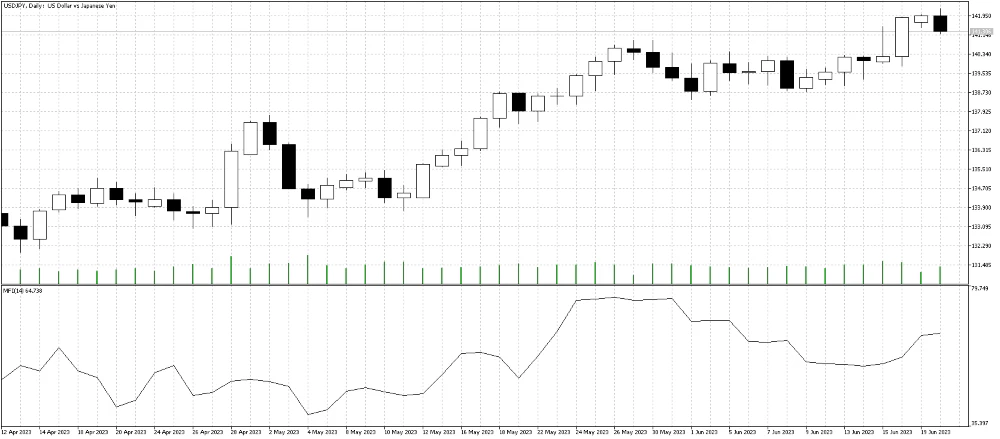
Using the Money Flow Index in Forex Trading
The MFI is most effective when used to identify key conditions in the market rather than as a standalone signal. It helps traders understand when a move is becoming stretched or when momentum is shifting.
Identifying Overbought and Oversold Conditions
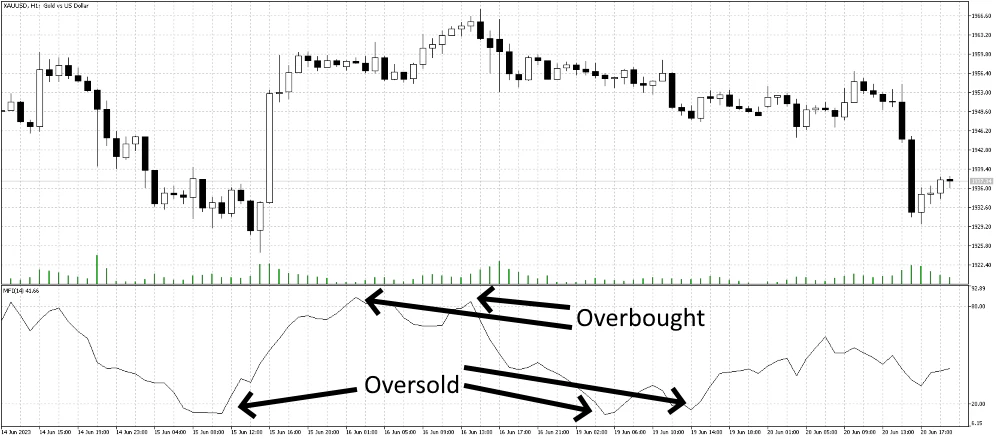
One of the most common uses of the MFI is spotting overbought and oversold levels. When the MFI moves above 80, it suggests that buying pressure may be overextended. This does not mean price will immediately reverse, but it indicates that the market may slow down or pull back.
When the MFI drops below 20, it suggests selling pressure may be exhausted, increasing the chance of a bounce or reversal. These levels are best used as warning signals rather than immediate trade entries.
Spotting Divergence for Early Signals
Divergence is one of the more powerful ways to use the MFI. A bullish divergence occurs when price makes lower lows but the MFI starts to rise. This shows that selling pressure is weakening even though price is still falling.
A bearish divergence happens when price makes higher highs but the MFI starts to fall, suggesting that buying pressure is losing strength. These signals often appear before a visible trend change, giving traders time to prepare rather than react.
Confirming Trend Strength
The MFI can also be used to confirm whether a trend has strong backing. In an uptrend, if the MFI continues to move higher, it shows that buying pressure supports the move. In a downtrend, a falling MFI confirms that sellers remain in control.
This helps traders avoid entering trades when momentum is weak or fading.
Advantages of the Money Flow Index
The MFI stands out because it combines price and volume, offering a more complete view of market activity.
It helps traders:
- Understand the strength behind price movements
- Identify potential reversal zones
- Confirm whether trends are supported by real market participation
Limitations to Keep in Mind
Like all indicators, the MFI is based on past data, which means signals can lag behind price. It can also produce false signals, especially in choppy or sideways markets where price lacks direction. In these conditions, overbought and oversold levels may be reached multiple times without a clear reversal.
Interpretation also varies between traders. Some focus on levels, others on divergence, and others on trend confirmation. Without a structured approach, this can lead to inconsistent decisions.
How to Use the MFI More Effectively
The best results come from combining the MFI with simple price action and market structure. Instead of trading every signal, focus on situations where multiple factors align. For example, a divergence forming near a key support or resistance level is more meaningful than a signal in the middle of a range.
Keeping the approach simple allows you to react quickly while maintaining consistency. The Money Flow Index is not about predicting every move. It is about understanding whether the market has the strength to continue or is starting to lose momentum. When used correctly, it helps you filter trades and focus on higher-quality opportunities.