
Nick Goold
The moving average (MA) is one of the most widely used technical indicators in trading. It helps traders understand the overall direction of the market by smoothing out price fluctuations and highlighting the underlying trend. :contentReference[oaicite:0]{index=0}
Rather than focusing on every small price movement, the moving average provides a clearer view of where the market is heading. This makes it easier to identify trends and avoid reacting to short-term noise. Because of its flexibility, it can be used across all timeframes, from short-term intraday trading to longer-term analysis.
There are several types of moving averages. The simple moving average (SMA) gives equal weight to all prices, while the exponential moving average (EMA) and weighted moving average (WMA) react more quickly to recent price changes. Many traders prefer the SMA for its simplicity and reliability, especially when identifying key market structure.
Why Moving Averages Are Effective in Forex Trading
Moving averages work because they reflect collective market behavior. Many traders watch similar levels, which often causes price to react around them. As a result, moving averages frequently act as dynamic support and resistance areas.
They also provide structure. Instead of trying to predict the market, traders can use moving averages to react consistently to price movements. This helps reduce emotional decision-making and creates a more disciplined trading approach.
In trending markets, moving averages help traders stay aligned with momentum. In quieter conditions, they can highlight when price is stretched too far from its average level.
Moving Average Crossover Strategy

The crossover strategy is one of the simplest and most commonly used approaches. It focuses on moments when price crosses above or below a moving average. A move above a downward-sloping average may signal the start of an upward trend, while a move below an upward-sloping average may indicate a potential decline.
This strategy is often most effective after extended price movements, where the market is more likely to reverse or correct. However, in sideways markets, frequent crossings can lead to false signals and unnecessary losses.
- Strength: Provides regular signals and is easy to apply
- Weakness: Can generate false entries in ranging conditions
Using Moving Averages as Support and Resistance

In strong trends, moving averages often act as support in rising markets and resistance in falling markets. Traders look for pullbacks toward the moving average as potential entry points in the direction of the trend.
This approach allows for better risk-reward opportunities, as entries are made closer to key levels. However, timing can be difficult, especially when volatility increases and price does not clearly reach the moving average.
- Strength: Offers strong entries aligned with the trend
- Weakness: Entries can be missed if price turns before reaching the average
Second Cross Strategy for Trend Continuation

The second cross strategy focuses on continuation rather than reversal. After a temporary break below the moving average in an uptrend, a move back above it can signal renewed strength. This often leads to stronger momentum as traders re-enter the market.
This setup is particularly effective in strong trending environments, where momentum remains consistent. In weaker conditions, however, the signal may lack follow-through.
- Strength: Can capture strong continuation moves with relatively tight risk
- Weakness: Less reliable when the trend is weak or unstable
Moving Average Gap Strategy
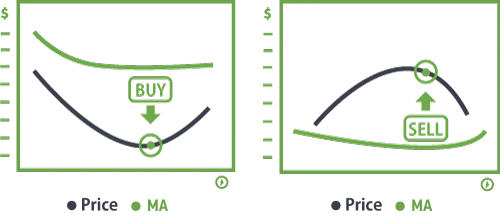
When price moves significantly away from the moving average, it often returns toward it. This is known as mean reversion. Traders look for situations where price is unusually far from its average and anticipate a correction.
This strategy can offer frequent opportunities, especially in stable market conditions. However, in strong trends, price can remain extended for longer than expected, which increases the risk of entering too early.
- Strength: Provides repeated opportunities based on consistent market behavior
- Weakness: Difficult to define extreme levels, increasing risk in trending markets
Golden Cross and Death Cross Strategy
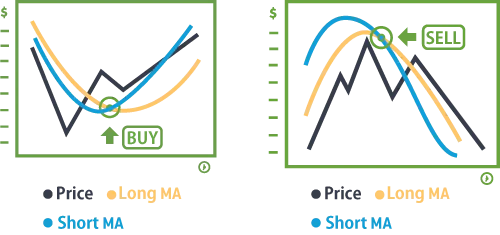
The golden cross and death cross use two moving averages of different lengths to identify major trend changes. A golden cross occurs when a shorter-term average crosses above a longer-term average, signaling bullish conditions. A death cross signals the opposite, indicating bearish momentum.
These signals are widely followed and can lead to significant market moves, especially in strong trending environments. However, they appear less frequently and often lag behind price action.
- Strength: Clear signals for major trend shifts
- Weakness: Fewer opportunities and delayed entries
How to Use Moving Averages in a Practical Trading Approach
Moving averages are most effective when used as part of a broader trading framework. They should not be relied on alone but combined with price action, market structure, and risk management. It is also important to match the moving average period to your trading style. Shorter periods respond quickly but generate more noise, while longer periods provide smoother signals but react more slowly.
Rather than trying multiple strategies at once, focus on one or two approaches and apply them consistently. Over time, this builds confidence and helps you understand how the market behaves under different conditions. With experience, moving averages become more than just an indicator. They become a tool for reading market structure, managing risk, and making more consistent trading decisions.