
Nick Goold
The Parabolic SAR (Stop and Reverse), developed by J. Welles Wilder Jr., is a widely used trend-following indicator that helps traders identify trend direction, potential reversals, and trade management levels. It is especially useful in markets that are trending clearly, where price moves in a consistent direction.
Rather than predicting the market, the Parabolic SAR reacts to price movement. This makes it a practical tool for staying aligned with trends and managing trades more effectively.
What the Parabolic SAR Shows
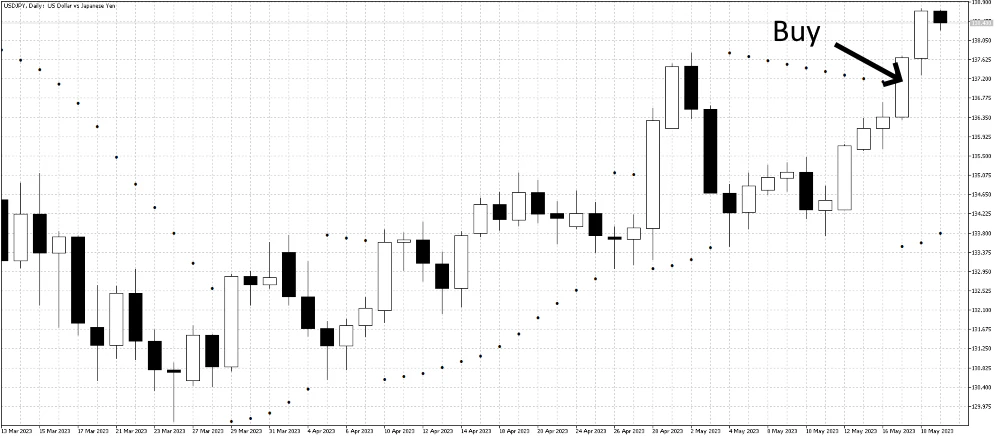
The Parabolic SAR appears on a chart as a series of dots placed either above or below price. These dots shift as price moves, giving a visual indication of the current trend. When the dots are below price, the market is considered to be in an uptrend. When the dots are above price, the market is in a downtrend. This simple visual structure makes it easy to quickly understand market direction.
The distance between the dots and price also provides useful information. When the gap is wide, the trend is strong. When the dots move closer to price, the trend may be slowing or approaching a reversal.
How the Indicator Works
The Parabolic SAR is based on two key components: the acceleration factor and the extreme point. The acceleration factor controls how quickly the indicator reacts to price. It starts small and increases as the trend continues, which makes the dots move closer to price over time. This is why the indicator becomes more sensitive during strong trends.
The extreme point represents the highest or lowest price reached during the current trend. As new highs or lows are made, the indicator adjusts its position to reflect the updated trend structure. This combination allows the Parabolic SAR to follow price closely while still giving room for trends to develop.
Using Parabolic SAR to Identify Trends
One of the main strengths of the Parabolic SAR is its ability to clearly show trend direction.
Traders often use it as a simple filter:
- Focus on buying when dots are below price
- Focus on selling when dots are above price
This helps remove unnecessary trades against the trend and keeps trading decisions aligned with overall market momentum.
Spotting Potential Reversals
A key feature of the Parabolic SAR is how it signals possible trend changes. When the dots switch from below price to above, it suggests the uptrend may be ending and a downtrend could begin. When the dots flip from above to below, it signals a potential move higher.
These signals can be useful for:
- Exiting existing trades
- Preparing for a possible change in direction
However, not every signal leads to a strong reversal. In sideways markets, the indicator can produce frequent false signals. This is why context matters.
Using Parabolic SAR for Entries and Exits
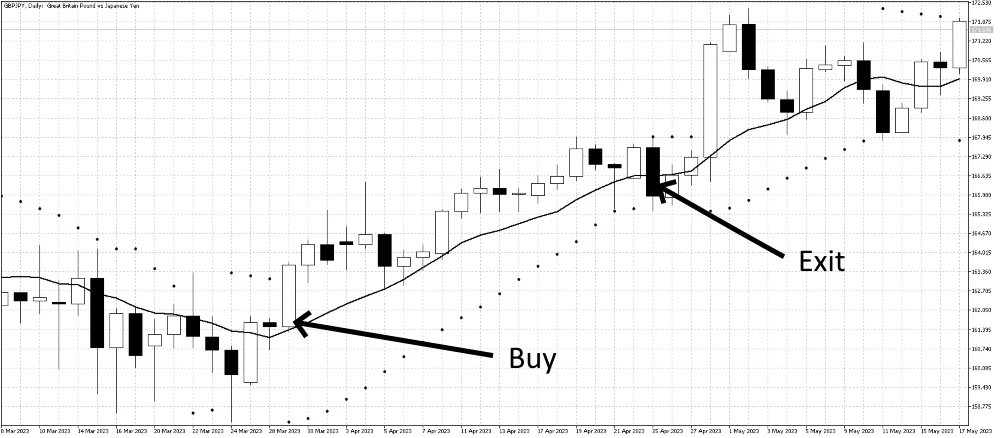
The Parabolic SAR can also help define clear trade management rules. For entries, traders may look for price to move in line with the dots. For example, entering long positions when price stays above the dots in an uptrend.
For exits, the indicator is often used as a trailing stop. As the dots move higher in an uptrend, traders can adjust their stop-loss to follow the dots. This allows profits to be protected while still giving the trade room to continue.
When the Parabolic SAR Works Best
The indicator performs best in trending markets where price moves consistently in one direction. In these conditions, it helps traders stay in trades longer and capture larger moves.
However, in ranging or choppy markets, price moves back and forth without direction. This causes the dots to flip frequently, which can lead to repeated losing trades. Understanding the market environment is important before relying on this indicator.
Improving Accuracy with Confirmation
Many traders combine the Parabolic SAR with other tools to improve decision-making.
For example:
- Using moving averages to confirm trend direction
- Using RSI to identify overbought or oversold conditions
- Checking support and resistance levels before entering trades
This combination reduces the risk of acting on false signals and provides a clearer overall picture.
Using Multiple Timeframes
Another effective approach is to analyse different timeframes. A higher timeframe can help identify the main trend, while a lower timeframe can be used for precise entries and exits. This adds structure to your trading and improves timing.
Practical Approach to Using Parabolic SAR
The Parabolic SAR is not designed to predict the market perfectly. It is a tool to help you stay aligned with price movement and manage trades with more structure. By focusing on trend direction, using the dots for trailing stops, and combining it with other analysis, traders can build a more consistent approach.
Like any indicator, it becomes more effective with practice. Testing it in different market conditions helps you understand when to rely on it and when to be cautious.