
Nick Goold
What Is Pivot Point Trading?
Pivot point trading is a widely used technical analysis method that helps traders identify key support and resistance levels in the market. It is especially popular among forex day traders because it provides clear, predefined levels that can be used to plan entries, exits, and risk management.
The idea behind pivot points is simple. By using the previous session’s high, low, and closing prices, traders can calculate levels that may influence price behavior in the current session. These levels act as reference points where price may pause, reverse, or accelerate.
The central pivot point represents the overall balance of the market, while additional levels above and below act as potential resistance and support.
How Pivot Points Are Calculated
The standard pivot point formula is based on the previous period’s price data:
Pivot Point (PP) = (High + Low + Close) / 3
From this value, multiple support and resistance levels are calculated. These levels are commonly labeled S1, S2, S3 for support and R1, R2, R3 for resistance. Each level represents a potential area where price may react.
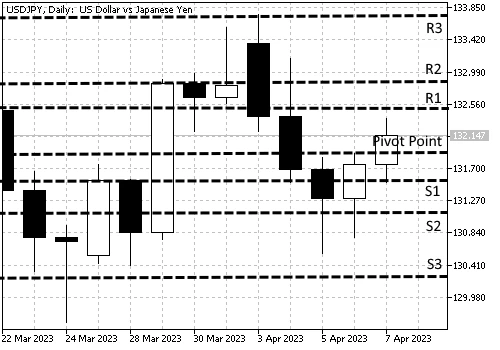
These levels are fixed for the trading session, which makes them easy to follow and widely used by many traders. Because so many participants watch the same levels, they often become self-reinforcing.
Using Pivot Points in Range Trading
Pivot points are particularly effective in range-bound markets where price moves between support and resistance levels. In these conditions, traders look for price reactions at key levels rather than expecting strong directional moves.
For example, if price approaches a resistance level such as R1 and begins to slow or reverse, this may signal a potential short trade. Similarly, if price reaches a support level like S1 and shows signs of holding, it may present a buying opportunity.
- Sell near resistance if price shows signs of rejection
- Buy near support if price begins to stabilize
- Use nearby levels to define entry and exit points
This approach works best when the market lacks a strong trend and is moving within a defined range.
Using Pivot Points in Trend Trading
Although pivot points are often associated with range trading, they can also be used in trending markets. The key is to use the central pivot point as a reference for overall market direction.
If the market opens above the pivot point, it may indicate bullish sentiment. Traders may then look for buying opportunities, especially on pullbacks toward support levels. If the market opens below the pivot point, it may suggest bearish conditions, encouraging traders to focus on selling opportunities.
Combining pivot points with simple tools such as moving averages can help confirm the trend and reduce false signals. This creates a more structured approach rather than relying on pivot levels alone.
Improving Trade Timing with Pivot Levels
One of the main advantages of pivot points is that they provide clear areas to plan trades in advance. Instead of reacting to price movements, traders can prepare scenarios based on how price behaves at each level.
For example, if price breaks through a resistance level with strong momentum, it may continue toward the next level. If it fails to break and reverses, it may return toward the pivot point or the next support level.
This structured approach helps traders stay disciplined and reduces impulsive decisions.
Risk Management Using Pivot Points
Pivot points are not only useful for identifying entries, but also for managing risk. Because the levels are clearly defined, they can be used to set stop losses and profit targets in a logical way.
For example, if a trader enters a long position near support, a stop loss can be placed below that level. If the level breaks, the trade idea is no longer valid. Profit targets can then be set near the next resistance level.
- Place stops beyond the level that invalidates the trade
- Use the next pivot level as a potential target
- Maintain a clear risk-to-reward ratio before entering
This structured approach helps control losses while allowing trades to develop when the market moves as expected.
When Pivot Points Work Best
Pivot points are most effective in active markets with consistent participation, such as major forex pairs during peak trading sessions. They are particularly useful for short-term traders who need clear and repeatable levels.
However, they are less reliable during major news events, when price can move quickly through multiple levels without reacting. In these situations, combining pivot points with market context becomes even more important.