
Nick Goold
Purchasing Managers’ Index (PMI): A Key Indicator for Forex Trading
Understanding the economic indicators that drive currency movements is essential for consistent forex trading. One of the most important leading indicators is the Purchasing Managers’ Index (PMI), which provides insight into business conditions and overall economic momentum.
PMI is widely followed because it reflects both current activity and future expectations. This makes it particularly useful for traders who want to anticipate market direction rather than react after the move has already happened. Changes in PMI can influence investor sentiment, central bank policy expectations, and ultimately currency prices.
What the PMI Measures and Why It Matters
The Purchasing Managers’ Index is based on monthly surveys of purchasing managers across key industries. These individuals are responsible for ordering materials and managing supply chains, so they often see changes in demand before they appear in broader economic data.
The survey covers several important areas, including new orders, production levels, employment, supplier delivery times, and inventories. These components are combined into a single index value ranging from 0 to 100.
A PMI reading above 50 indicates expansion in economic activity, while a reading below 50 suggests contraction. Because this data is released frequently and reflects forward-looking conditions, it is considered one of the most reliable early indicators of economic trends.

The image above shows how shifts in PMI data can align with currency movements. Strong readings tend to support a currency, while weaker data can lead to declines.
How PMI Influences Currency Movements
PMI affects the forex market through several key channels. These influences are often interconnected, which is why PMI releases can trigger sharp and immediate price reactions.
When PMI data is stronger than expected, it suggests that economic activity is improving. This can increase investor confidence and attract capital into that country, leading to a stronger currency. Conversely, weaker PMI readings may indicate slowing growth, reducing demand for the currency.
Another important factor is interest rate expectations. Central banks monitor PMI data as part of their decision-making process. If business activity is strong and inflation risks are rising, central banks may consider tightening monetary policy. Higher interest rates tend to attract foreign investment, supporting the currency. If PMI data weakens, the opposite may occur, with expectations shifting toward lower interest rates.
PMI also plays a role in shaping global risk sentiment. Strong data encourages a more positive outlook on growth, which can lead investors to move into higher-yielding currencies. Weaker data can increase uncertainty and push traders toward safer assets.
PMI and Global Market Dynamics
Beyond individual currencies, PMI has a broader impact on global markets. Because it reflects demand for goods and services, it is closely linked to international trade and commodity demand.
Export-driven economies often benefit when PMI data improves, as it suggests stronger global demand. This can lead to increased demand for their currencies. Commodity-linked currencies, such as those tied to energy or raw materials, can also be influenced by PMI trends, as stronger business activity often leads to higher commodity consumption.
On the other hand, weak PMI readings can signal slowing global demand, which may weigh on both commodities and the currencies of exporting countries. This interconnected relationship makes PMI a valuable indicator not just for individual markets, but for understanding global economic momentum.
Key PMI Releases and Market Timing
PMI data is released monthly across major economies, and these releases are closely watched by forex traders due to their ability to move markets quickly. The timing of these releases also matters, as they often occur early in the month and can set the tone for market expectations.
The United States, Eurozone, China, Japan, and the United Kingdom all publish PMI data regularly. These reports provide a snapshot of economic conditions across different regions, allowing traders to compare relative strength between economies.
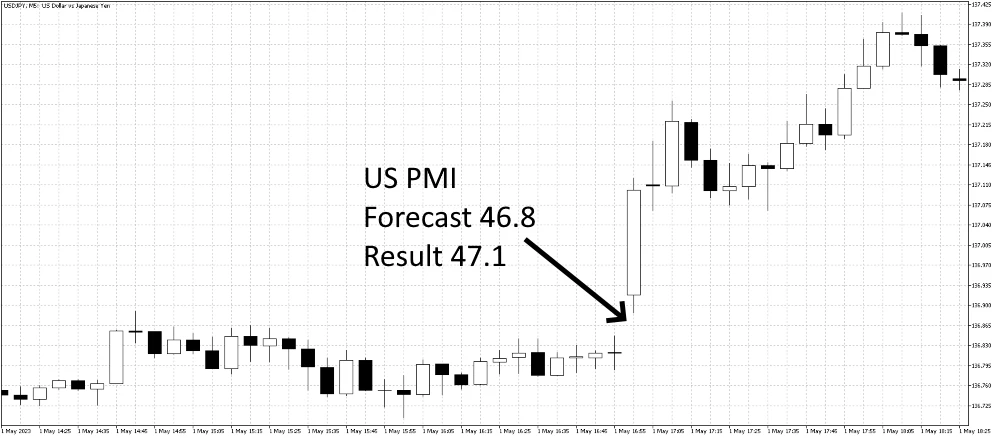
The image above highlights how currency pairs such as USD/JPY can react quickly to PMI releases. Initial reactions are often driven by how the data compares to expectations, rather than the absolute number itself.
Using PMI in a Forex Trading Approach
PMI is most effective when used as part of a broader trading framework. While it provides valuable insight into economic direction, it should not be relied on in isolation.
Traders who consistently perform well tend to combine PMI analysis with other economic indicators such as inflation, employment, and GDP. This helps build a more complete picture of the market and reduces the risk of acting on a single data point.
It is also important to consider market expectations before each release. If strong PMI data is already expected, the impact may be limited unless the result significantly exceeds forecasts. On the other hand, unexpected results can lead to sharp price movements.
By understanding how PMI fits into the bigger picture of economic data and market sentiment, traders can make more informed decisions about when to enter or exit trades. Over time, this approach can improve consistency and help traders stay aligned with broader market trends.