
Nick Goold
The RSI indicator, or Relative Strength Index, is one of the most widely used technical tools in trading. It measures the speed and strength of price movements over a selected period and helps traders understand whether a market may be stretched too far in one direction.
The RSI is displayed as a value between 0 and 100. This makes it easy to interpret across different markets and timeframes. Traders typically use it to identify potential turning points, especially when markets become overbought or oversold.
How the RSI Indicator Works in Real Market Conditions
The RSI is commonly interpreted using two key levels. When the RSI rises above 70, the market is considered overbought. This does not mean price will immediately fall, but it suggests that buying pressure may be slowing and a pullback could develop.
When the RSI falls below 30, the market is considered oversold. This indicates that selling pressure may be exhausted, and a bounce or reversal could occur. However, in strong trends, the RSI can remain in these zones for longer than expected, which is why context matters.
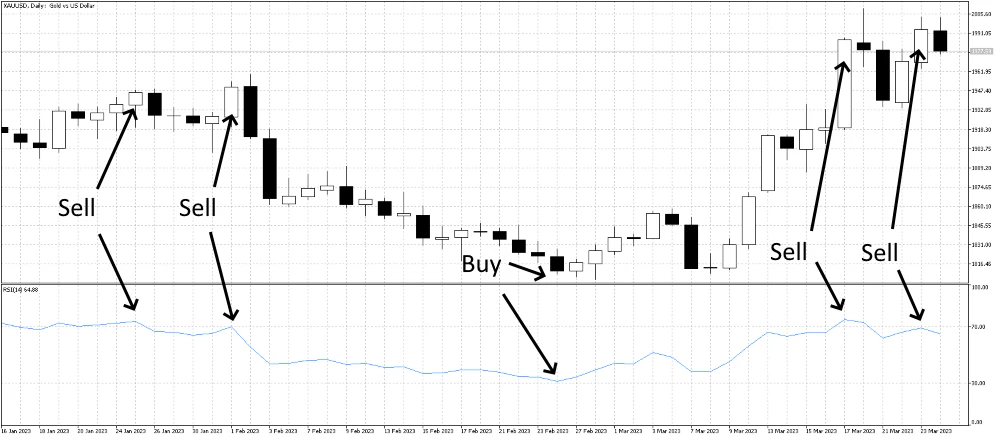
Rather than using these levels in isolation, experienced traders combine RSI readings with trend direction, support and resistance levels, and overall market conditions. This approach helps avoid reacting too early or trading against strong momentum.
When RSI Signals Are Most Useful
The RSI tends to perform best in ranging or slower-moving markets where price moves between clear support and resistance levels. In these conditions, overbought and oversold signals are more likely to lead to reversals.
In trending markets, the RSI behaves differently. During a strong uptrend, the indicator may stay above 50 and frequently reach overbought levels without a meaningful reversal. The same applies in downtrends, where RSI can remain weak for extended periods.
- Use RSI signals more cautiously in strong trends
- Look for alignment with support and resistance levels
- Combine RSI with simple tools like moving averages for context
This shift in behavior is one of the most important things to understand when using RSI effectively.
Strengths of the RSI Indicator
The RSI is popular because it provides clear and easy-to-read signals. Traders can quickly identify potential opportunities without needing complex calculations or advanced tools.
It is also flexible and works across different markets including forex, indices, and commodities. Because of its simplicity, it is often one of the first indicators new traders learn, but it remains useful even for experienced traders when applied correctly.
- Simple to understand and apply across all markets
- Clearly highlights potential overbought and oversold conditions
- Works well when combined with trend and price structure
Another advantage is that RSI can act as a confirmation tool. For example, if price reaches a key support level while RSI is oversold, it strengthens the case for a potential bounce.
Limitations and Common Mistakes
Despite its usefulness, the RSI has clear limitations. One of the most common issues is false signals, especially when traders try to use it against a strong trend. Just because RSI shows overbought does not mean the market will reverse immediately.
The RSI is also a lagging indicator, meaning it reacts to price movements rather than predicting them. In fast-moving markets, this can lead to delayed entries or missed opportunities.
- Overbought does not always mean price will fall
- Oversold does not always mean price will rise
- Signals can be weaker during major news events
Another challenge is patience. RSI signals do not appear as frequently as some other indicators, so traders may need to monitor multiple markets or wait longer for setups to form.
Using RSI in a Practical Trading Approach
The RSI works best when it is part of a broader strategy rather than the only decision-making tool. Combining it with price action, trend analysis, and basic technical levels can improve accuracy without making the strategy overly complex.
For example, instead of buying simply because RSI is below 30, a more structured approach would be to wait for price to reach a support level, confirm the trend is slowing, and then look for entry signals.
Traders should also pay attention to fundamentals such as economic data or central bank decisions. These factors can override technical signals and lead to strong directional moves where RSI becomes less effective.
Why Risk and Reward Matter More Than Win Rate
The RSI does not guarantee a high win rate, and it should not be used with that expectation. What matters more is how trades are managed. Even with a lower win rate, traders can remain profitable by controlling losses and allowing winning trades to develop.
Using stop losses is essential, especially when trading against the trend. Markets can remain overbought or oversold longer than expected, and without proper risk control, losses can increase quickly.
A consistent approach that balances risk and reward will produce better long-term results than relying on any single indicator. The RSI is a useful tool, but its real value comes from how it is combined with disciplined decision-making.