
Nick Goold
Losses are part of trading. No matter your experience level, every trader will face losing trades. What separates successful traders from the rest is not avoiding losses, but controlling them.
This is where the stop loss becomes essential. Understanding how to use a stop loss properly is one of the most important skills in forex trading. It protects your capital, keeps your risk under control, and helps you stay disciplined in all market conditions
What Is a Stop Loss in Forex Trading?
A stop loss is an order placed with your broker to close a trade automatically when price reaches a certain level. It is designed to limit how much you lose if the market moves against your position.
In simple terms, a stop loss defines your maximum acceptable loss before you enter the trade. Once it is set, it removes the need to make emotional decisions while the trade is running.
Every professional trader uses stop losses. Not because they expect to be wrong, but because they understand that protecting capital is the priority.
Why Stop Loss Is Critical for Risk Management
A stop loss is more than just a safety tool. It plays a key role in building consistency over time.
There are several reasons why it is essential:
- It defines your risk before entering a trade
- It prevents small losses from turning into large ones
- It allows you to survive losing streaks
Many experienced traders risk only 1–2% of their account on a single trade. This keeps drawdowns manageable and allows them to stay in the market long enough to take advantage of future opportunities.
Remove Emotions from Your Trading Decisions
One of the biggest challenges in trading is emotional control. Without a stop loss, it is easy to hold onto losing trades, hoping the market will reverse.
This often leads to bigger losses than originally planned.
A stop loss removes that decision from you. The trade is closed automatically, allowing you to stay focused and disciplined. Over time, this reduces stress and improves consistency.

Managing Risk in Volatile Forex Markets
The forex market can move quickly, especially during news events or high volatility periods. Price can change direction in seconds.
Without a stop loss, a small loss can turn into a large one very quickly.
A properly placed stop loss protects you from these unexpected moves. It allows you to stay in control even when the market becomes unpredictable.
Build Discipline Through Consistent Stop Loss Use
Professional traders always plan their stop loss before entering a trade. It is part of their setup, not something decided later.
One important rule is to never widen your stop loss after entering a trade. Moving your stop further away increases your risk and often leads to bigger losses.
Instead:
- Set your stop before entering
- Accept the risk
- Let the trade play out
This habit alone can significantly improve your long-term performance.
Types of Stop Loss Orders
There are different ways to use stop losses depending on your strategy.
Regular stop loss:
- A fixed level where the trade will close
- Simple and easy to manage
- Best for beginners
Trailing stop loss:
- Moves with price as the trade becomes profitable
- Helps lock in profits while allowing the trade to continue
- Useful in trending markets
For example, if you buy USDJPY at 143.00, you may place a stop at 142.90. If the trade moves in your favor, you can gradually move the stop higher to protect profits.
How to Place a Stop Loss Effectively
There is no single correct way to place a stop loss. It depends on your strategy, time frame, and risk tolerance.
However, there are common approaches:
Risk based on account size:
- Risk a fixed percentage per trade (e.g. 1–2%)
- Keeps losses consistent
Volatility-based stop loss:
- Adjust stop size based on market movement
- Use tools like ATR to measure volatility
- Avoid stops that are too tight in volatile markets
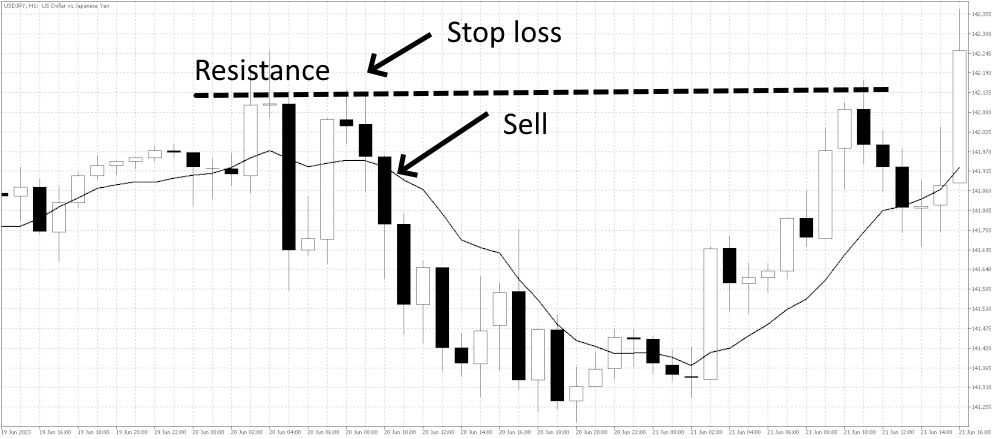
Support and resistance levels:
- Place stops beyond key price levels
- If those levels break, the trade idea is likely invalid
Good stop placement is about logic, not guesswork. Your stop should be placed where your trade idea is no longer valid.
Using Stop Loss to Stay in the Game Long Term
Trading is not about one trade. It is about a series of trades over time.
Without proper risk control, even a good strategy can fail. With strong risk management, even a simple strategy can perform well.
A stop loss allows you to:
- Protect your capital
- Stay consistent
- Keep trading through different market conditions
Once you accept losses as part of the process and focus on controlling them, your trading becomes more stable and structured.
The goal is not to avoid losing trades. The goal is to make sure no single trade has a significant impact on your account.