
Nick Goold
Trend continuation patterns are one of the most practical ways to trade strong markets. Instead of trying to predict tops and bottoms, this approach focuses on joining a trend after a temporary pullback. When used correctly, it allows traders to enter with controlled risk while still targeting larger moves.
In forex trading, trends rarely move in a straight line. Price will often pull back, pause, or briefly reverse before continuing in the original direction. These pauses create opportunities for traders who understand how to identify continuation setups.
Understanding trend continuation patterns
A trend continuation occurs when price temporarily moves against the main trend and then resumes in the original direction. These pullbacks are a natural part of market structure and are often driven by profit-taking or short-term changes in sentiment.
Rather than chasing price after a large move, traders wait for these pullbacks to enter at better levels. This improves risk management and increases the potential reward compared to entering late in a trend.
Step 1: Define the trend using a moving average
The first step is to clearly identify the trend. A simple and effective way to do this is by using a moving average. The direction of the moving average shows the overall trend, while its slope gives an indication of strength.
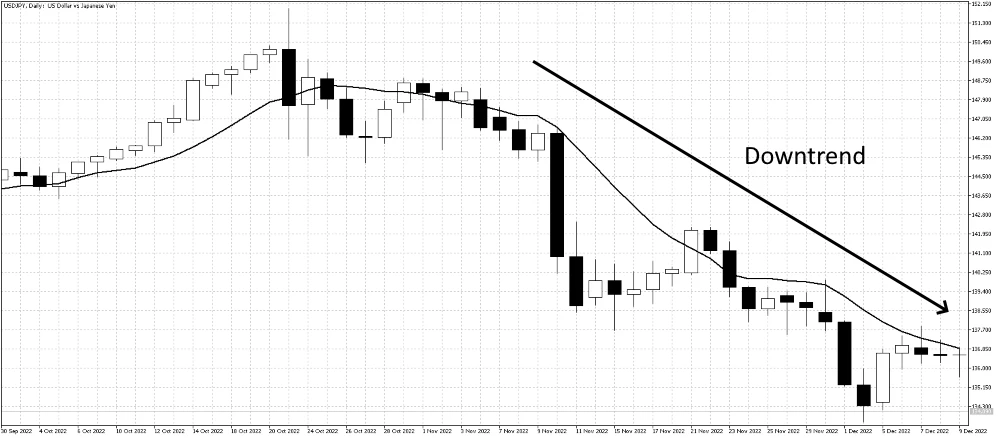
In an uptrend, the moving average points higher and price tends to stay above it. The moving average often acts as support, meaning price may bounce from it during pullbacks. In a downtrend, the opposite happens. The moving average slopes downward, price stays below it, and it acts as resistance.
Stronger trends are usually easier to trade. A steeper moving average often signals stronger momentum and cleaner continuation opportunities.
Step 2: Recognize the pullback or temporary reversal
Once a trend is established, the next step is to wait for a pullback. This is where many traders get confused, as price may briefly move against the trend and look like a reversal.
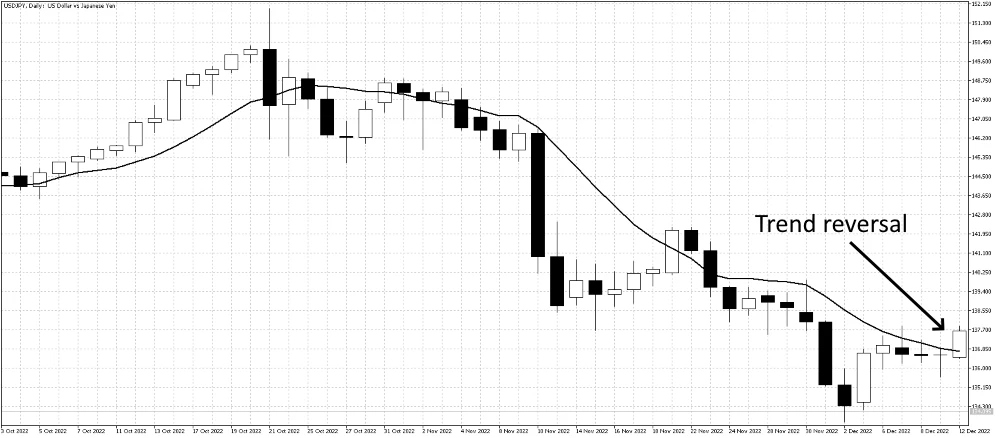
These pullbacks often happen because traders take profits or react to short-term news. Some traders may try to trade a full reversal at this stage, which can add volatility to the market.
However, not all pullbacks lead to a trend change. In strong trends, these moves are often temporary and provide opportunities to rejoin the trend at better prices.
Step 3: Enter when the trend resumes
The key moment in this strategy is when the trend resumes. This happens when price moves back in the direction of the original trend after the pullback.
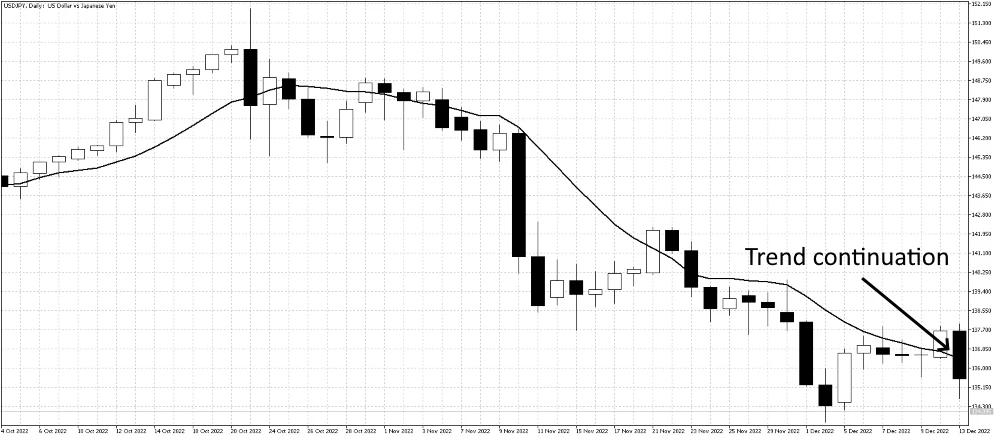
In an uptrend, a continuation entry occurs when price moves back above the moving average. In a downtrend, the signal is when price moves back below it. This shift often shows that the pullback has ended and momentum is returning.
Traders who attempted to trade the reversal may exit at this point, which can add further momentum to the continuation move. The cleaner and stronger the trend, the more reliable these continuation signals tend to be.
Choosing the right moving average
The length of the moving average should match your trading style. Short-term traders often prefer faster settings, while longer-term traders use smoother averages.
- Short-term trading: 5 to 20 periods for more frequent opportunities
- Longer-term trading: 20 periods or more for more stable signals
Shorter moving averages react quickly to price changes but can produce more false signals. Longer moving averages provide fewer signals but are generally more reliable. Many traders monitor multiple markets when using longer-term averages to find enough opportunities.
Managing risk in trend continuation trades
One of the advantages of this strategy is that risk can be controlled more easily compared to chasing breakouts. Entries are taken closer to the moving average, allowing for tighter stop placement.
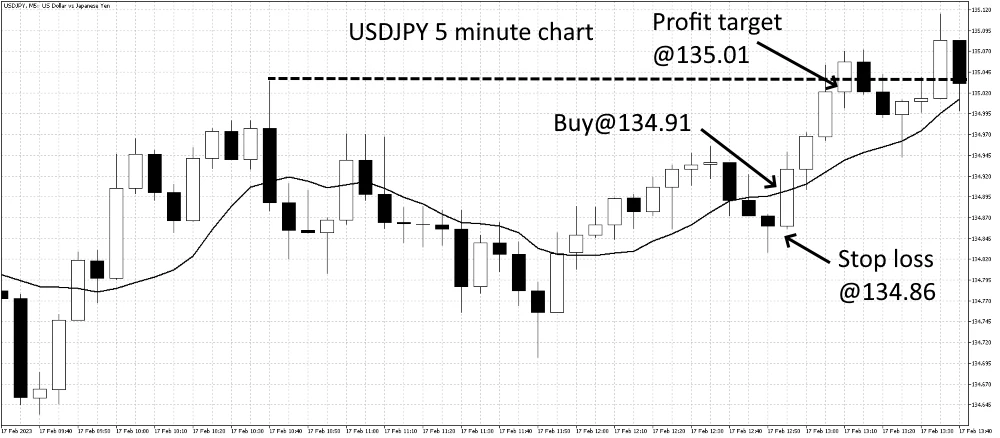
For stop-loss placement, traders typically position it just beyond the moving average. In an uptrend, this means placing it below the average, while in a downtrend it is placed above. As the trade moves in your favor, a trailing stop can be used to lock in profits. This allows you to stay in strong trends while protecting gains if the market reverses.
Profit targets depend on market conditions. In strong trends, price can move beyond resistance or support levels, so exiting too early can limit potential returns. In some cases, using a trailing stop without a fixed target allows traders to capture larger moves.
The role of patience and discipline
Trend continuation trading requires patience. Opportunities do not appear constantly, and forcing trades during unclear conditions often leads to poor results. It is also important to accept that not every trade will work. Trend-following strategies often have a lower win rate, but they make up for it by capturing larger moves when the market trends strongly.
Staying disciplined, following your plan, and focusing on risk management will have a greater impact on long-term results than trying to win every trade. By waiting for clear trends, identifying controlled pullbacks, and entering when momentum returns, traders can build a structured approach to trading strong markets with consistency.