
Nick Goold
Stochastics and divergence are two widely used tools in forex trading that help traders understand momentum and identify potential trend reversals. When used together, they provide a more complete view of market conditions and improve the timing of entries and exits.
Rather than focusing only on price direction, these tools help answer a key question: is the current move still strong, or is it starting to weaken?
What the Stochastic Indicator Shows
The Stochastic oscillator is a momentum indicator that compares the closing price to its recent price range. It moves between 0 and 100 and shows where price is positioned relative to its recent highs and lows.
In an uptrend, price tends to close near the top of the range. In a downtrend, it tends to close near the bottom. The Stochastic captures this behaviour and turns it into a simple visual signal.
The indicator consists of two lines:
- %K, which reacts quickly to price movement
- %D, which is a smoothed version used for confirmation
This structure helps traders see both short-term momentum and slightly longer-term direction.
Understanding Overbought and Oversold Levels
The most common use of Stochastics is identifying overbought and oversold conditions.
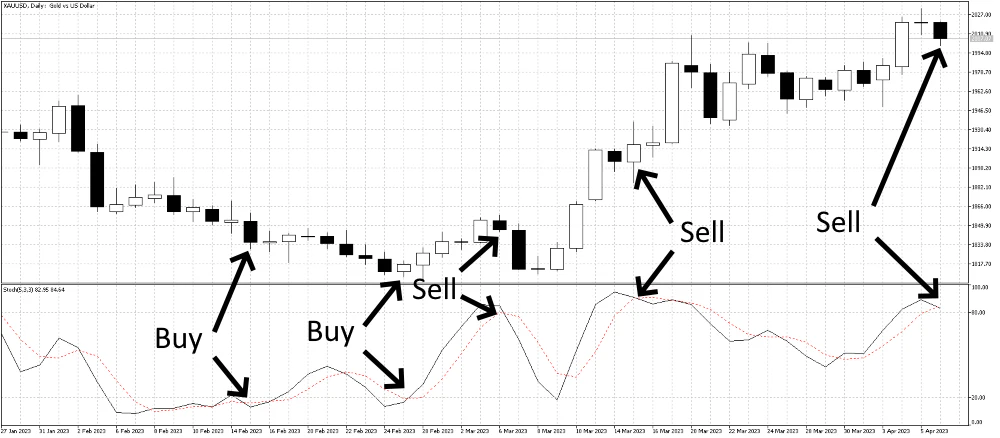
When the indicator moves above 80, the market is considered overbought. This means price has moved strongly upward and may begin to slow or pull back. When the indicator moves below 20, the market is considered oversold. This suggests price may have fallen too quickly and could be ready to recover.
These levels do not guarantee reversals, but they highlight areas where momentum may be stretched.
How Traders Use Stochastics for Entries
A simple approach is to wait for the indicator to move out of extreme levels.
For example:
- Look for buying opportunities when the indicator rises from below 20
- Look for selling opportunities when it falls from above 80
This helps avoid entering trades too early while momentum is still strong in the opposite direction.
However, in strong trends, the indicator can stay overbought or oversold for extended periods. This is why additional confirmation is important.
What Divergence Tells You
Divergence compares price movement with an indicator such as Stochastics to identify potential weakening momentum.
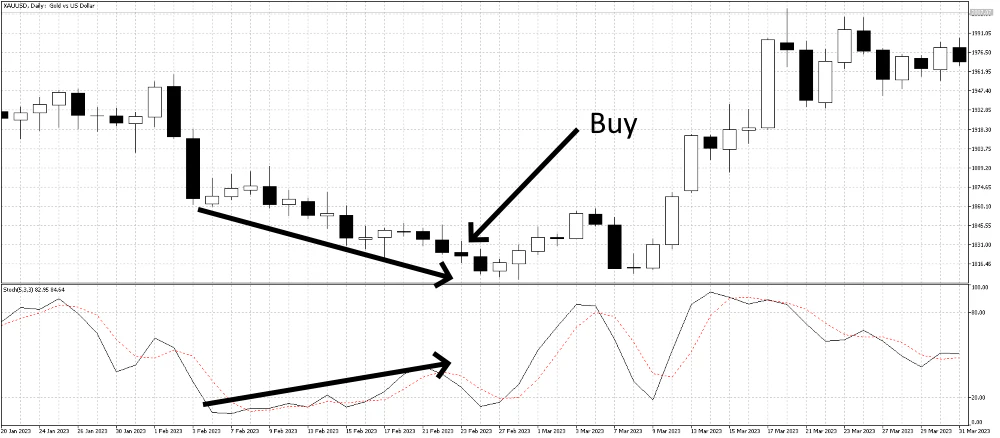
A bullish divergence occurs when price makes lower lows, but the indicator makes higher lows. This suggests selling pressure is fading. A bearish divergence occurs when price makes higher highs, but the indicator makes lower highs. This indicates buying momentum may be weakening.
Divergence does not predict exact turning points, but it highlights when a trend may be losing strength.
Combining Stochastics and Divergence
Using both tools together can improve trade quality. A common approach is to first identify an overbought or oversold condition using Stochastics, and then wait for divergence to confirm a potential reversal.
For example:
- In an oversold market, wait for bullish divergence before buying
- In an overbought market, wait for bearish divergence before selling
This adds an extra layer of confirmation and reduces the risk of entering trades too early.
Adapting to Different Market Conditions
These tools work best when used in the right environment. Stochastics can be useful in both trending and ranging markets, but signals should be interpreted differently. In trending markets, focus on signals that align with the trend. In ranging markets, overbought and oversold levels become more reliable.
Divergence is most effective when momentum is slowing. It helps identify potential turning points rather than continuation trades.
Managing Risk When Using These Tools
No indicator provides perfect signals, so risk management is essential. Stop-loss levels should be placed based on market structure, such as recent highs or lows, rather than relying only on indicator signals.
It is also important to remain patient. Divergence signals do not appear frequently, and forcing trades when conditions are unclear often leads to losses.
Building a Practical Approach
Stochastics and divergence are most effective when used as part of a broader trading plan. They help traders understand momentum, identify potential reversal areas, and improve timing. When combined with trend analysis, support and resistance, and disciplined risk management, they become much more powerful.
With experience, traders can use these tools to avoid poor entries, stay aligned with market conditions, and make more consistent decisions.