
Nick Goold
Trend reversal trading is attractive because it offers the potential for strong reward relative to risk. Entering near the turning point of a market move can lead to high win rates and favorable risk-reward outcomes. However, trading against the trend is also one of the most challenging approaches in forex trading. Trends can continue longer than expected, and entering too early can result in repeated losses.
For this reason, a structured trading strategy and strict risk management are essential. Traders who approach reversals with patience and discipline are far more likely to succeed than those who try to guess the top or bottom of every move.
What Is a Trend Reversal Trading Strategy?
A trend reversal strategy involves taking a position against the current market direction in anticipation of a change in trend. This means selling in an uptrend or buying in a downtrend, with the expectation that the existing trend is coming to an end.
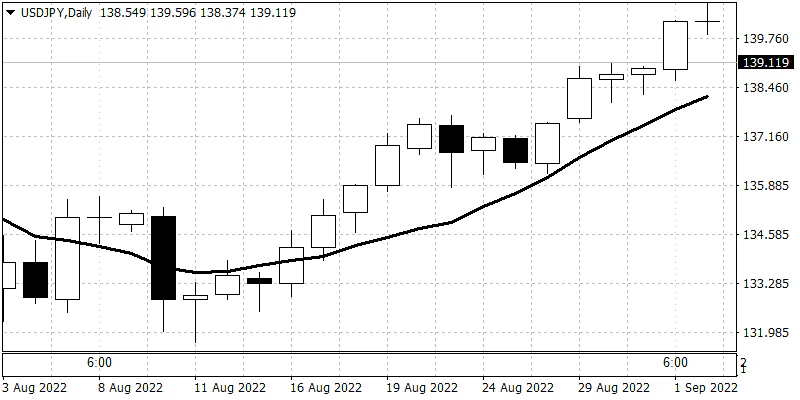
One simple way to identify the current trend is by using a moving average. When the moving average is sloping upward, the market is generally in an uptrend. When it is sloping downward, the market is in a downtrend.
Uptrend
Downtrend
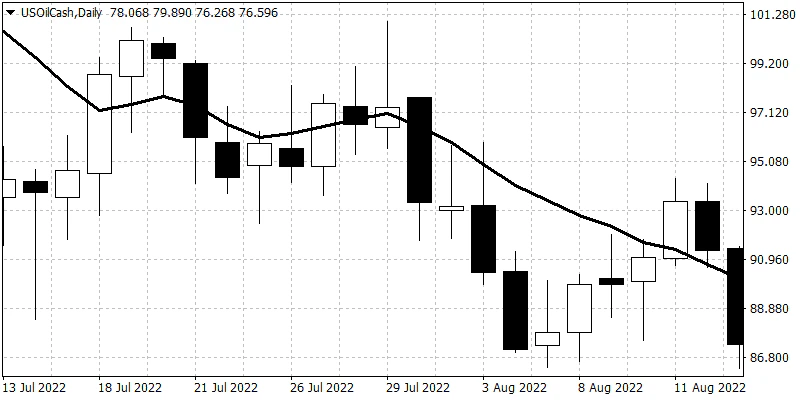
In this context, a reversal trader looks for signs that the trend is weakening and prepares to enter in the opposite direction. The challenge is distinguishing between a temporary pullback and a true reversal.
Strategy 1: High–Low Structure Break
One of the most reliable ways to identify a potential reversal is by observing changes in market structure. Trends are built on consistent patterns. In an uptrend, price forms higher highs and higher lows. In a downtrend, it forms lower highs and lower lows.
When this structure breaks, it can signal that the trend is losing strength.
In an uptrend, if price breaks below a recent higher low, it may indicate that buyers are losing control. This creates a potential selling opportunity.
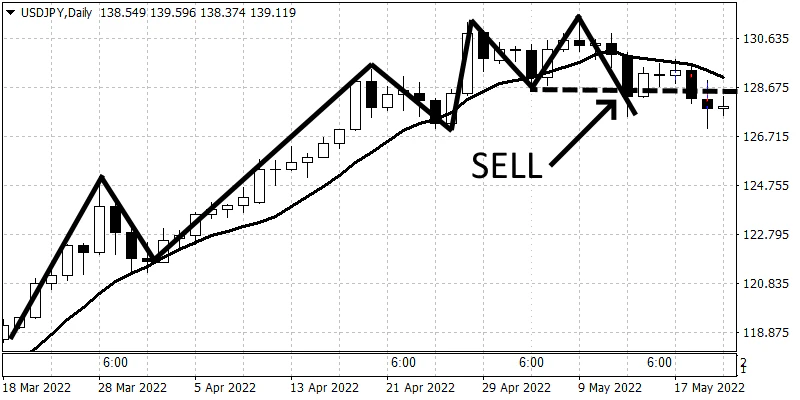
In a downtrend, if price breaks above a recent lower high, it may suggest that selling pressure is weakening and buyers are starting to take control.
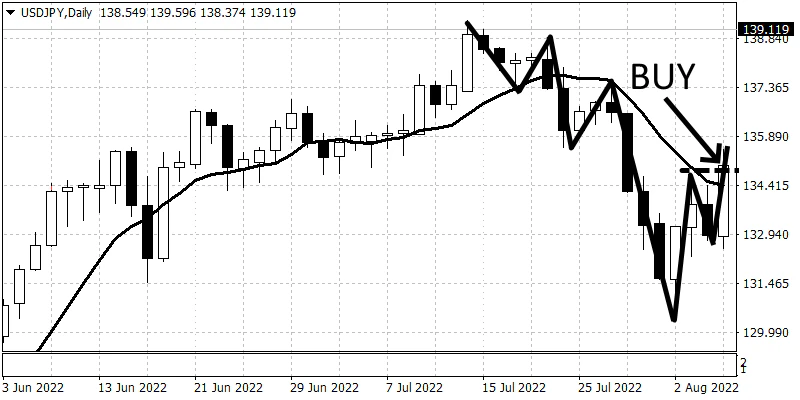
This approach focuses on price action rather than indicators, making it a practical method for identifying early signs of a reversal.
Strategy 2: Moving Average Break
Moving averages are widely used to define trend direction and dynamic support or resistance. In a strong uptrend, price often stays above the moving average, which acts as a support level. In a downtrend, price typically remains below it.
When price breaks through the moving average with momentum, it can indicate a shift in market conditions.
In an uptrend, a decisive move below the moving average may signal that buyers are losing control and that a reversal could develop.
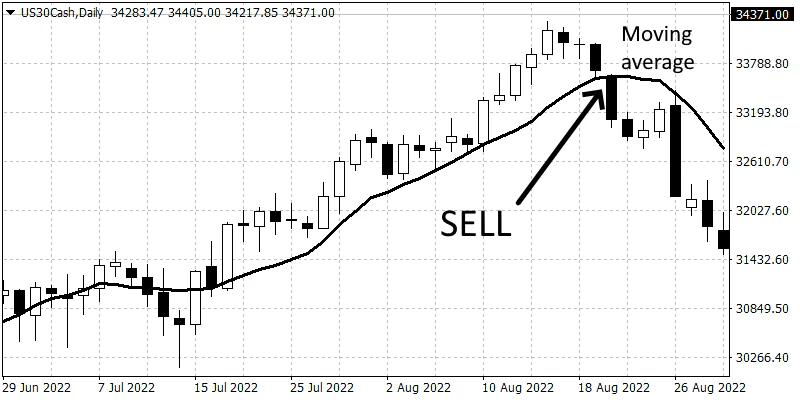
In a downtrend, a move above the moving average can suggest that the market is preparing to move higher.
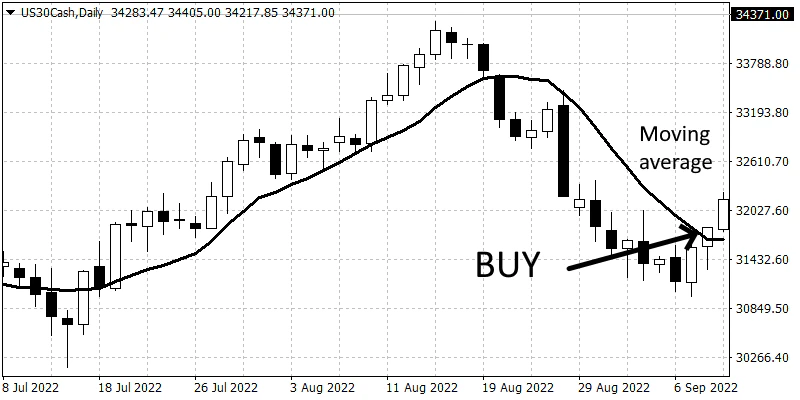
While this method is simple, it works best when combined with other signals, such as changes in market structure or strong momentum.
Strategy 3: Large Distance from Moving Average
Markets rarely move in a straight line for extended periods. When price moves too far away from the moving average, it often indicates that the market is overextended. In these situations, a pullback or reversal becomes more likely.
This concept is based on the idea that price tends to revert toward its average over time.
When price rises significantly above the moving average, it can create a potential selling opportunity as the market may correct lower.
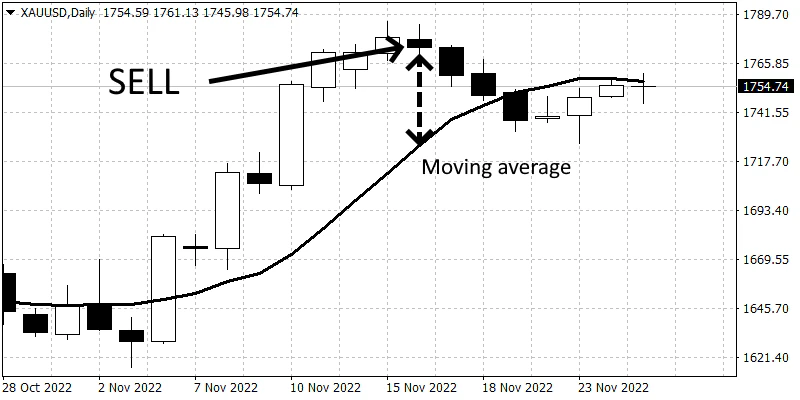
Similarly, when price falls sharply below the moving average, it may present a buying opportunity as the market looks to recover.
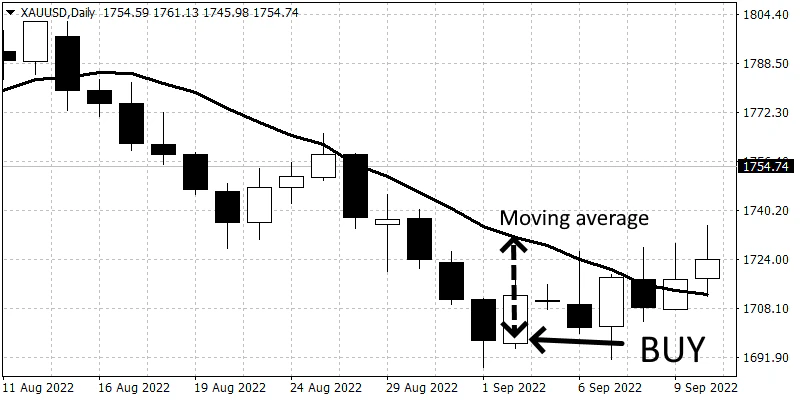
This strategy works particularly well in markets that are temporarily overbought or oversold, but timing remains critical.
Risk Management in Trend Reversal Trading
Trading against the trend carries higher risk than trading with it. Trends can continue longer than expected, and entering too early can lead to multiple losing trades. Managing risk effectively is therefore essential.
Always place a stop loss immediately after entering a trade. This protects your account if the trend continues in the opposite direction.
- Accept that not every reversal attempt will succeed
- Keep losses small to allow for multiple attempts if needed
- Avoid widening stops unnecessarily when price moves against you
Another important rule is to avoid adding to losing positions. Increasing exposure when a trade is already failing can quickly lead to large losses, especially in strong trending markets.
Using News to Improve Reversal Timing
Market fundamentals play an important role in trend reversals. Major news events, such as economic data releases or central bank announcements, can trigger sharp changes in market direction.
Understanding the broader context helps you avoid entering trades at the wrong time. For example, trying to trade a reversal immediately after a major news release can be risky, as volatility may still be high and direction unclear.
It is often better to wait until the market stabilizes and the impact of the news becomes clearer before entering a reversal trade. By combining technical signals with awareness of market fundamentals, traders can improve their timing and avoid unnecessary risk.
Trend reversal trading can be highly rewarding when executed correctly, but it requires patience, discipline, and a strong understanding of market behavior. Over time, experience will help you recognize when a trend is truly weakening and when it is simply pausing before continuing.