
Nick Goold
Trendlines are one of the most widely used tools in technical analysis, helping traders identify the direction of the market and potential entry or exit points. They provide a simple visual guide to understanding whether the market is trending higher, lower, or moving sideways. However, while drawing trendlines is straightforward in theory, in practice different traders may draw them slightly differently depending on which highs and lows they choose.
It is important to remember that trendlines are not exact levels. Price may break them temporarily or react slightly before reaching them. These false breakouts are common, especially in fast-moving markets. For this reason, trendlines should always be used alongside other tools and proper risk management rather than as a standalone signal.
How to Draw Trendlines Correctly
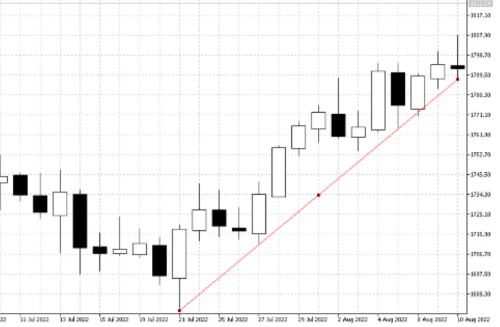
Drawing a trendline begins with understanding the overall market structure. The goal is not to connect random points, but to identify meaningful swings that reflect how price is moving. The first step is to identify the trend direction. In an uptrend, the market forms higher highs and higher lows, showing consistent buying pressure. In a downtrend, the opposite occurs, with lower highs and lower lows indicating selling pressure.
Once the trend is clear, the next step is selecting the key points to connect. In an uptrend, you should connect two or more higher lows. In a downtrend, you connect two or more lower highs. These points should be clear and significant, not minor fluctuations. After selecting the points, extend the trendline to the right so it projects future potential support or resistance. The more times price respects the trendline, the more relevant it becomes, but it should not be forced to fit the chart.
Using Trendlines to Trade With the Trend
Trendlines are most effective when used to trade in the direction of the prevailing trend. They act as dynamic support in an uptrend and dynamic resistance in a downtrend.
In an uptrend, traders look for buying opportunities when price pulls back toward the trendline and shows signs of support. This approach allows traders to enter at better prices rather than chasing upward moves. In a downtrend, traders look for selling opportunities when price rallies toward the trendline and begins to weaken.
- Buy near the trendline in an uptrend after a pullback
- Sell near the trendline in a downtrend after a retracement
- Wait for confirmation such as slowing momentum or rejection candles
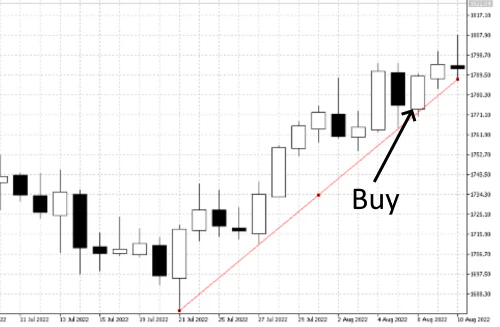
Patience is important when using this strategy. Entering too early before price reaches the trendline often leads to poor timing and unnecessary risk.
Identifying Potential Trend Reversals
Trendlines can also help signal when a trend may be ending. A clear break of a well-respected trendline can indicate a shift in market structure, especially if it is supported by strong momentum or fundamental changes.
In an uptrend, if price breaks below the trendline and fails to recover quickly, it may suggest that buying pressure is weakening. In a downtrend, a break above the trendline can signal that sellers are losing control.
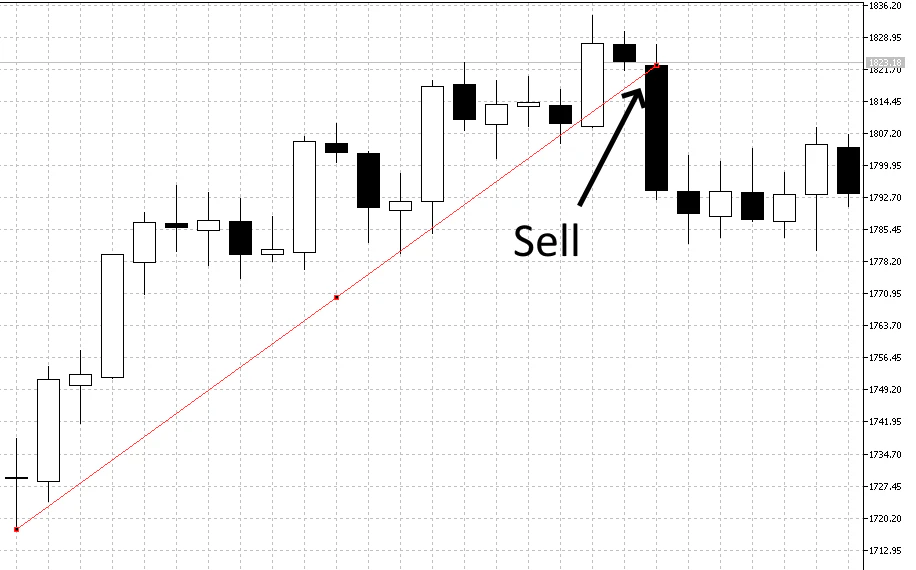
However, not every break leads to a reversal. False breakouts are common, so it is important to wait for confirmation rather than reacting immediately.
Managing Risk When Trading Trendlines
Risk management is essential when trading with trendlines, as price often moves around these levels before committing to a direction. Placing stops too close to the trendline can result in being stopped out unnecessarily.
In an uptrend, stop losses are typically placed below the trendline. In a downtrend, they are placed above it. The distance should account for the volatility of the market being traded.
- Use a slightly wider stop to avoid being caught by normal price fluctuations
- Adjust stop size depending on whether you are day trading or swing trading
- Different markets require different stop distances due to varying volatility
A trailing stop can also be useful as the trade moves in your favor. In an uptrend, the stop can be gradually moved higher while staying below the trendline. This helps lock in profits while allowing the trade to continue if the trend persists.
Setting Profit Targets Using Trend Channels
While the trendline provides an entry and risk reference, profit targets can be planned using additional structure. One common method is to create a trend channel by connecting recent highs in an uptrend or recent lows in a downtrend.
In an uptrend, the upper boundary of the channel can act as a resistance level where price may slow down or reverse. In a downtrend, the lower boundary can act as support.
Another practical approach is to use key support and resistance levels. Since trends do not last forever, it is often better to take profits when price reaches a clear level and shows signs of slowing or reversing. Allowing trades to run while managing risk carefully is important, but being aware of potential turning points helps protect profits.
Handling the Subjectivity of Trendlines
One of the challenges of using trendlines is that they are not exact or objective. Different traders may draw them slightly differently, which can lead to doubt when trades do not work as expected. This subjectivity can affect confidence, especially after a losing trade. It is important to understand that no trendline is perfect and no strategy works every time. Losses are part of trading, even when the analysis is correct.
Rather than comparing your trendlines with others, focus on building consistency in your own approach. Over time, experience will help you identify which structures are more reliable and how to manage trades more effectively. By combining trendlines with disciplined execution and solid risk management, traders can use this simple tool to better understand market structure and improve their decision-making across different market conditions.