
Nick Goold
The DeMarker Indicator, developed by Tom DeMark, is a momentum-based tool used to identify overbought and oversold conditions in the forex market. It helps traders understand whether buying or selling pressure is increasing and where potential reversals may occur.
Unlike many indicators that focus only on closing prices, the DeMarker compares highs and lows over time. This gives a clearer picture of market strength and helps traders identify when price movements are becoming stretched.
What the DeMarker Indicator Shows
The DeMarker Indicator moves between 0 and 1. It reflects the balance between buying pressure and selling pressure in the market.
When the value moves closer to 1, it suggests strong buying pressure and a potentially overbought market. When it moves closer to 0, it indicates strong selling pressure and a potentially oversold market. This makes it a useful tool for spotting areas where price may slow down, pause, or reverse.
How the DeMarker Indicator Works
The indicator is built by comparing the current high and low prices to those of the previous period. If the current high is higher than the previous high, it reflects upward momentum. If the current low is lower than the previous low, it reflects downward momentum.
These movements are then smoothed over time to produce a value between 0 and 1, making it easier to interpret market conditions. Rather than focusing on exact calculations, traders can use it as a simple way to measure whether buyers or sellers are in control.
Identifying Overbought and Oversold Levels
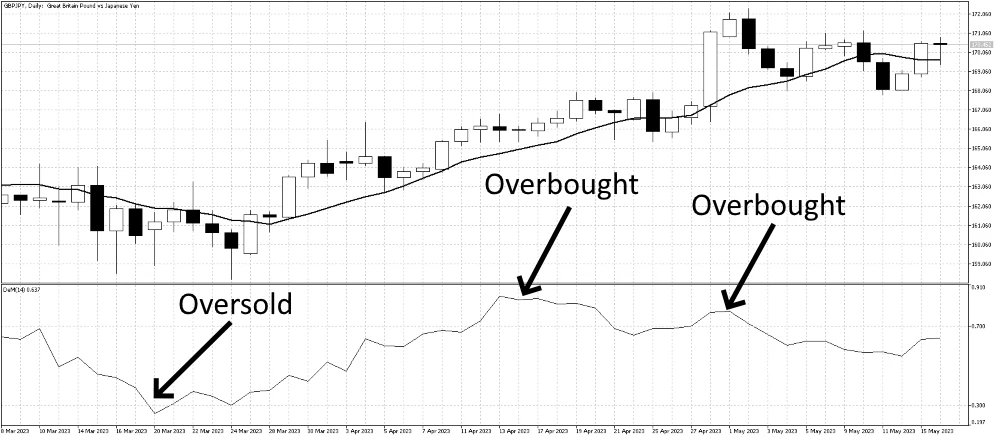
The most common use of the DeMarker Indicator is to identify extreme market conditions. When the indicator rises above 0.7, the market is considered overbought. This means price may have moved too far upward and could be at risk of a pullback.
When the indicator falls below 0.3, the market is considered oversold. This suggests price may have fallen too quickly and could be ready to recover. These levels help traders prepare for potential reversals rather than reacting too late.
Using DeMarker to Spot Reversals
The DeMarker Indicator is particularly useful for identifying potential turning points. When the indicator reaches an extreme level and begins to reverse direction, it can signal that momentum is weakening. For example, if the market is overbought and the indicator starts to decline, it may suggest a shift toward selling pressure.
However, reversals are not guaranteed. Strong trends can remain overbought or oversold for extended periods, so it is important to wait for confirmation.
Using Divergence for Early Signals
Divergence can provide an early warning that the current trend is losing strength.
A bullish divergence occurs when price makes a lower low, but the indicator forms a higher low. This suggests that selling pressure is weakening. A bearish divergence occurs when price makes a higher high, but the indicator forms a lower high. This indicates that buying momentum may be fading.
These setups can highlight potential reversal areas, especially when combined with support and resistance.
Filtering Trades with Market Direction
Using the DeMarker Indicator without considering the overall trend can lead to poor results.
In an uptrend, oversold signals are generally more reliable, as they align with buying opportunities. In a downtrend, overbought signals are more useful for identifying selling opportunities. This approach helps traders avoid trading against strong market momentum.
Improving Entry and Exit Timing
The DeMarker Indicator can help refine trade timing rather than act as a standalone signal.
For example:
- Wait for the indicator to leave extreme levels before entering a trade
- Use price action or structure to confirm the setup
- Avoid entering trades when the indicator is still moving strongly in one direction
This improves the quality of entries and reduces the risk of entering too early.
Managing Risk When Using DeMarker
Reversal trading can be risky, especially in strong trends. This makes risk management essential.
Stop losses should be placed beyond key levels such as recent highs or lows. This ensures that trades are protected if the market continues moving against the position. Take profit levels can be set based on nearby support and resistance or when the indicator returns toward the middle range.
Maintaining a balanced risk-reward ratio is important, especially when trading against the trend.
Building a Practical Approach with DeMarker
The DeMarker Indicator is a useful tool for understanding momentum and identifying potential reversal areas. Its strength lies in highlighting when price has moved too far in one direction. When combined with trend analysis, support and resistance, and proper risk management, it becomes much more effective.
With practice, traders can use the DeMarker to improve timing, avoid poor entries, and make more informed trading decisions across different market conditions.