
Nick Goold
Averaging down is a trading approach where you add to a position after it moves against you. Instead of closing the trade at a loss, you enter additional positions at better prices, lowering your overall average entry.
This method is often used in both stocks and FX trading. When managed carefully, it can improve entry pricing and reduce the pressure to time trades perfectly. However, it also increases exposure, which makes risk management critical. Understanding when averaging down works, and when it becomes dangerous, is what separates controlled use from uncontrolled losses.
How Averaging Down Works in Practice
When price moves against your initial position, you add another position at a lower price (for buys) or a higher price (for sells). This reduces your average entry price, meaning the market does not need to move as far for you to return to break-even.
For example, if you buy at one level and price drops, adding another position at a lower level brings your average entry closer to the current price. A smaller move in your favor can then recover the position. This creates flexibility in entry timing, but it also increases the size of the position and the total risk.
When Averaging Down Can Be Effective
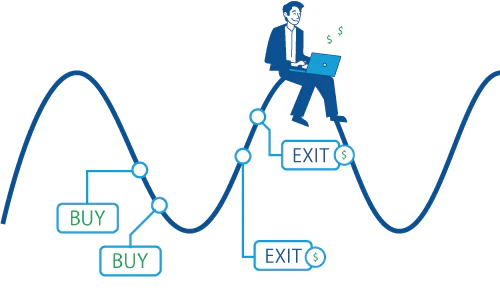
Averaging down tends to work best in stable or range-bound markets where price moves back and forth within a defined area. In these conditions, price often returns toward previous levels, allowing traders to benefit from improved average entries.
It can also reduce the need for precise timing. Instead of trying to enter at the exact turning point, traders build positions gradually as price moves within the range. However, this advantage only applies when the market continues to rotate rather than trend strongly in one direction.
The Risks of Averaging Down
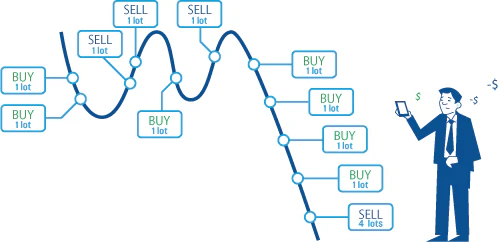
The main risk of averaging down is that losses can increase quickly if the market continues to move against you.
In a strong trend, price may not return to your entry level for a long time. Each additional position increases exposure, which means losses can grow faster than expected.
Another challenge is psychological. It becomes difficult to stop adding positions because there is always the expectation that price will reverse. Without clear limits, this can lead to large drawdowns or even account loss.
Even when the market eventually reverses, adding too many positions can reduce the overall profitability of the trade due to increased risk and capital usage.
Setting Rules Before Using This Strategy
Averaging down should never be used without a clear plan. The structure of the strategy must be defined before entering the trade.
This includes deciding in advance how many positions you are willing to add and under what conditions you will stop.
A simple framework can include:
- A maximum number of entries per trade
- A fixed distance between each additional position
- A total loss limit where all positions are closed
Without these rules, the strategy can quickly become reactive rather than controlled.
Managing Risk and Trade Outcomes
One of the challenges with averaging down is maintaining a balanced risk-to-reward profile.
When price returns to your average entry, it can be tempting to close the trade quickly to avoid further risk. However, consistently exiting at small gains while holding large potential losses creates an unstable trading profile.
To improve consistency, trades should still aim for a reasonable reward relative to risk. This requires discipline, especially after recovering from a drawdown. At the same time, setting a maximum loss for the overall position is essential. Losses must be controlled before they reach a level that is difficult to recover from.
Avoiding High-Risk Market Conditions
Averaging down becomes significantly more risky during periods of high volatility. Major economic announcements, central bank decisions, or unexpected news events can cause strong directional moves. In these situations, price may continue in one direction without retracing.
Avoiding averaging strategies during these periods helps reduce exposure to unpredictable moves.
Keeping Position Size Under Control
As positions are added, total exposure increases. Managing this growth is essential. Many traders set a limit on how many times they will add to a position. Keeping this number small helps prevent risk from escalating too quickly.
For example, adding to a position a limited number of times allows flexibility without creating excessive exposure. Beyond that, the risk often increases faster than the potential reward. Planning this in advance removes the need to make decisions under pressure.
Think in Risk and Reward, Not Win Rate
Averaging down strategies often produce a higher win rate because positions can recover when price retraces. However, this can create a false sense of security. What matters is not how often trades win, but how losses are managed when they occur. A single large loss can offset many small gains if risk is not controlled.
Keeping losses limited while allowing trades to reach meaningful targets is what creates long-term stability. Averaging down can be useful, but only when combined with strict risk control and clear rules. Used carefully, it can improve trade flexibility. Used without discipline, it can quickly lead to significant losses.