
Nick Goold
Average True Range (ATR) is one of the most practical tools traders can use to understand market conditions. While many indicators focus on direction, ATR focuses on movement. It shows how much the market is moving, not where it is going, which makes it especially useful for managing trades rather than predicting them.
Originally developed by J. Welles Wilder, ATR is widely used across forex, commodities, and stock markets. It helps traders adjust their strategy based on current volatility instead of applying fixed rules that may not suit changing conditions.
What ATR Measures and Why It Matters
ATR measures volatility by calculating the average range of price movement over a set period, most commonly 14 bars. Instead of simply measuring the difference between the high and low, ATR also considers gaps between the previous close and the current price. This makes it more accurate, especially in markets that move quickly or react to news.
The true range is calculated by taking the largest of the following:
- The difference between the current high and low
- The distance from the previous close to the current high
- The distance from the previous close to the current low
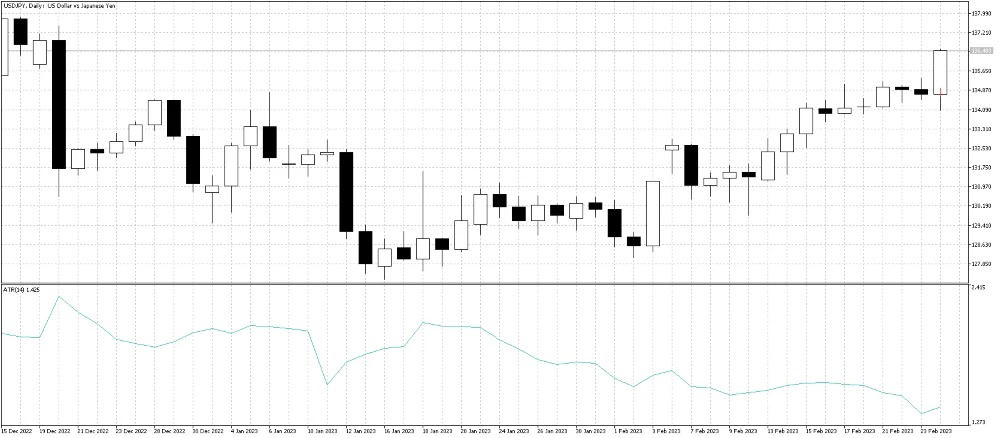
Once the true range is calculated for each period, it is averaged over time. A rising ATR means the market is becoming more active, while a falling ATR suggests quieter conditions. This simple insight can have a significant impact on how trades are planned and managed.
Using ATR to Adjust Risk and Position Size
One of the most effective uses of ATR is in setting stop loss and take profit levels. Instead of using fixed pip distances, traders can base their risk on current market conditions. This creates a more flexible approach that adapts as volatility changes.
For example, if the 14-day ATR on a daily chart is 120 pips, a swing trader might use a stop loss around half of that range. This allows the trade to move naturally without being stopped out too early. At the same time, targets can be set at multiples of ATR to maintain a balanced risk-to-reward profile.
Short-term traders can apply the same idea on lower timeframes. On a 5-minute chart, if ATR is 10 pips, a tighter stop and smaller target would be more appropriate. The key idea is consistency. When volatility increases, risk parameters widen. When volatility drops, they tighten.
Finding Better Trade Opportunities with ATR
ATR is not just a risk tool. It can also help identify when the market is likely to offer better opportunities. Markets do not stay quiet forever. Periods of low volatility are often followed by expansion, and ATR can help highlight these transitions.
When ATR is unusually low compared to recent history, it can indicate that the market is building toward a larger move. Traders can prepare for breakouts or trend development rather than forcing trades in quiet conditions.
On the other hand, when ATR is already high, the market may be in an active phase. This can be beneficial for trend traders, but it also increases the risk of sharp reversals. Understanding this balance helps traders decide whether to be aggressive or more cautious.
Using ATR to Understand Trend Strength
ATR can also provide insight into how strong a trend is. When a trend is developing and ATR is increasing, it suggests that momentum is building and participation is rising. This often leads to cleaner moves and better follow-through.
If ATR starts to decline during a trend, it can signal that momentum is fading. The market may continue moving, but with less conviction. In these conditions, traders may choose to reduce position size, tighten stops, or begin taking profits.
In contrast, low and falling ATR often aligns with range-bound markets. During these periods, breakout strategies tend to struggle, while range trading approaches may be more effective.
Improving Market Selection with ATR
Not all markets offer the same opportunities. ATR can be used to compare different instruments and identify where the best conditions exist.
Markets with higher ATR values tend to provide more movement and therefore more trading opportunities. However, this needs to be balanced with transaction costs. A market with high volatility but wide spreads may not be as attractive as a slightly less volatile market with tighter pricing.
This is particularly important in forex trading, where spreads vary between pairs. Comparing ATR alongside spread costs helps traders focus on markets that offer both movement and efficiency.
Combining ATR with Other Tools
ATR works best when used alongside other forms of analysis rather than in isolation. It does not provide direction, so combining it with trend tools such as moving averages or structure analysis like support and resistance gives a more complete view of the market.
For example, a trader might use a moving average to identify trend direction and ATR to decide how wide stops should be. Or they may use support and resistance levels for entries, while ATR helps define realistic profit targets based on current conditions.
This combination creates a more balanced approach where decisions are based on both direction and volatility.
A Practical Way to Use ATR in Daily Trading
ATR is most useful when it becomes part of a trader’s routine rather than a one-off calculation. Checking volatility before entering a trade can prevent common mistakes such as using stops that are too tight in volatile markets or targets that are unrealistic in quiet conditions.
Over time, traders develop a feel for what is considered high or low ATR for each market they trade. This awareness allows for better timing, improved consistency, and more controlled risk.
Instead of treating ATR as a complex indicator, it is more effective to see it as a simple guide to how the market is behaving right now. That perspective alone can significantly improve decision-making.