
Nick Goold
Once you have chosen a trading strategy, the next step is deciding how to execute it in the market. This is where many traders struggle. Even with a good strategy, poor execution can lead to missed opportunities or unnecessary losses.
Financial markets move quickly, especially in forex. If you hesitate or use the wrong type of order, you may enter too late, enter at a poor price, or miss the trade entirely. Understanding how different order types work allows you to match your execution to your strategy and market conditions.
There are three main types of orders used to enter the market. Each has its own strengths and weaknesses, and knowing when to use them is an important part of improving trading performance.
Market orders: prioritizing speed over price
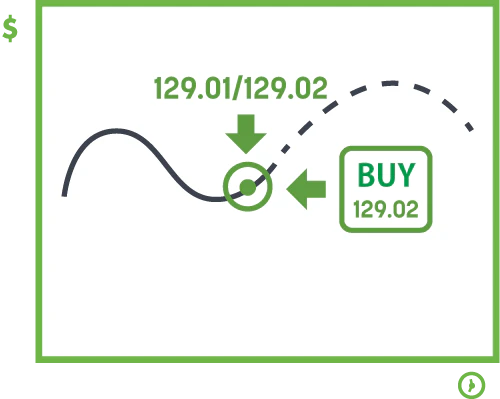
A market order is the simplest way to enter a trade. It allows you to buy or sell immediately at the best available price. This type of order is used when execution speed is more important than getting the exact price.
For example, if the current price is 129.01/129.02, placing a market buy order means you will be filled at 129.02. You accept the current price in exchange for immediate entry.
Market orders are often used in fast-moving conditions where waiting for a better price could mean missing the trade entirely.
Advantages:
- Allows instant entry without delay
- Reduces the risk of missing strong moves
- Useful in breakout or high-momentum conditions
Disadvantages:
- Less control over the entry price
- Higher chance of entering during emotional or impulsive moments
- May result in worse pricing during volatile conditions
Market orders are most effective when you have strong conviction in your setup and the market is already moving in your direction. They are commonly used in trending markets or during breakouts where timing is critical.
Limit orders: focusing on price precision
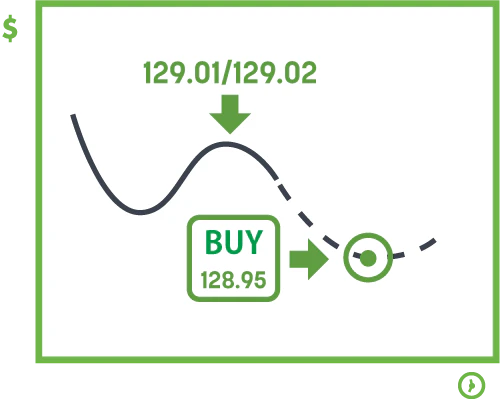
A limit order allows you to set the exact price at which you want to enter a trade. Your order will only be executed if the market reaches your chosen level or better. This gives you more control and encourages patience.
For example, if the current market is 129.01/129.02, you may place a limit order to buy at 128.95, expecting the price to retrace before moving higher.
This type of order is often used in range-bound markets or when traders expect pullbacks before continuation.
Advantages:
- Better entry prices compared to market orders
- Encourages more structured and less emotional trading
- No need to constantly watch the screen
Disadvantages:
- Risk of missing the trade if price does not reach your level
- Price may move against you immediately after entry
Limit orders work well in quieter markets where price tends to move within defined levels. They are especially useful when trading support and resistance zones or when waiting for pullbacks in a trend.
Stop entry orders: entering momentum and breakouts
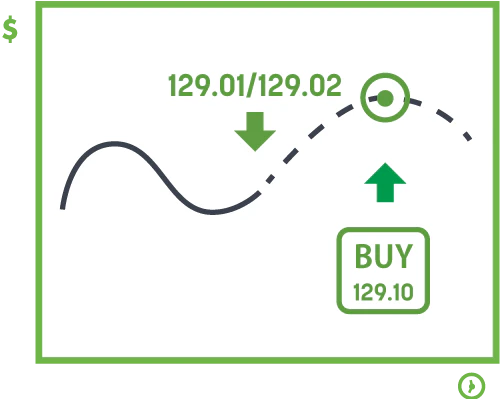
A stop entry order is used to enter the market once price reaches a specific level, typically above or below the current price. It is designed to capture momentum and confirm that the market is moving in a particular direction before entering.
For example, if the current market is 129.01/129.02, you might place a buy stop at 129.10. The trade is only triggered if price rises to that level, confirming upward momentum.
This type of order is commonly used by traders who follow trends and want confirmation before entering.
Advantages:
- Helps capture strong directional moves
- Removes the need to monitor the market constantly
- Confirms momentum before entry
Disadvantages:
- Can result in poor entries during false breakouts
- Higher risk of entering at extreme prices during volatile spikes
Stop orders are most effective in trending markets or breakout strategies. However, they require awareness of market conditions, as sudden spikes can trigger entries that quickly reverse.
Choosing the right order type for your strategy
No single order type is always better than the others. The key is to match your order type to your trading strategy and the current market environment.
A simple way to think about it:
- Use market orders when speed matters and the move is already happening
- Use limit orders when you want better pricing and can wait for the market to come to you
- Use stop orders when you want confirmation of momentum before entering
As your experience grows, you will naturally begin to combine these order types depending on the situation. This flexibility allows you to adapt to different market conditions rather than relying on a single approach.
Execution is part of your edge
Many traders focus heavily on strategy but overlook execution. In reality, how you enter a trade can be just as important as why you enter. Practicing with different order types and reviewing your results will help you understand which approach works best for your style. Over time, improving your execution can lead to more consistent entries, better risk management, and stronger overall performance.
Trading is not only about finding opportunities. It is also about entering those opportunities in the most effective way possible.