
Nick Goold
The Golden Cross is one of the most widely followed trend signals in forex and CFD trading. It is simple to understand, but using it effectively requires more than just waiting for two lines to cross. Traders who get the most out of this strategy combine it with market context, timing, and risk control.
At its core, the Golden Cross forms when a short-term moving average moves above a long-term moving average. This shift suggests that recent price momentum is turning stronger than the longer-term trend, often marking the early stages of a bullish move. :contentReference[oaicite:0]{index=0}
Understanding the Golden Cross and Dead Cross
The most common version of this strategy uses the 50-day simple moving average and the 200-day simple moving average. When the 50-day moves above the 200-day, it signals a potential shift toward an uptrend. When it crosses below, it creates what is known as a Dead Cross, suggesting downside pressure.
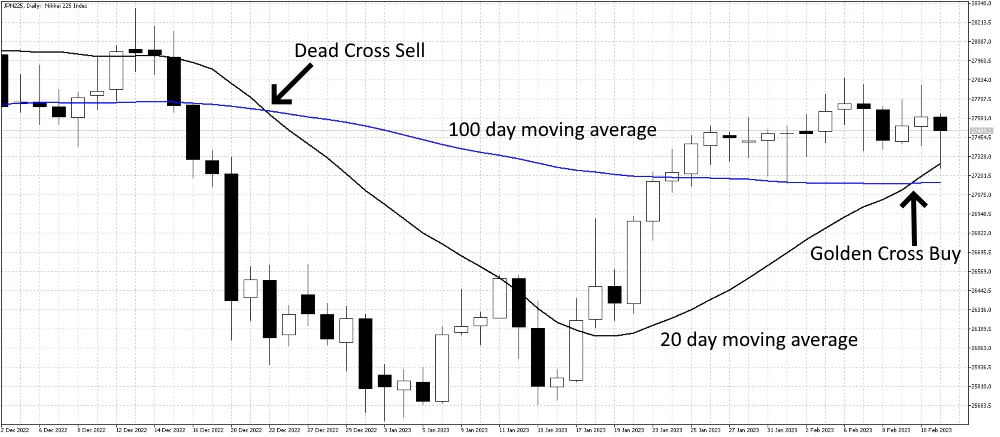
While this setup is popular, it is important to understand that moving averages are lagging indicators. They react to price rather than predict it. This means the signal often appears after the trend has already started. In strong trends, this delay is acceptable. In ranging markets, it can lead to false signals and frustration.
Choosing the Right Moving Average Settings
The standard 50/200 combination is widely used because it filters out short-term noise and focuses on larger trends. However, this also means signals are relatively rare, which may not suit active traders.
To adapt the strategy to different trading styles, many traders adjust the moving average lengths:
- 10 SMA / 30 SMA for short-term trends and more frequent signals
- 20 SMA / 100 SMA for a balance between speed and reliability
- 50 SMA / 200 SMA for longer-term trend confirmation
Shorter combinations respond faster but produce more false signals. Longer combinations are more reliable but slower. The key is to match the settings to the market conditions and your trading timeframe rather than relying on a fixed setup.
When the Golden Cross Works Best
The Golden Cross performs best in markets that are already showing signs of directional movement. It is not a tool for predicting reversals in quiet conditions. Instead, it works as confirmation that a trend is gaining strength.
This is why traders should first ask a simple question: is the market trending or ranging?
If price is moving sideways, with frequent reversals and no clear direction, crossover signals will often fail. In contrast, when momentum builds after a breakout or during strong macro-driven moves, the Golden Cross can help traders stay in the trend rather than exit too early.
The strategy is also flexible across timeframes. A day trader may apply it on a 1-minute or 5-minute chart, while a swing trader may focus on hourly or daily charts. The principle remains the same, but the context changes.
Improving Trade Quality with Market Context
Using the Golden Cross on its own can lead to inconsistent results. Adding simple context can significantly improve trade selection.
Support and resistance levels provide a practical filter. Entering a trade close to support increases the chance of follow-through, while entering near resistance limits upside potential. If a crossover occurs just below a major resistance level, it is often better to wait.
Time of day also matters, especially for shorter-term traders. Some sessions naturally trend more than others. For example, trend strategies tend to perform better during active market hours when liquidity and participation increase, while quieter periods often lead to choppy conditions.
Fundamental drivers can also play a role. Strong trends are often supported by macro themes such as interest rate expectations, inflation data, or geopolitical developments. When there is no clear driver, trends are less likely to sustain, making crossover signals weaker.
Managing Risk with the Golden Cross
One of the simplest ways to use this strategy is to exit when the moving averages cross back in the opposite direction. However, relying only on this can result in giving back a large portion of profits.
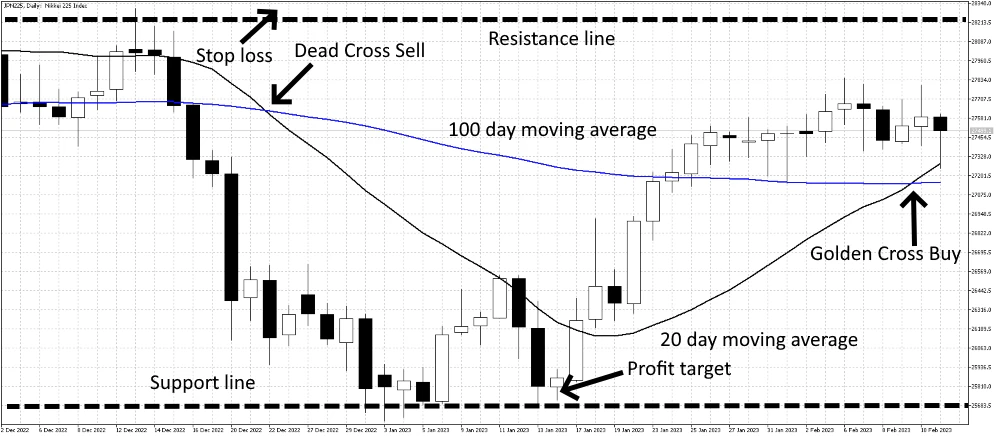
Adding structured risk management improves consistency and protects capital.
Stop loss placement should be based on market structure rather than the crossover itself. For example, placing a stop below a recent support level or swing low gives the trade room to develop while still controlling risk.
Profit management is equally important. In strong trends, fixed targets can limit performance. Allowing the trade to run, while locking in profits using a trailing stop, often leads to better results. At the same time, taking partial profits near key resistance levels can reduce risk and improve overall outcomes.
The Role of Patience and Trade Management
The Golden Cross is not a high-frequency strategy. Signals can take time to appear, and trades often need to be held through normal pullbacks. This requires patience and a clear understanding of the strategy’s nature.
Traders often struggle not because the strategy is flawed, but because expectations are misaligned. This approach typically has a lower win rate than short-term strategies, but the size of winning trades can outweigh the losses if managed properly.
Holding positions through uncertainty can be uncomfortable, especially when unexpected news creates short-term volatility. Managing multiple positions across different markets can help smooth results and reduce reliance on a single trade.
Using the Golden Cross with a Practical Approach
The Golden Cross is best viewed as a confirmation tool rather than a complete trading system. It highlights when momentum is shifting, but it does not replace decision-making.
Combining it with structure, timing, and awareness of market conditions allows traders to filter out weaker setups and focus on higher-quality opportunities. Over time, experience in reading price behavior around these signals becomes more valuable than the signal itself.
Rather than applying it mechanically, treating the Golden Cross as part of a broader framework will lead to more consistent results and better trade selection.