
Nick Goold
AUD/USD dropped to near five-year lows over the New Year, raising fears of further losses and attracting traders’ attention. Moves toward key support or resistance levels often bring higher volatility and stronger market interest—favorable conditions for traders eager to seize new opportunities. In this report, we’ll explain why AUD/USD has declined so much, highlight potential trading setups, and discuss the market outlook for the weeks ahead.
Why AUD/USD Has Declined
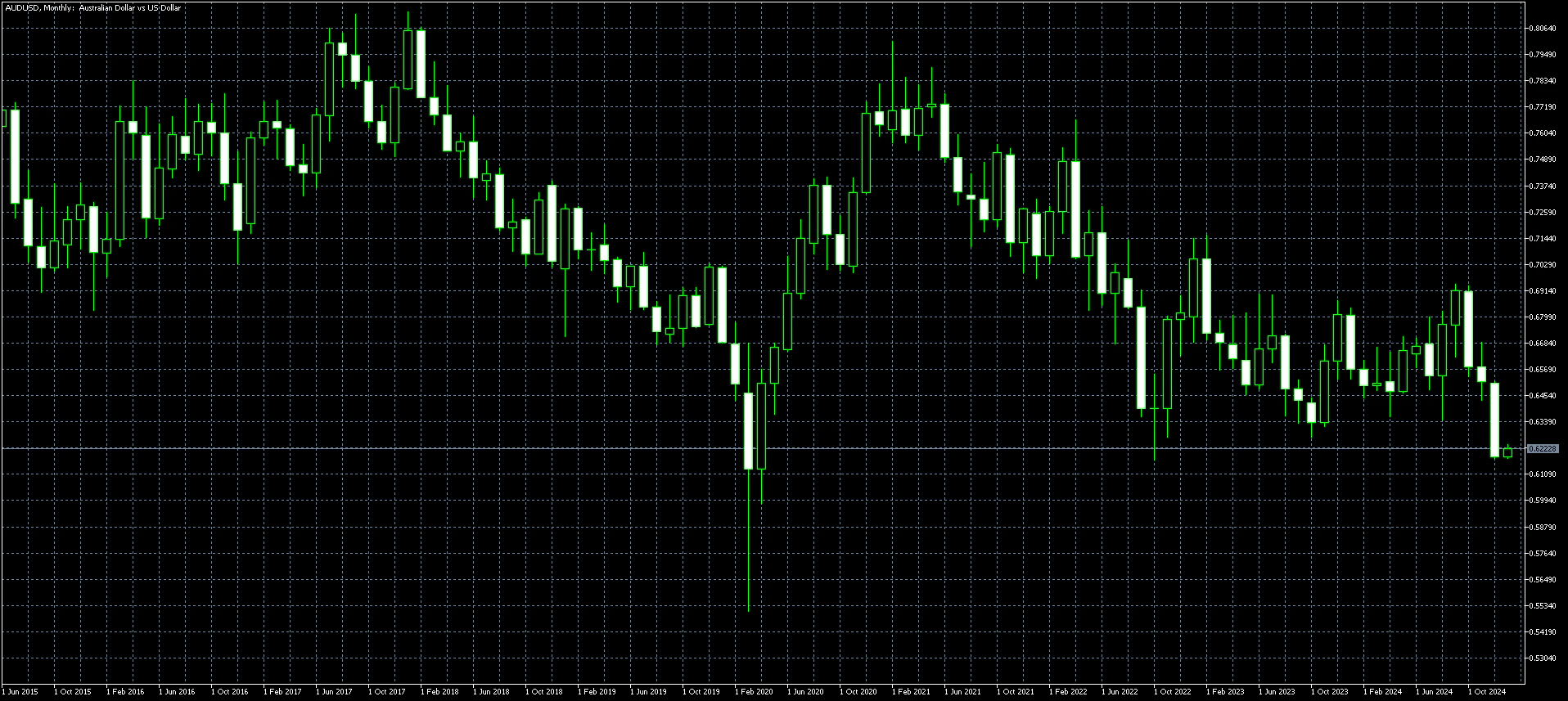
AUDUSD Monthly Chart
Understanding the fundamental factors behind AUD/USD’s drop is crucial for determining whether its downtrend is likely to continue or if it might reverse in the near future. Fundamentals—such as economic indicators, central bank policies, and global sentiment—tend to drive long-term currency trends, while technical analysis is often more useful for identifying short-term trading signals. Below, we’ll explore the key fundamentals that have contributed to AUD/USD’s recent slide.
1. Concerns About the Chinese Economy
Australia’s economy depends heavily on commodity demand from China. Any slowdown in China’s economy can hurt the Australian dollar. The Chinese Yuan has been weakening since October, and fears of a trade war could push the Australian Dollar even lower if growth in China deteriorates further. The new U.S. president-elect threatened to raise tariffs on Chinese goods to 60% or higher (up from an average of 17%, with the market expecting around 40%). If these higher tariffs go ahead, it may push the Australian dollar lower by weakening China’s demand for Australian exports.
2. Strong USD and Fewer U.S. Rate Cuts Than Expected
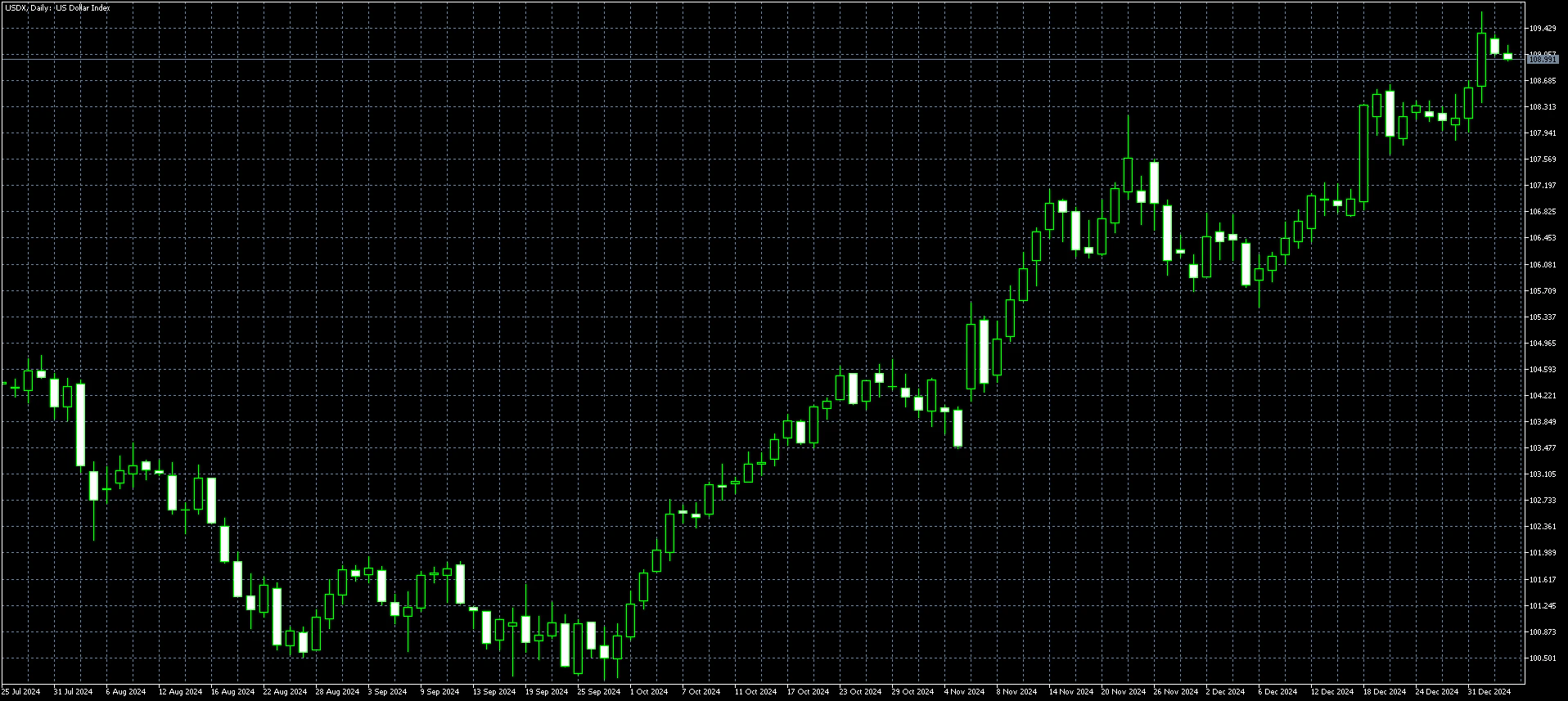
USD Dollar Index Daily Chart
Another factor dragging AUD/USD down is the strong U.S. dollar. In December, the Federal Reserve cut rates a quarter point as expected, but surprised markets by lowering its 2025 rate forecast from a full percentage point (four quarter-point cuts) to half a point (two quarter-point cuts). Higher than expected USD interest rates make the USD more attractive than the AUD for investors seeking returns, placing additional downward pressure on the Australian dollar.
3. Potential Australian Interest Rate Cuts
Australian economists anticipate up to four Australian interest rate cuts of 0.25% this year, which would reduce the AUD’s appeal. The market is already pricing in a 55% chance of an Australian rate cut in February. The Reserve Bank of Australia’s (RBA) December meeting minutes hinted it could soon be “relaxing the degree of monetary policy tightness,” pointing to further easing ahead. If so, lower yields on Australian assets may push AUD/USD even lower.
Market Outlook: What’s Next for AUD/USD?
Most analysts predict further weakness in the medium term, with some expecting a test of the important 0.6000 level. They point to potential U.S. equity weakness triggered by a global trade war, ineffective Chinese fiscal stimulus, and the need for the Reserve Bank of Australia (RBA) to reduce interest rates if China’s economy continues to slow.
Reserve Bank of Australia (RBA) Concerns
Even though a weaker Aussie could boost Australian exports, the RBA worries that higher import prices—most notably petrol—might push inflation up. Some analysts believe the RBA might intervene to keep AUD/USD from falling below 0.6000, although such a move seems unlikely because the currency’s decline appears driven by fundamental factors rather than mere speculation.
Key Economic Events
- Caixin China Services PMI: Surpassed expectations, helping AUD/USD bounce off recent lows.
- FOMC Meeting Minutes (Jan 8): Markets will examine discussions about U.S. rate cuts this year.
- U.S. Employment Data (Jan 10): A crucial indicator for USD strength or weakness.
- U.S. Central Bank Meeting (Jan 30–31): Could confirm or alter expectations for upcoming rate policy.
- Australian Central Bank Meeting (Feb 17–18): RBA’s stance on rate cuts will be closely watched.
- Chinese Economic Releases & Stimulus: Any measures from Beijing to support growth may bolster AUD.

Overall, the downside risk remains if trade war fears intensify, China’s stimulus measures fall short, or the RBA becomes more dovish than expected. However, positive surprises in Chinese data or shifts in U.S. monetary policy could provide short-term relief for AUD/USD. Traders should keep an eye on these major events and data releases, as AUD/USD’s next move could depend heavily on global sentiment and central bank policies in the coming weeks.
Trading Opportunities
When markets, like AUD/USD, reach significant levels, volumes and market interest often rise, creating more chances for active traders. The recent drop to multi-year lows has attracted short-term and long-term participants alike—each group can find ways to capitalize on increased volatility without necessarily needing to predict the next major directional move.
Short-Term Range Trading
Volatility Advantage: Short-term traders benefit when volatility picks up, as it creates frequent price swings.
Reversal Setups: Consider a strategy where you look for a notable gap between the current price and a 10-bar moving average (on a 5-minute, 15-minute, or 60-minute chart). If there’s an unusually large distance between price and the MA, enter a reversal trade aiming for a move back toward the moving average.
Range Bound Tactics: Even if the broader trend is bearish, traders can profit from temporary bounces off recent lows when price becomes oversold or deviates significantly from its short-term mean.
Medium/Long-Term Trend Following
Selling Strength: In a downtrend, look to sell on rallies when price returns to resistance (e.g., a moving average, trend line, or a prior swing high). This approach helps you re-enter the broader bearish move without chasing price at extreme lows.
Fundamental Shifts: If fundamentals (like positive Chinese data, a reduction in trade war rhetoric from the U.S. president-elect, or lower-than-expected long-term U.S. interest rates) start to improve, be prepared to buy AUD/USD. A shift in sentiment could lead to a significant rebound from oversold levels.
Overall, the key is to stay flexible. Short-term traders should exploit intra-day volatility and mean reversion setups, while medium to long-term traders may do better selling into rallies so long as the fundamentals remain weak for AUD. However, keep an eye out for any notable fundamental trend reversals—that’s your cue to pivot, potentially capturing the next substantial move higher if the macro picture brightens.
Take Advantage of AUD/USD Market Moves with Titan FX
With AUD/USD near multi-year lows and volatility on the rise, Titan FX offers the perfect environment to capture new opportunities. A single MT5 login gives you access to FX (including the Aussie dollar), as well as stock indices, commodities, Bitcoin, and single stock CFDs—all on one platform.
Why Trade with Titan FX?
- Fast Execution: Trade quickly and efficiently in fast-moving markets
- Dedicated Support: Helpful, professional assistance whenever you need it.
- Easy Deposits & Withdrawals: Stay focused on trading rather than account logistics.
- Multi-Market Access: Seamlessly switch between AUD/USD and other assets to adapt to market shifts.
As global events drive renewed volatility, Titan FX empowers you to navigate AUD/USD moves confidently. Experience Titan FX now and discover new possibilities in today’s active currency markets.