
Nick Goold
Understanding Market Trends in Forex Trading
Trend identification is one of the most important skills in trading. Before entering any trade, a trader needs to understand the current market condition. Without this, even a good entry setup can fail because it is taken in the wrong environment.
All price movement can be broadly grouped into three types of market conditions:
- Uptrend
- Downtrend
- Range (no clear trend)
Each condition requires a different approach. Trading with the trend generally offers higher probability opportunities, while trading in a range requires more patience and precision. Recognizing which environment you are in is the first step to building a consistent trading strategy.
How to Identify a Trend Using Price Structure
The most direct way to understand market direction is by looking at price itself. This means observing how highs and lows are forming over time. This method does not rely on indicators and reflects the actual behavior of buyers and sellers.
Uptrend: Higher Highs and Higher Lows
An uptrend forms when price consistently creates higher highs and higher lows. This shows that buyers are in control, pushing price upward while also stepping in earlier on pullbacks.
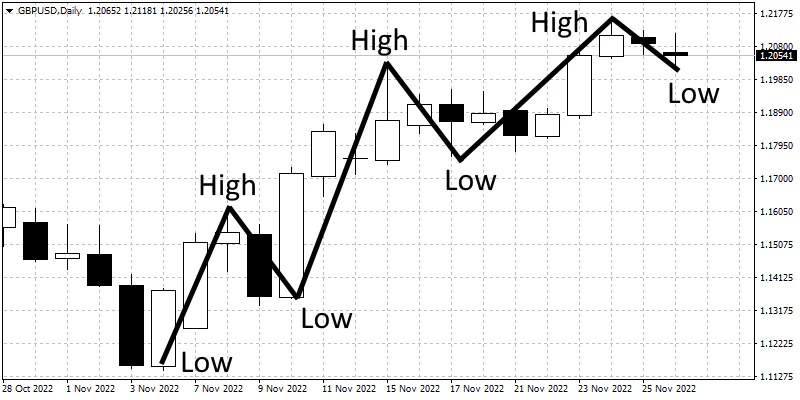
In this type of market, pullbacks toward previous lows can provide trading opportunities. Connecting these higher lows creates a trend line, which can help visualize the direction and structure of the trend.
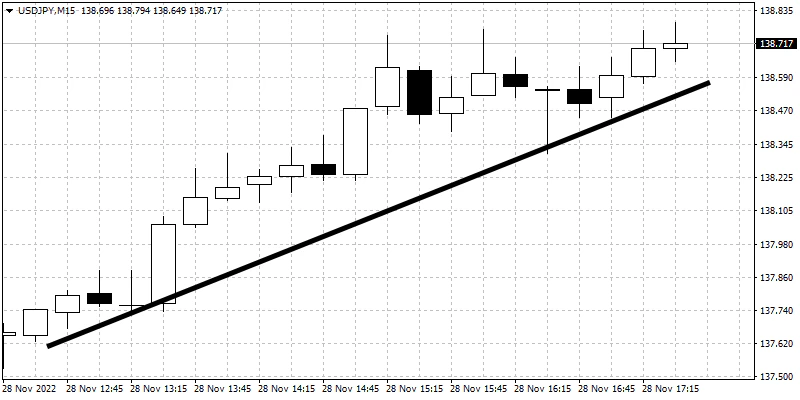
As long as this structure remains intact, the trend is considered strong. Once the pattern breaks, it may signal a change in market conditions.
Downtrend: Lower Highs and Lower Lows
A downtrend is the opposite structure. Price forms lower highs and lower lows, showing that sellers are in control and pushing price downward.
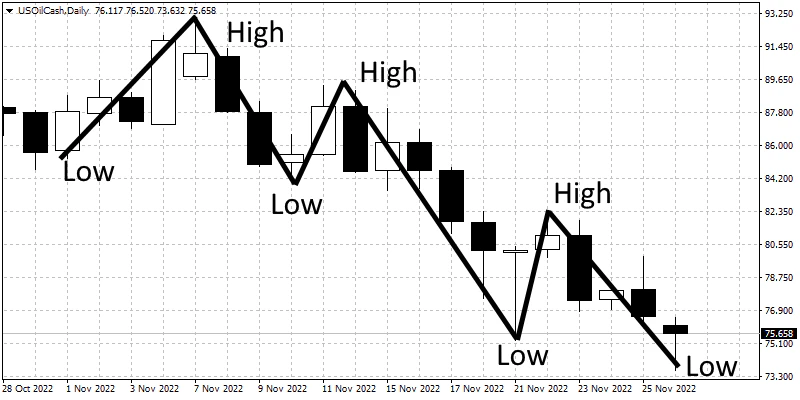
In this environment, rallies toward previous highs often present selling opportunities. Drawing a line across lower highs helps define the trend direction and provides a reference for potential entry points.
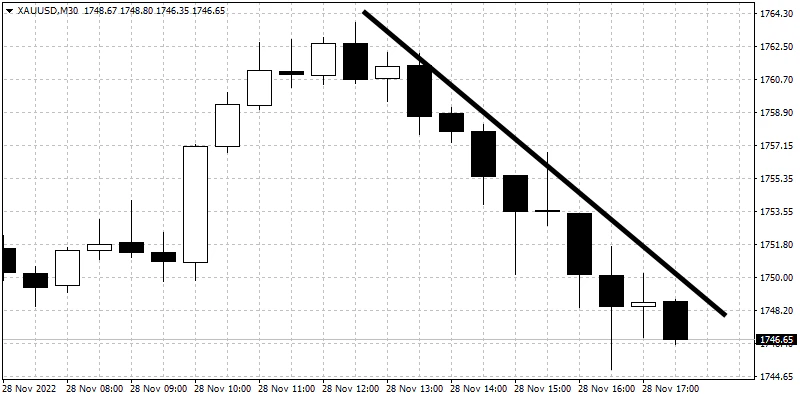
When this pattern begins to break, it may indicate that selling pressure is weakening and the market could move into a range or reversal phase.
Range Markets: No Clear Direction
Not all markets trend. A range occurs when price moves sideways without forming a clear sequence of highs or lows. In this environment, buyers and sellers are balanced, and price tends to move between support and resistance levels.
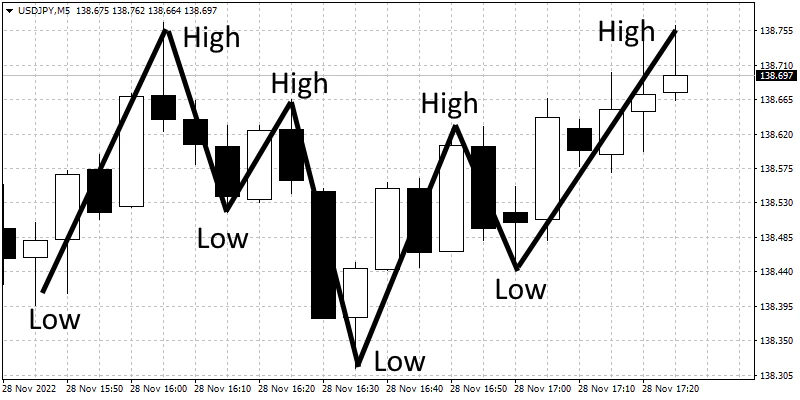
Range conditions require a different approach. Instead of following momentum, traders often look for reversals at the edges of the range. However, false breakouts are more common, so patience and confirmation are important.
Using Moving Averages to Confirm Trend Direction
Moving averages provide a simple way to confirm trend direction. While price structure shows the raw movement, moving averages smooth out fluctuations and make trends easier to identify.
When the moving average is rising, the market is generally in an uptrend. When it is falling, the market is in a downtrend. When it moves sideways, the market is likely ranging.
Reading Trend Strength with Moving Averages
The angle of the moving average can give insight into the strength of the trend. A steep slope suggests strong momentum, while a flatter slope indicates a weaker trend or a transition into a range.
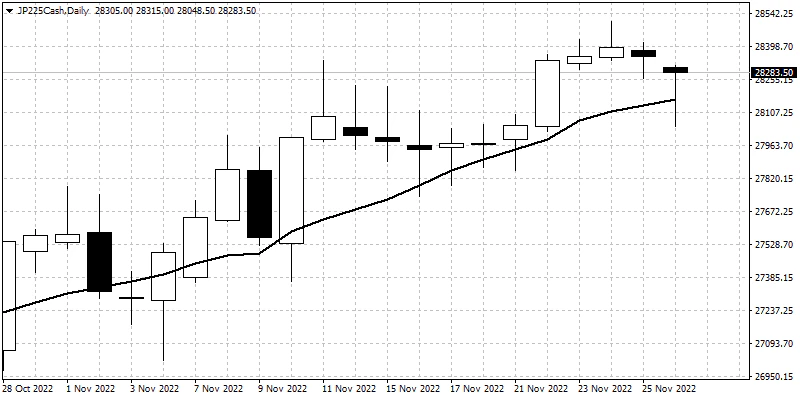
Uptrend
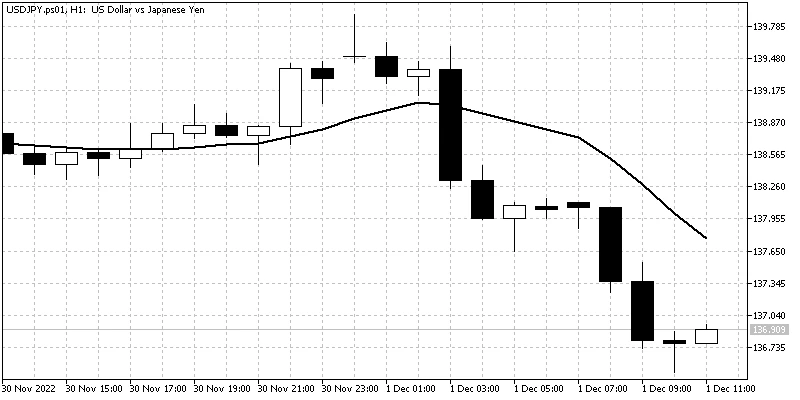 Downtrend
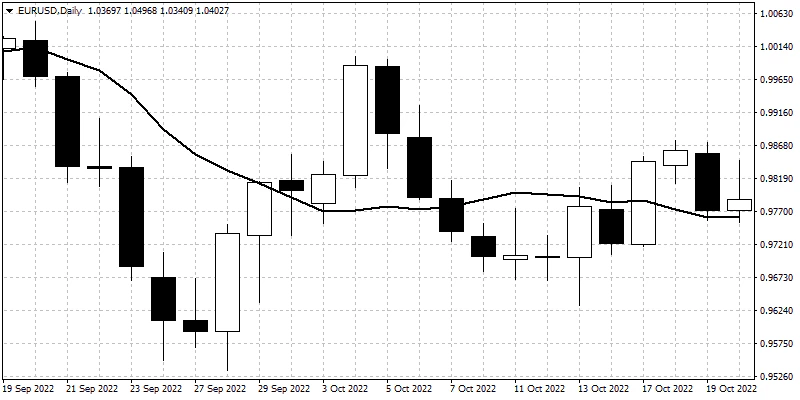 Range (no clear trend)
Understanding the strength of a trend helps traders adjust expectations. Strong trends may continue further, while weaker trends are more likely to reverse or move sideways.
Choosing the Right Moving Average Period
The period of the moving average determines how sensitive it is to price changes. Shorter periods react quickly and are useful for identifying short-term trends, while longer periods provide a smoother view of the overall direction.
For short-term analysis, moving averages such as 5 or 10 periods are commonly used. These help traders identify immediate momentum and potential entry timing.
For longer-term trend analysis, moving averages between 30 and 200 periods are more effective. These provide a broader view of the market and help filter out short-term noise.
Combining price structure with moving averages gives a more complete picture. Price action shows what the market is doing, while the moving average helps confirm the direction and strength of that movement.
Applying Trend Analysis in Trading
Understanding trend is not just about identifying direction, but about adapting your strategy to current conditions. In trending markets, following the direction of the trend often provides better opportunities. In range markets, focusing on support and resistance becomes more important.
Traders who consistently identify the correct market condition are better positioned to select appropriate strategies, manage risk, and avoid unnecessary trades. Over time, this skill becomes a key part of building consistent performance.