
Nick Goold
If you want to understand what moves the USD/JPY exchange rate, start by looking at interest rates. When interest rates in the U.S. and Japan move in different directions, it creates a gap—called the interest rate differential—and this gap is a major reason why USD/JPY rises or falls.
In this article, you’ll learn how the US–Japan rate difference works, why it matters, and how traders use this knowledge to make better decisions.
What Is the US–Japan Interest Rate Difference?
The US–Japan interest rate difference is the gap between how much interest you can earn in the U.S. versus Japan. It’s usually measured by central bank rates—set by the Federal Reserve (Fed) and the Bank of Japan (BoJ)—or by government bond yields.
This gap is a major driver of USD/JPY:
- When U.S. rates are higher, investors move money into the U.S. for better returns. This increases demand for the dollar and pushes USD/JPY higher.
- If U.S. rates fall or Japan raises rates, the gap shrinks. Capital may flow back to Japan, causing USD/JPY to drop.
Even small changes in interest rate expectations can move billions of dollars and shift forex prices quickly. This is also the logic behind the carry trade—a strategy where traders borrow in low-rate currencies like the yen and invest in high-rate currencies like the dollar to profit from the interest rate spread.
How the Fed and BoJ Set Interest Rates
The Federal Reserve (U.S.)
The Fed raises or lowers interest rates depending on how the U.S. economy is doing:
- If inflation is too high, the Fed may raise rates to slow things down.
- If the economy is weak, the Fed may cut rates to support growth.
In 2025, the Fed is in a tough spot. The economy is slowing, which supports lower rates, but inflation—partly caused by new tariffs from the Trump administration—is still a problem. There’s also political pressure on the Fed to cut rates before the next election, adding more uncertainty.
The Bank of Japan (BoJ)
The BoJ has kept rates near zero for a long time, but things are changing:
- Inflation is rising in Japan.
- A new trade deal with the U.S. has boosted exports.
- The BoJ is slowly considering raising rates for the first time in years.
But Japan’s economy is still fragile, so the BoJ is being careful. These different paths from the Fed and BoJ are creating big moves in USD/JPY.
How Economic Data Changes USD/JPY
Economic reports are important because they change what traders think central banks will do next. One report can change the whole outlook for interest rates—and cause big moves in USD/JPY.
August 2, 2025 – Weak U.S. Jobs Report
On this day, the U.S. Non-Farm Payrolls (NFP) report came in weaker than expected, signaling a potential slowdown in the economy.
Here’s what followed:
- Traders priced in a Fed rate cut
The disappointing jobs data increased expectations that the Federal Reserve would cut interest rates to support growth. - U.S. bond yields declined
Investors moved into bonds, anticipating lower future rates. This drove yields down. - USD/JPY dropped
The prospect of lower U.S. rates made the dollar less appealing. With Japan possibly hiking rates, the narrowing interest rate gap pushed USD/JPY lower.
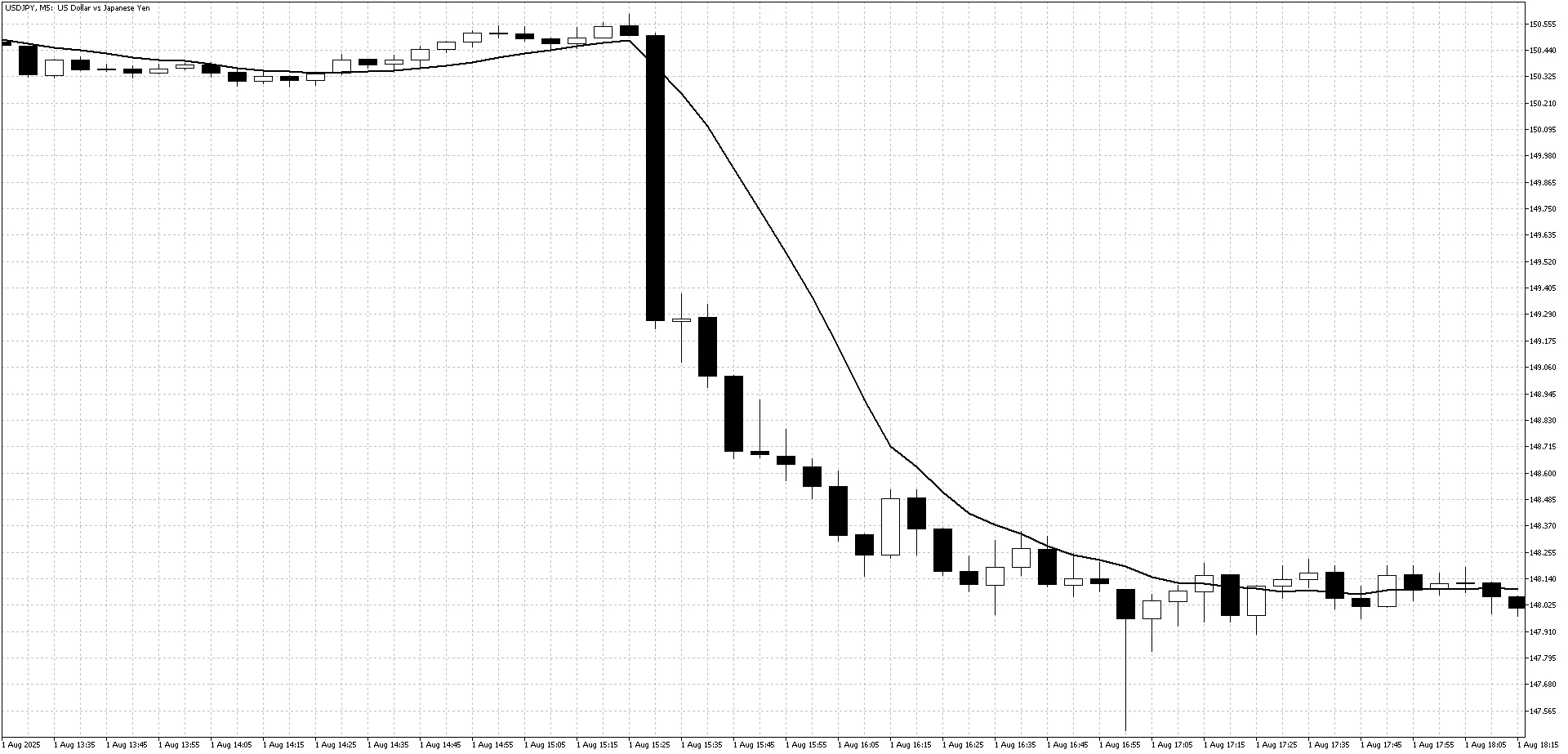
USD/JPY 5 minute chart August 1st 2025
This shows how one report can change expectations and move the market.
Important Economic Reports to Watch
If you're trading USD/JPY, keep an eye on these important reports that influence interest rate decisions:
- Non-Farm Payrolls (NFP) – U.S. job creation; strong numbers may lead to rate hikes.
- Consumer Price Index (CPI) – Measures inflation for consumers.
- Producer Price Index (PPI) – Tracks wholesale inflation; can signal future CPI moves.
- GDP Growth – Overall strength of the economy.
- PMI – Business activity and confidence in manufacturing and services.
- FOMC Statements & Fed Minutes – Reveal the Federal Reserve’s interest rate outlook.
- BoJ Outlook Reports – Show the Bank of Japan’s future policy direction
These reports help traders anticipate shifts in the US–Japan interest rate gap, which directly affects USD/JPY movements.
How to Track the Interest Rate Gap
You don’t need to be an economist to follow interest rate trends. Here’s how to do it in a simple way:
Watch Government Bond Yields
Bond yields show what investors expect to earn over time. The gap between U.S. and Japanese bond yields shows the rate difference.
U.S. 10-Year Yield – Japan 10-Year Yield = Interest Rate Differential
- If the U.S. yield is rising more than Japan’s, USD/JPY usually goes up.
- If the gap gets smaller, USD/JPY often falls.
You can find yield data on major financial news websites like Bloomberg, Reuters, or Investing.com. Central bank websites like the Fed and BoJ also post updates.
How to Trade USD/JPY Using Rate Differences
1. Use Interest Rate Trends for Direction
If U.S. rates are likely to stay higher than Japan’s, USD/JPY often trends up. If the Fed is expected to cut and Japan may raise rates, look for USD/JPY to go down.
2. Watch for Surprise Reports
Unexpected job or inflation numbers can quickly change market expectations. Be ready to shift your strategy.
3. Combine With Technical Analysis
Use charts to find good entry and exit points:
- Look for support and resistance zones
- Use moving averages (like 10 or 50-day)
- Check RSI or MACD for timing
Technical tools help you avoid poor timing, even when your fundamental view is right.
Why Interest Rates Drive USD/JPY
Interest rates are the biggest reason why USD/JPY moves. When the U.S. and Japan have very different interest rates, it pulls investors and traders from one currency to another. By watching central bank actions, tracking key economic reports, and keeping an eye on bond yield differences, you can better understand the USD/JPY trend—and trade with more confidence.