
Nick Goold
Last week was one of the most volatile in recent memory. By Friday, markets began to stabilize, with U.S. stock indexes rising more than 1.5% as they continued a recovery from earlier in the week. Meanwhile, investor confidence in the U.S. economy weakened. The U.S. dollar index fell below key support at 100 on Friday, and gold extended its gains as investors looked for safer assets.
Friday’s rally was driven by renewed optimism around U.S.-China trade relations. President Trump expressed hope for a deal and announced that smartphones, computers, and key components like semiconductors would be temporarily exempt from new “reciprocal” tariffs. This boosted buying across tech and other sectors. However, over the weekend, Trump clarified the exemptions were not permanent. He said the products are still subject to “20% Fentanyl Tariffs” and may be moved into a different tariff category. Commerce Secretary Howard Lutnick echoed that stance, adding to the uncertainty.
There was also heavy selling of U.S. Treasuries. Analysts say this may be linked to China and Japan reducing their holdings in response to rising trade tensions. This pushed yields higher and added pressure to the already fragile bond market. Over the weekend, Ray Dalio warned that the U.S. is “on the brink of recession” due to the ongoing trade conflict.

Markets This Week
U.S. Stocks
The worst of the selling appears to be behind U.S. equities in the short term, following President Trump’s 90-day tariff delay. However, uncertainty remains high, with analysts lowering earnings forecasts and market sentiment still fragile. Volatility is expected to stay high as the U.S.–China tariff standoff continues, likely leading to a sideways-to-higher trading range this week. The Dow faces key resistance at 40,800—the March lows and last week’s highs—with important support at 38,000.
Japanese Stocks
The Nikkei 225 remains under pressure as USD/JPY trends lower, despite Japan’s finance minister voicing concerns about excessive currency volatility. The risk of new U.S. tariffs on Japan is also weighing on sentiment. Technical resistance lies at 35,000 and 36,000, while a drop below the 10-day moving average would trigger a fresh sell signal. Support can be found near 32,500 and 31,000.
USD/JPY
The U.S. dollar remains weak amid growing concerns about the U.S. economy—and especially against the yen. Speculation that Japan may be reducing its U.S. Treasury holdings is contributing to downside pressure on USD/JPY. Support is seen at 142 and 140, with resistance at 146.50 and 148. Selling into strength remains the preferred approach for both short- and medium-term traders.
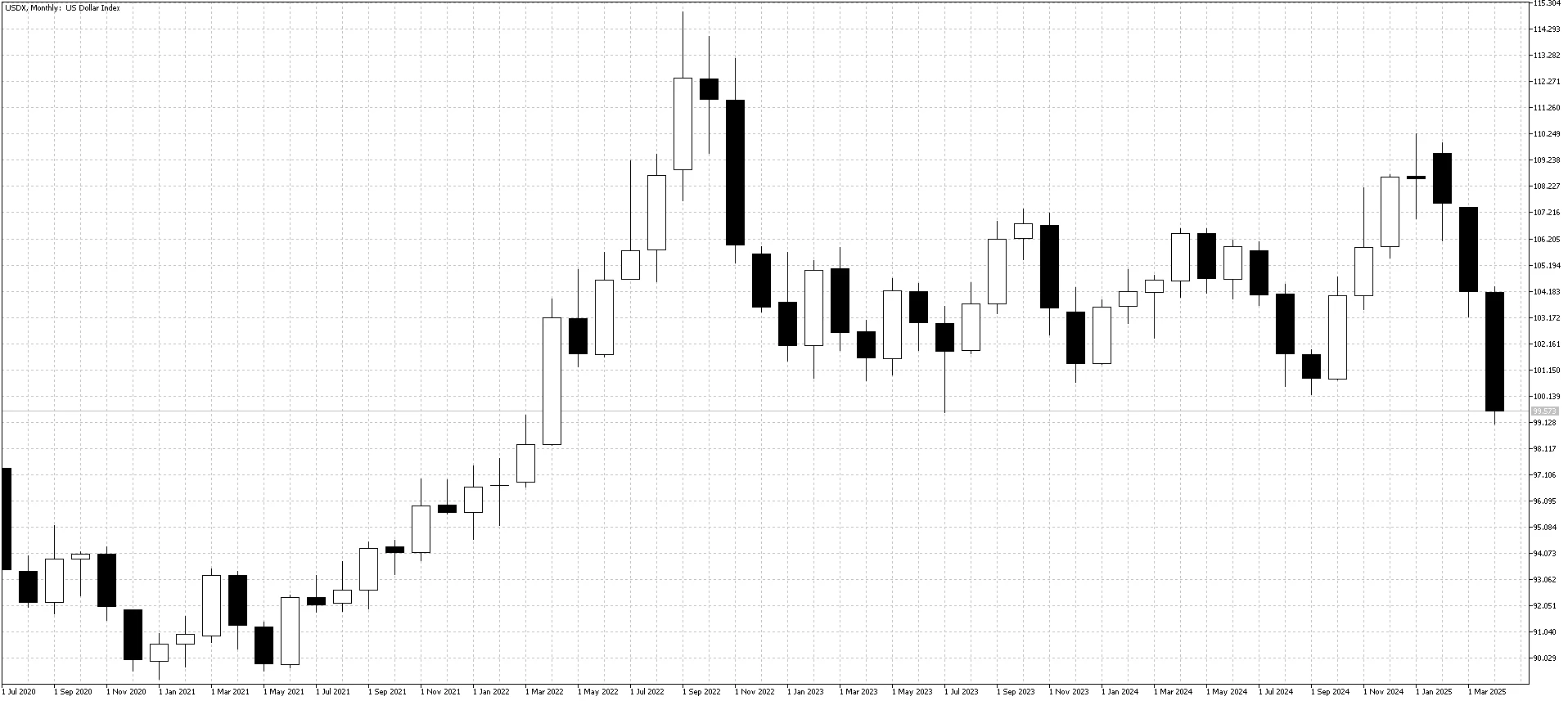
US Dollar Index Monthly Chart
Gold
Gold continues to hit record highs, supported by a weak dollar and high market volatility. The trend remains strong, but trade timing is crucial. Look to join the uptrend when prices pull back to the 10-bar moving average on short-term charts (5, 15, 60-minute) with a rising slope. If the USD strengthens, short-term traders may also find profitable short-selling opportunities.
Crude Oil
Crude oil remains in a downtrend, with resistance around $63.50—last week’s highs and the 10-day moving average. Ongoing recession concerns in the U.S. are limiting upside potential. Still, with some improvement in the overall market, the worst may be over in the short term. Range trading looks like the best strategy this week.
Bitcoin
Bitcoin is holding above the key $80,000 level, signaling improving risk appetite among traders. As long as this level holds, short- and medium-term traders should focus on buying opportunities. A break below would signal caution, but for now, the momentum remains positive.
This Week’s Focus
Wednesday: U.S. Retail Sales, U.S. Industrial Production
All Week: Headlines from Trump, China, and Global Leaders
The key economic reports this week are Wednesday’s U.S. retail sales and industrial production. While the new tariffs won’t affect this data yet, signs of strong consumer demand will be important for the future of the stock market. Expect lots of headlines as the U.S.–China tariff fight continues. If the USD/JPY keeps falling, Japanese officials may speak out more strongly, even if actual intervention is unlikely.
What Traders Should Focus On This Week
This week has good trading opportunities, but success comes from staying calm, being flexible, and adjusting to what the market is doing now. Here are three key points to stay focused:
1. Watch Volatility, Not Just Direction
There will be lots of talk about Trump and trade. It’s important, but still very hard to predict. Don’t get distracted — trust your technical signals and stick to your plan. A clear, disciplined strategy is your best tool in uncertain times.
2. Follow Your Strategy
This is not the time to guess where the market will be in a month. Focus on today and tomorrow. Follow short-term momentum, react to headlines, and manage risk on a day-to-day basis.
3. Try New Markets
If your usual trades aren’t working, look at other markets. Instead of just USD/JPY or GBP/JPY, try USD/CNH, JPY/CNY, gold, or bitcoin. These may give better setups right now and help you see the market with fresh eyes.
Understanding the Chinese Yuan (CNY): What Traders Should Know
What Drives the Yuan?
Several key factors influence the value of the yuan:
- Trade Tensions: Ongoing tariff battles with the U.S. put downward pressure on the yuan. The currency is seen as one of China’s tools to absorb the impact of reduced exports.
- Economic Growth: Slower growth in China weakens the yuan, while strong export performance supports it.
- Interest Rates: China’s central bank, the PBoC, is expected to ease policy—through rate cuts or reserve requirement reductions—if the trade war worsens.
- U.S. Dollar Strength: A strong dollar, driven by high U.S. interest rates, pushes USD/CNH higher and the yuan lower.
- Capital Flows & Stability: A sharp drop in the yuan could trigger capital outflows and instability. That’s why the PBoC is likely to allow only gradual and controlled weakening.
Current Situation
USD/CNH (Dollar/Yuan):
The yuan is trading near a 17-year low. Trump has accused China of currency manipulation, but most experts believe Beijing won’t allow a major devaluation. The PBoC sets a daily reference rate and manages the pace of any moves. The weak yuan helps exports, but too much weakness risks financial instability.
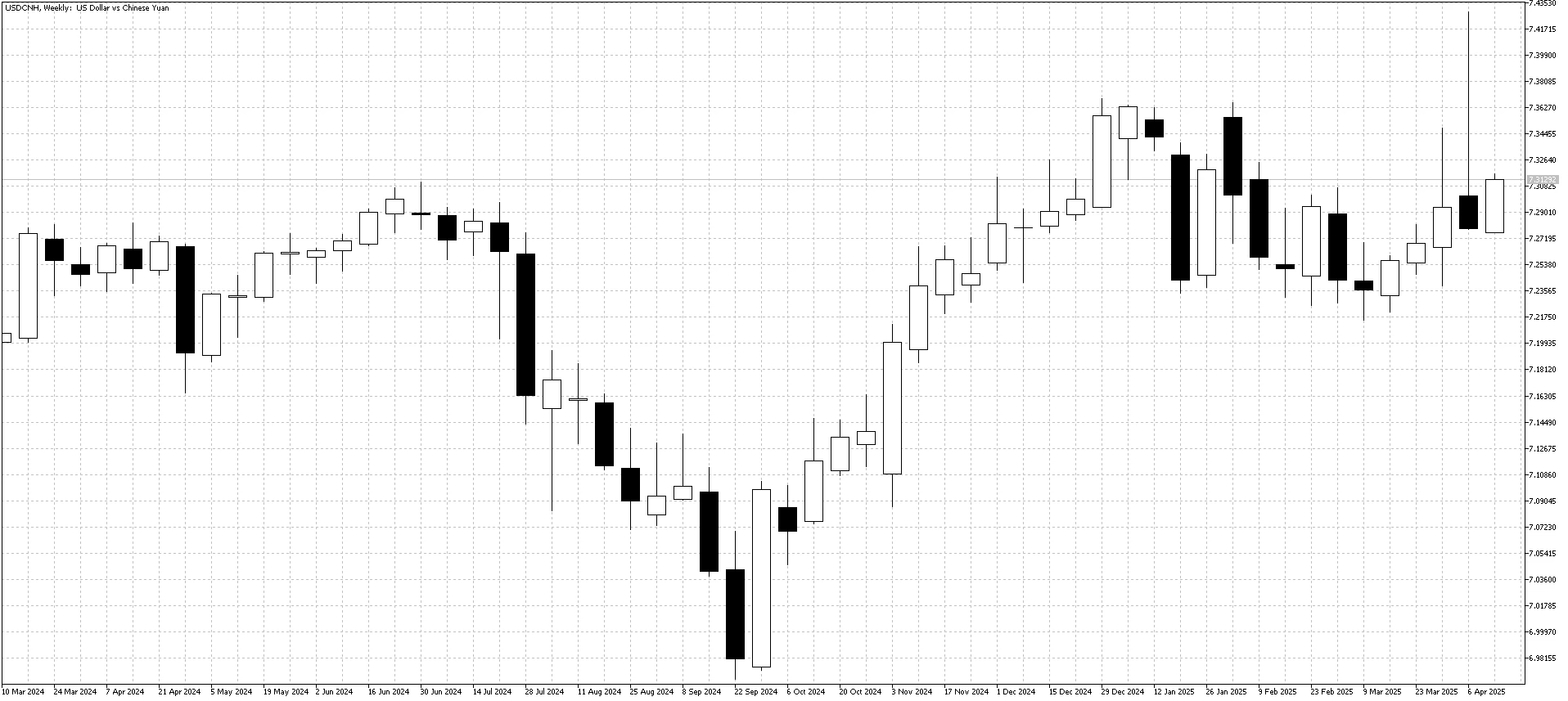
USDCNY Weekly Chart
Targeting profits in the market after Liberation Day with Titan FX
April 2 marks the start of Liberation Day — a major turning point in global markets. With new tariffs, shifting trade policies, and rising volatility across currencies, commodities, and equities, traders face both risk and opportunity. Whether you're trading FX, gold, indices, or crypto, Titan FX gives you the speed, tools, and tight spreads to stay ahead and make the most of this high-impact event.
Why Trade FX & CFDs with Titan FX After Liberation Day?
✅ Ultra-Fast Execution – Stay ahead of sharp market movements in FX, indices, stocks, crypto, and commodities.
✅ Advanced Charting & Analysis Tools – Identify breakout points, trend shifts, and key trading levels with confidence.
✅ Trade Multiple Markets – From FX to gold, crude oil, stock indices, individual stocks, and crypto, trade it all from one platform.
✅ Secure and Flexible Funding – Focus on trading while we handle seamless deposits and withdrawals.
With markets moving at fast speed—tariffs reshaping global trade, central bank policies shifting currencies, and volatility presenting new opportunities daily—Titan FX ensures that you have the best execution, tight spreads, and cutting-edge tools to capitalize on every trading challenge.
Don’t just watch the action—profit from it. Start trading with Titan FX today!