
Nick Goold
What Is Happening in USD/JPY Recently
The USD/JPY has been very active in recent weeks as traders react to Japan’s changing fiscal and monetary policies. The yen has weakened since Prime Minister Sanae Takaichi took office, as her government supports expansionary policies similar to Abenomics. Markets expect new stimulus measures, while the Bank of Japan (BoJ) faces pressure to support growth without letting inflation rise too much. At its last meeting, the BoJ kept interest rates unchanged, delaying an expected rate hike and signaling that easy policy will continue for now.
Last week, the yen briefly strengthened after officials expressed concern about its rapid and one-sided fall. Finance Minister Satsuki Katayama warned against “disorderly moves” and said the government would act if volatility became too strong. Her comments showed growing concern about higher import costs and the impact of yen weakness on household spending.
Why a Weak Yen Is a Concern for Japan
A weaker yen boosts exporters’ profits but also raises the cost of imported goods such as energy and food—both critical for Japan’s resource-dependent economy. This leads to higher inflation, which erodes household spending power. With real wages already stagnant, the government faces growing pressure to curb excessive yen weakness before it hurts domestic demand and consumer confidence.
What Is Central Bank Intervention?
Currency intervention happens when a central bank buys or sells its own currency in the open market to influence its exchange rate. In Japan’s case, the Bank of Japan (BoJ) may sell U.S. dollars and buy yen to slow or reverse the yen’s decline.
Such interventions often cause sharp, short-term market moves. The first drop in USD/JPY is usually sudden and large, meant to surprise traders and stop speculative buying. After that, the market often rebounds slowly, but if the BoJ steps in again, another quick fall can follow.
Intervention usually creates a resistance zone that shows the level policymakers are defending. However, it rarely changes the long-term trend—U.S. interest rates are still much higher than Japan’s, keeping pressure on the yen. A surprise rate hike by the BoJ would have a stronger and longer-lasting effect than intervention alone, while joint action with the U.S. Federal Reserve remains unlikely for now.
When Did the Bank of Japan Last Intervene?
Japan carried out major dollar-selling, yen-buying operations on at least two occasions in 2024. The first took place in late April and early May, after the yen rapidly weakened past ¥160 per dollar. Authorities are widely believed to have stepped in on April 29 and May 1 to slow the decline.
The second intervention came in mid-July, when official data later confirmed that action was taken on July 11 and July 12 as the yen again tested the ¥160 level. These moves show that both the ¥160 mark and a fast pace of depreciation are key triggers for direct market action by Japanese authorities.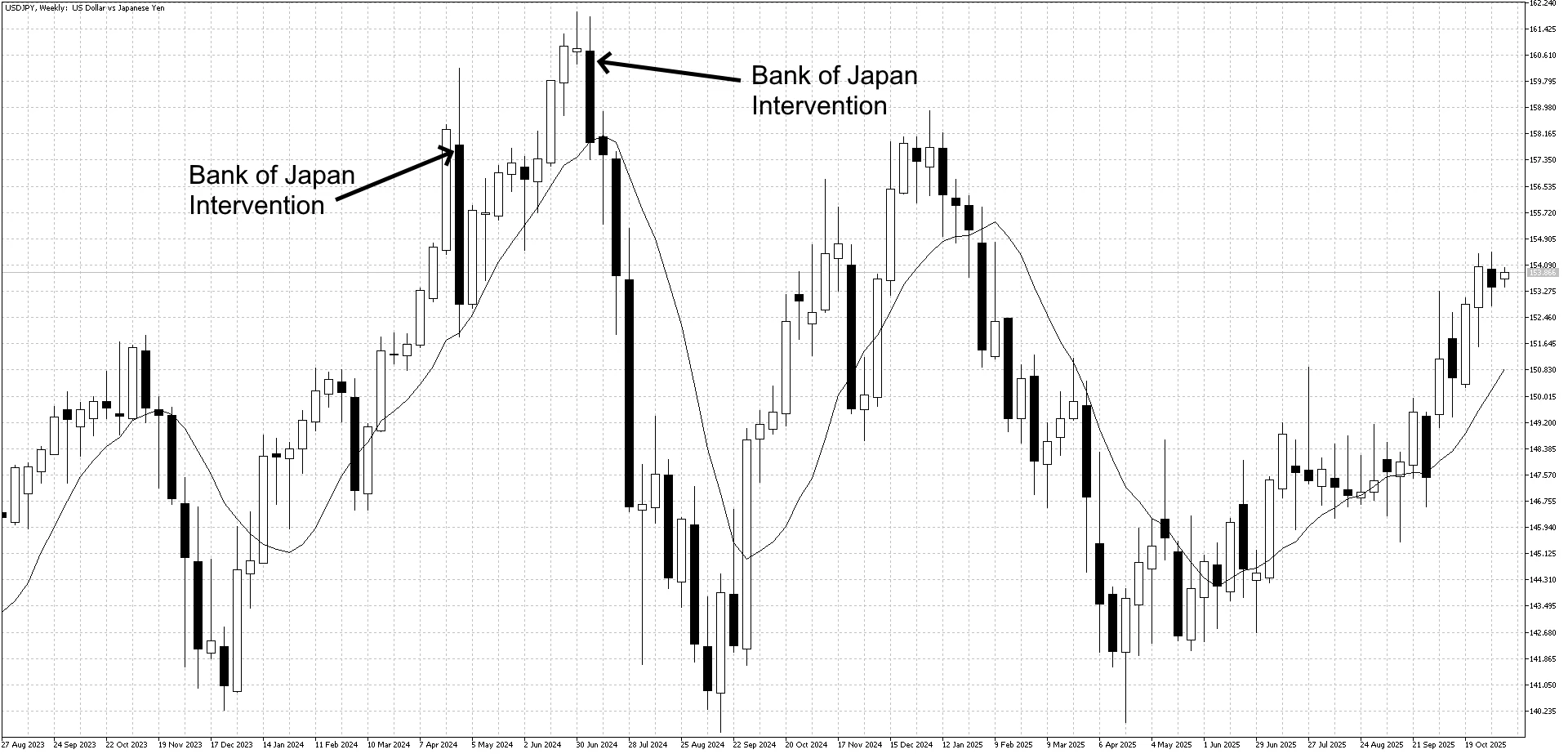
How to Forecast the Timing of Intervention
Predicting when Japan will intervene in the currency market is extremely difficult, because interventions work best when they catch traders by surprise. Still, there are several clues traders can watch for.
1. Watch for Official Warnings
The first sign often comes from government comments. When officials move from simply “monitoring” the market to warning about “rapid” or “one-sided” moves, the chance of intervention increases. Stronger language from the Finance Minister or top currency officials is usually a signal that authorities are preparing to act—but they always maintain some uncertainty to preserve the element of surprise.
2. Pay Attention to Key Technical Levels
Many traders are now watching moves above 155 in USD/JPY as a potential trigger for intervention. A fast, speculative rise beyond this level—especially after strong U.S. economic data—can increase the risk of official action. It’s not only the level itself that matters, but also the speed and nature of the move. Sharp, one-way surges tend to attract a quicker response than gradual climbs.
3. Market Timing and Uncertainty
Authorities often act when traders least expect it—such as during quiet trading hours or when global markets are closed—to maximize the shock effect. Intervention is designed to be unpredictable; if traders could anticipate it, it would lose its impact. This element of surprise keeps the market alert and makes trading USD/JPY during such periods both risky and full of opportunity.
Trading Strategies Around Intervention
1. Selling Ahead of Intervention
This strategy means selling USD/JPY as it rises quickly, expecting that the Bank of Japan will step in to stop further yen weakness. You’re positioning early in hopes of catching the drop once intervention begins.
Pros:
- You can enter at better prices before volatility spikes.
- If intervention happens, profits can be large and fast.
Cons:
- There’s no guarantee of intervention at any level.
- USD/JPY can keep rising, causing quick losses.
- Requires discipline—use tight stops and never add to losing positions.
2. Selling During Intervention
This involves selling USD/JPY as intervention actually occurs, trying to ride the sharp move lower. However, the drop often happens within minutes, making execution extremely difficult.
Pros:
- Can capture part of a powerful, fast-moving decline.
- Works well for traders already watching the market in real time.
Cons:
- Reaction time must be instant—200-pip drops can happen in minutes.
- Slippage and price gaps are common.
- Most traders will miss the best entry unless orders are pre-set.
3. Buying After Intervention
After intervention, the market often overreacts, with USD/JPY falling too far too fast. Once prices begin to stabilize, a rebound is likely.
Pros:
- Potential to buy near short-term lows.
- High reward-to-risk setup—small stops can yield large profits.
- Works best when the panic clearly fades.
Cons:
- Difficult to know when intervention has truly ended.
- Volatility remains high, and prices can drop again suddenly.
- Emotionally challenging to buy when sentiment is bearish.
4. Trading the Retest
Following intervention, USD/JPY often rebounds to test whether the authorities will defend the same level again (e.g., near 155 or 160). Selling near that zone can be profitable if another round of action occurs.
Pros:
- Provides a second opportunity after the initial move.
- Aligns with official defense levels already proven in past interventions.
Cons:
- If authorities stay silent, USD/JPY may break higher again.
- Timing depends on official signals, which are often unclear.
- Risk of renewed momentum if the market believes the intervention is over.

Trading Strategy Advice
When volatility is high, short-term charts such as 1-minute or 5-minute can help identify quick trend shifts.
- Use a 10-period moving average to track short-term direction.
- A sharp move above a downward-sloping average can signal a reversal; the same applies in the opposite direction.
- During high volatility, enter trades in the direction of the current bar—buy on an up-bar or sell on a down-bar—to follow momentum without waiting for candle closes.
Risk Management Around Intervention
FX intervention periods can bring great opportunities—but also extreme risk. Volatility can rise sharply, and prices may move hundreds of pips in minutes. To stay safe and profitable, traders should:
- Avoid adding to losing positions. Many traders lose heavily by averaging down during volatile periods. Stick to your plan, accept losses quickly, and wait for a new setup.
- Use clear risk–reward targets. Aim for trades where potential profits are at least three times larger than your stop-loss (a 1:3 ratio). For example, if your stop-loss is 20 pips, target at least 60 pips of profit. This way, even with a lower win rate, one strong trade can cover several small losses.
- Focus on discipline, not frequency. You don’t need to trade every move. During interventions, patience and timing matter far more than taking many small trades.
By managing risk carefully, traders can benefit from the volatility without being caught on the wrong side of sudden market swings.
Be Ready for Possible Intervention
Trading USD/JPY when the Bank of Japan might step in brings both big risks and big opportunities. With the yen nearing levels that have triggered action before, traders should watch policy comments and key price levels closely. Sudden intervention can cause sharp reversals, but the wider trend still follows interest rate differences and overall economic strength.
Intervention can move markets fast. Staying alert, managing risk carefully, and reacting quickly will help traders make the most of this volatile and unpredictable period.