
Nick Goold
Volatile markets create opportunity. Big price moves can lead to strong profits in a short time. But volatility also makes it harder to decide where to take profit. A trade can move in your favor and then quickly reverse. A winner can turn into a loss in minutes, which is frustrating and stressful.
Many traders try to improve their win rate. But it is often more effective to focus on making your winning trades bigger, rather than trying to win more often. Letting profits run can improve long-term results more than a small increase in win percentage. Partial exits offer a simple and structured way to do this.
The Problem with a Single Take-Profit
Most traders use a simple plan: enter a trade, set a stop loss, and set one take-profit level. This is logical and supports good risk management.
But in volatile markets, this approach has a weakness. It forces you to rely on one exact target. Price might move 50 pips easily, but whether it reaches 100 or 200 depends on many factors — news, central banks, order flow, or technical levels. No one can predict this perfectly.
If price turns just before your target, you earn nothing. If it moves far beyond your target, you miss extra profit. Both situations can lead to frustration and overtrading, as traders try to “win back” missed gains with worse decisions.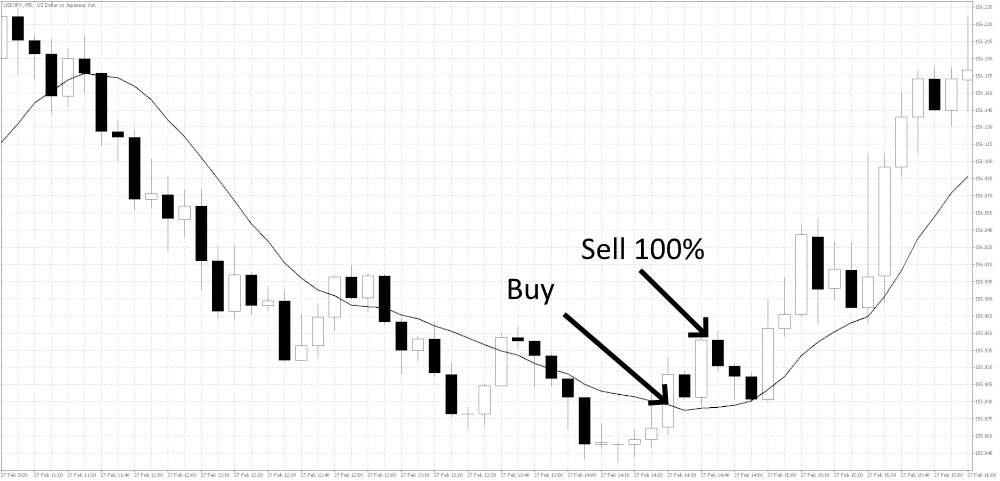
What Is a Partial Exit?
A partial exit means closing part of your trade at one level, and leaving the rest open for a bigger move. Instead of using one take-profit target, you split your position into parts.
Example: USD/JPY
- Buy 1 lot at 155.00
- Stop loss at 154.50
- First target at 155.50
- Second target at 157.00
When price reaches 155.50:
- Close 0.5 lots
- Move stop loss to 155.00 (breakeven)
Now the trade cannot lose.
If price reverses, you keep profit from the first exit.
If price continues higher, you earn more from the remaining position.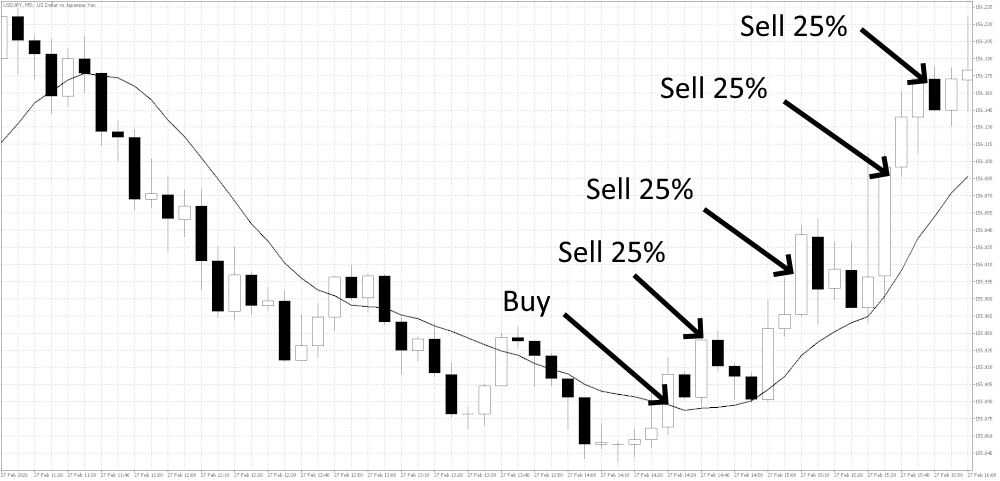
The Benefits of Partial Exits
1. Less Stress and No Risk After First Target
When your whole trade depends on one target, every small price move feels stressful. After you take partial profit and move your stop to breakeven, the pressure drops. You have locked in some profit, and the trade can no longer lose. From that point, you are managing opportunity, not defending risk.
2. Capture Bigger Moves
Markets can move much further than expected, especially during strong trends. If you close the full position too early, you miss those larger moves. Partial exits allow you to stay in and benefit if the trend continues.
3. Less Overtrading
Missing big profits often leads to frustration. Traders then try to chase the market. By securing partial profit, you reduce emotional pressure and make calmer decisions.
4. Works in Different Market Conditions
In choppy markets, the first target may be hit before price reverses. In trending markets, the remaining position can capture extended moves. The strategy adjusts naturally to conditions.
5. Bigger Average Winning Trades
You don’t always need to win more often to improve performance. Increasing the size of your winners can have a bigger impact. Partial exits help increase your average profit per trade over time.
Choosing Exit Levels Properly
Partial exits should follow a clear plan. They should not be random.
1. Use Support and Resistance
- First target: near the closest resistance level
- Second target: next key price level
- Final target: major weekly level
This keeps your exits based on real market structure.
2. Use Average Daily Range (ADR)
If USD/JPY moves about 100 pips per day on average:
- Target 1: around 50 pips (50% of ADR)
- Target 2: around 100 pips (100% of ADR)
- Target 3: 150–200 pips on strong trend days
Swing traders can use the same idea with the weekly range.
This approach keeps your targets realistic and based on how the market normally moves.
Using Partial Exits in Different Trading Styles
Partial exits work for all types of traders.
Scalping
Scalpers aim for small moves, usually 5–15 pips.
For example:
- Close 50% at +6 pips
- Let 50% run to +12 pips or more
After the first exit, moving the stop to breakeven helps control risk, even in short trades.
Day Trading
Day traders often target 30–150 pips.
A simple plan could be:
- Take some profit at the first resistance
- Move stop to breakeven
- Take more profit at the next key level
This gives both protection and the chance for bigger gains.
Swing and Position Trading
Swing traders may hold trades for hundreds of pips.
For example:
- Close 25% at the first major level
- Close another 25% at the next level
- Let the remaining 50% run with a trailing stop and no fixed target
This method locks in profit while allowing very large upside if the trend continues.
MT4 and MT5 Practical Tip
On MT4 or MT5, it is easier to manage partial exits if you split your position at the start. Instead of opening 1.00 lot in one trade, consider opening four separate trades of 0.25 lots each.
This gives you more control. You can close one position at the first target, another at the second target, and leave the rest running. It makes trade management simple and clear, without needing to manually adjust lot sizes each time.
Common Mistakes to Avoid
1. Moving the Stop Too Quickly
Markets often pull back before continuing.
If you move your stop too tight after the first exit, you may get stopped out too early.
2. Setting the First Target Too Far
Your first target should be realistic.
If it is too far away, price may never reach it, and you will not secure breakeven protection.
3. Forgetting to Move the Stop
After the first target is hit, move your stop to entry.
This should be automatic in your plan.
4. Making It Too Complicated
Start simple. Use two exit levels at first.
Only add more targets after you gain experience.
Trade Smarter in Volatile Markets
Volatile markets create big opportunities, but they can also cause stress. Trying to pick one perfect exit often leads to frustration. Partial exits help you take some profit early while still staying in the trade if the move continues.
Professional trading is not about guessing the exact top or bottom. It is about managing your trade step by step. Partial exits help you stay calm, protect profits, and improve your results over time.