
Nick Goold
When you first start trading FX and CFDs, most people learn two main strategies:
Trend trading – following strong moves in one direction
Range trading – buying near support and selling near resistance when price moves sideways
Both of these approaches are important and can be very profitable when used with discipline and proper risk management. However, as traders gain more experience, many begin to notice another type of opportunity that beginners often overlook: overextended price moves.
These occur when price moves too far, too fast, stretching well beyond what could be considered a normal or balanced level. When this happens, the market often slows down, pauses, or pulls back. Learning to recognize overextended price moves can help traders identify short-term reversal opportunities, especially for day traders who rely on momentum and precise timing.
The Problem With Chasing the Market
Almost every trader has been in this situation:
- The market suddenly moves sharply higher or lower
- You regret missing the move
- You jump in late, hoping there is still profit left
This behavior—chasing price—is one of the most common and costly mistakes in trading.
When price moves very fast, it is hard to know whether:
- A real new trend is starting, or
- The market is just reacting emotionally in the short term
In reality, most sharp moves are driven by emotion and urgency, not by strong, lasting trends. After the initial surge, price often slows down, pulls back, or reverses as the market returns to balance. Instead of chasing these moves, experienced traders wait for signs that momentum is fading and look for opportunities created by panic and overreaction.
What Is an Overextension?
An overextension happens when price moves a large distance away from its recent average in a very short period of time.
In simple terms, price has moved too far, too fast.
Key points to understand:
- Price normally stays close to its average level
- Fast, sharp moves can push price well beyond that normal range
- When this happens, the move often cannot continue at the same speed
Overextensions are not about guessing exact tops or bottoms. Instead, they help traders spot moments when price is temporarily out of balance with normal market behavior, increasing the chances of a pause, pullback, or short-term reversal.
How to Spot an Overextended Market
1. Distance From a Moving Average
- Use a 10-period simple moving average
- Day traders: 1-minute or 5-minute charts
- Swing traders: Daily charts
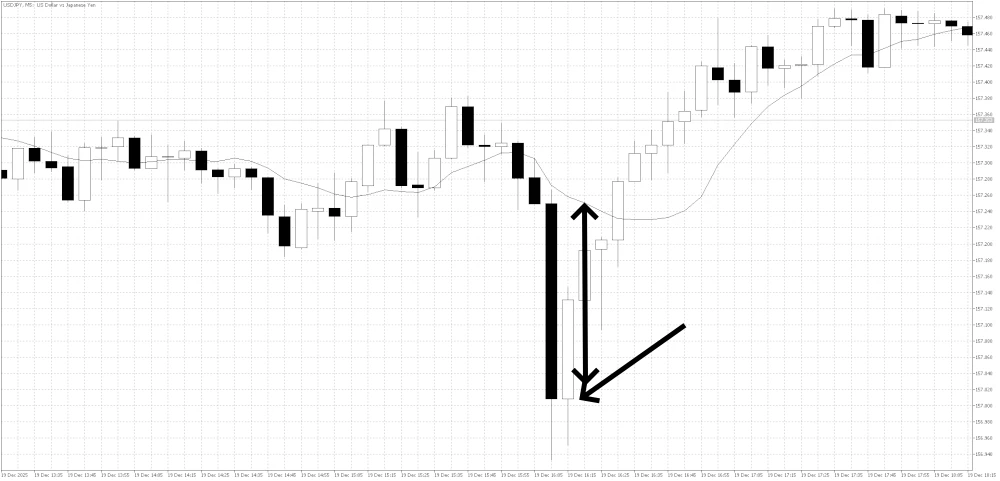
USDJPY 5 minute chart with 10 bar moving average
If price is unusually far from the moving average, the market may be stretched.
General guidelines (not fixed rules):
- Major FX pairs: 10–20 pips
- Gold (XAU/USD): 20–50 pips (depending on volatility)
These distances change with market conditions, so regular observation is essential.
2. Bollinger Band Breaches
Bollinger Bands visualize volatility.
An overextension often appears when:
- Price pushes above the upper band
- Or drops below the lower band
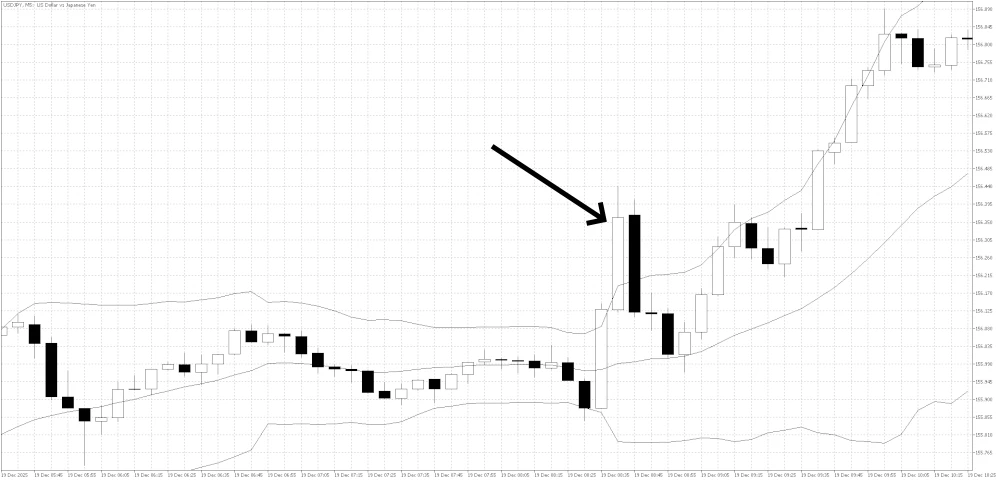
USDJPY 5 minute chart with Bollinger Band
When price moves outside the bands and then struggles to continue, it often signals exhaustion.
Why Do Markets Overextend?
Overextensions are driven by a mix of technical forces and human psychology:
- Economic data and news releases that surprise the market
- Large institutional orders overwhelming short-term liquidity
- Algorithmic and high-frequency trading reacting in milliseconds
- Fear of missing out (FOMO) as retail traders chase the move
By the time most retail traders react, the move is often already near the end, increasing the chance of a reversal.
The Core Idea: Mean Reversion
Overextension trading is a form of mean reversion. The goal is not to fight long-term trends, but to trade the short-term snap back toward the average.
This is a timing-based strategy, not a prediction-based one.
A Simple Overextension Trading Framework
Step 1: Identify the Overextension
- Use a 1 or 5-minute candlestick chart.
- Add a 10-period moving average.
- Look for price that is clearly far away from the average.
Step 2: Wait for Momentum to Slow
Do not try to jump in while price is still moving fast.
Instead:
- For short trades, wait for a bearish candle after a strong rise.
- For long trades, wait for a bullish candle after a sharp fall.
This is a sign that momentum may be weakening.
Important note:
Waiting for a candle to fully close is safer. However, reversals can happen very quickly. More experienced traders sometimes enter as the candle starts to turn, while beginners should practice both methods on a demo account.
Step 3: Put Risk Management First
Even overextended markets can move further than expected.
- Place your stop loss just beyond the recent price spike.
- Keep the stop small and decided in advance.
- Accept small losses as part of the strategy.
Without a stop loss, this type of trading becomes risky very quickly.
Step 4: Set Realistic Profit Targets
Common targets include:
- A move back toward the moving average.
- The next short-term support or resistance level.
These are short, quick trades—not long-term positions. Once price returns to a more balanced level, the opportunity is usually gone.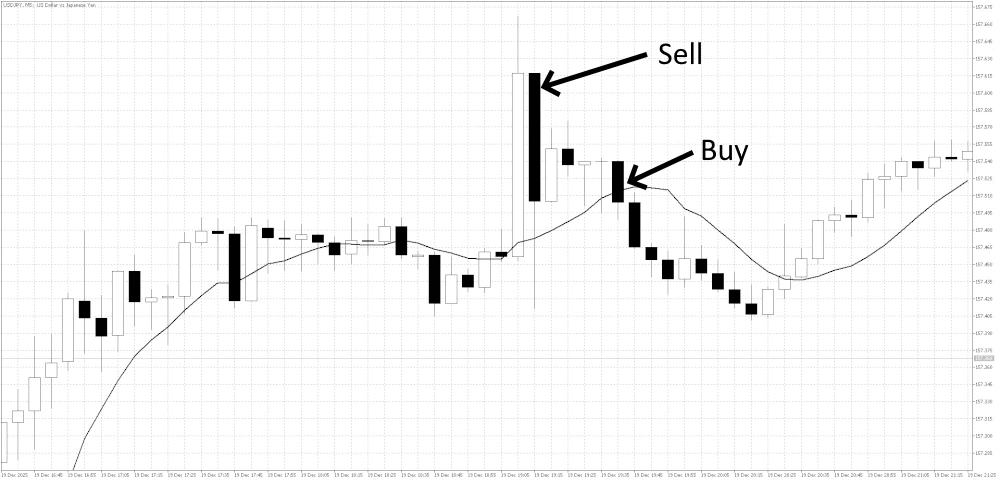 USDJPY 5 minute chart with 10 bar moving average
Alternative Method: Bollinger Band Reversal
Another popular approach is:
- Sell after price moves above the upper band and returns inside
- Buy after price moves below the lower band and returns inside
This method provides stronger confirmation but usually results in later entries and potentially smaller profits.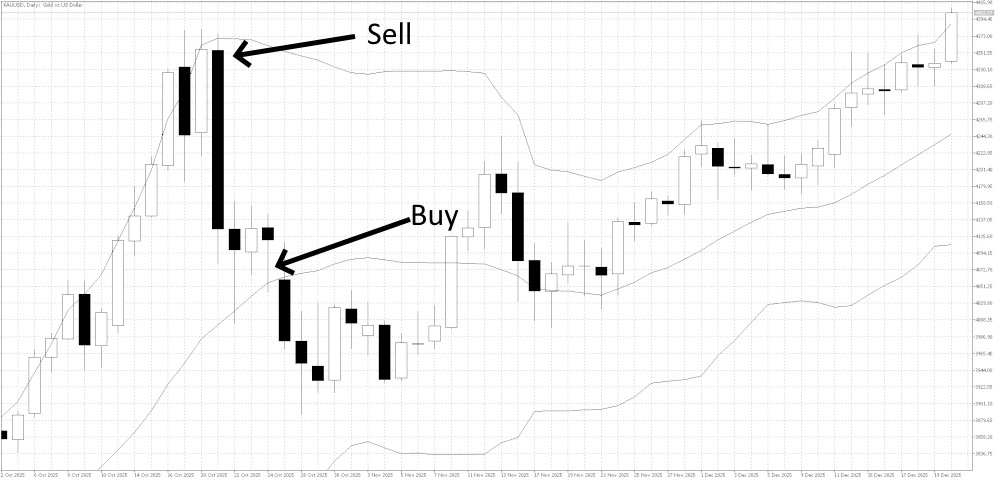
How to Improve Your Success Rate
1. Use Higher-Timeframe Context
If trading on a 5-minute chart:
- Check daily and weekly support and resistance
Short-term panic that runs into long-term resistance often reverses as larger traders enter the market.
2. Understand the Catalyst
If the move was caused by:
- Major economic data
- Central bank decisions
- Unexpected geopolitical events
Reversal trades become much riskier. In these cases, the market may be revaluing, not overreacting.
3. Apply the “Three-Strike Rule”
If you take three losses in a row fading moves:
- Stop trading against price
- Accept that a genuine trend may be forming
Discipline protects both capital and confidence.
4. Be Prepared and Decisive
Overextension setups develop and reverse quickly.
- Know your levels in advance
- Pre-calculate position size
- Be ready to execute
Hesitation often means watching the move happen without you.
5. Control Fear With Structure
Selling into strong green candles or buying after sharp drops feels uncomfortable.
Fear decreases when:
- Risk is small and defined
- The plan is clear
- Losses are accepted as normal
Confidence comes from preparation, not prediction.
Additional Practical Tips
- Combine with momentum indicators like RSI for extra confirmation
- Reduce position size when volatility is extreme
- Keep a trading journal focused on overextension setups
- Practice on demo accounts before using real money
Finding Opportunities After Big Price Moves
Overextended price moves are usually driven by emotion and urgency, not calm decision-making. While many traders rush in and chase price, more experienced traders wait for signs that momentum is slowing.
Start small, focus on risk management, and treat overextension trading as a skill that takes practice. Over time, learning to recognize these situations can help you trade volatile FX and CFD markets with more confidence and control.