
Nick Goold
Day and swing traders often get caught trying to trade every short-term move. With prices constantly moving up and down, this leads to confusion, overtrading, and unnecessary losses. Using the long-term trend as a guide simplifies trading decisions. It gives you a clear directional bias and helps you focus only on higher-probability setups instead of reacting to every price fluctuation.
By aligning your short-term trades with the long-term trend, you’ll often see:
- Better entry points
- Clearer stop-loss points
- The ability to let winning trades run further
Focusing on the long-term trend makes trading calmer and more structured. It helps you avoid bad trades, manage risk more clearly, and steadily improve day and swing trading performance.
Why the Long-Term Trend Matters
Many major markets show strong long-term momentum. Stock indices like the Dow Jones have reached record highs, gold has moved to new highs, and Bitcoin has been in a long-term uptrend. When a market trends strongly over a long period, it usually reflects sustained buying interest. For traders, this matters because a strong long-term trend gives clearer direction and improves trade selection.
In simple terms:
- If gold has been in an uptrend for months, a short-term dip is often a pullback rather than a major reversal.
- In an uptrend, price often finds buyers quickly after short-term weakness.
At the same time, no trend lasts forever. Even strong long-term trends—such as Bitcoin’s—can slow down or eventually end, which is why discipline is still important.
Understanding the long-term trend helps day and swing traders trade with the market’s direction, aim for larger profits, and avoid emotional decisions when price moves against them.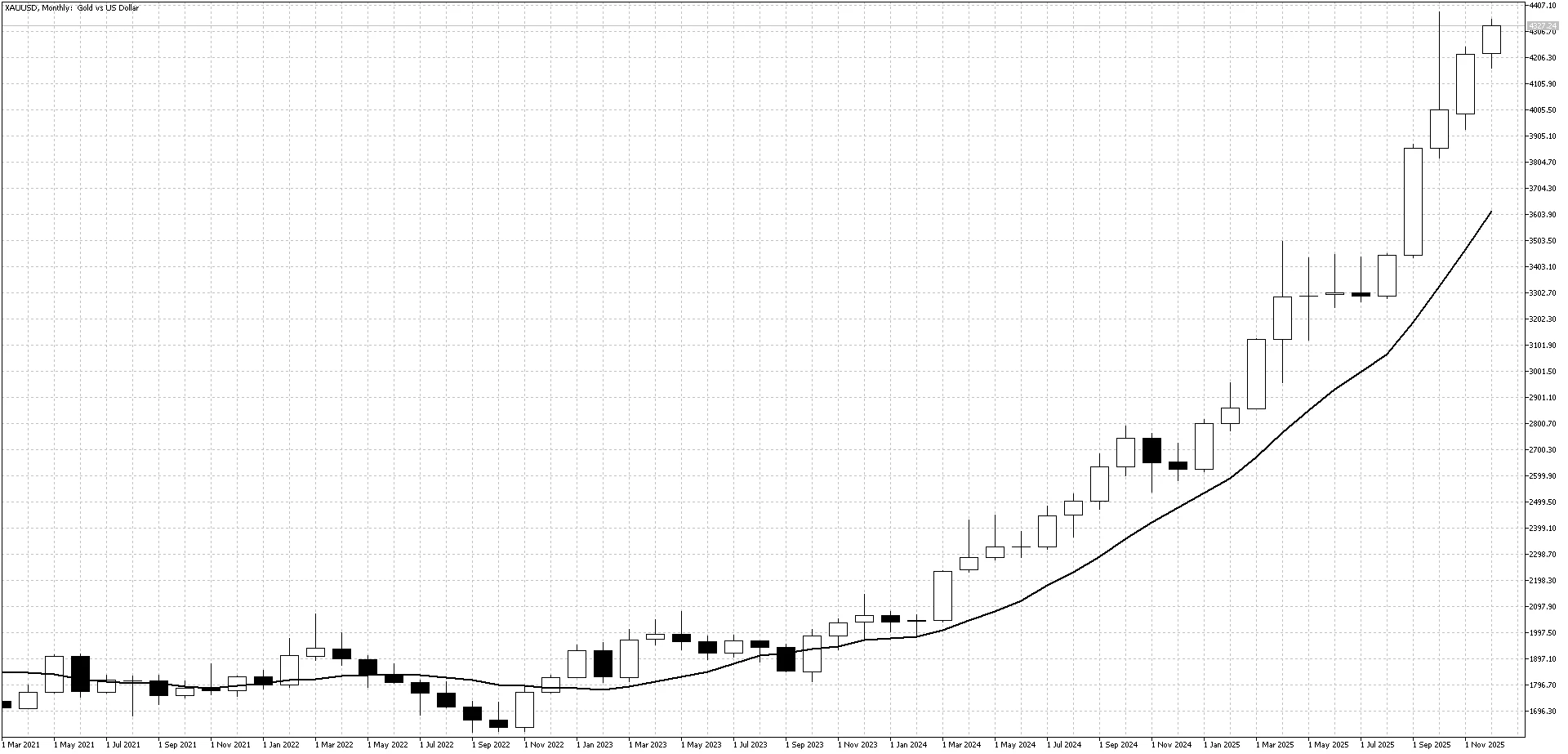
Gold monthly chart showing a long-term uptrend
The Power of Trading With the Trend
1. Following the long-term trend makes timing easier
When you follow the long-term trend, you no longer have to decide whether to buy or sell.
- If the long-term trend is up, you wait for buying opportunities when day trading or swing trading.
- If the long-term trend is down, you wait for selling opportunities when day trading or swing trading.
This removes a lot of confusion. Instead of reacting to every move, you simply wait for pullbacks and look for entries in one direction. As a result, entry timing naturally becomes clearer and more consistent.
2. It helps you avoid fighting stronger market forces
Long-term trends are driven by large traders and investors, and these trends can last much longer than most beginners expect.
Trying to trade against them—such as shorting an overbought market in a strong uptrend—often leads to losses. The market may only pull back briefly before continuing in the main direction.
By trading with the long-term trend, you avoid fighting experienced traders with more capital and patience. This keeps you on the stronger side of the market and helps you stay in profitable trades longer.
What Is a Long-Term Trend?
A long-term trend is the market’s main direction over an extended period:
- Uptrend = buyers are in control over weeks/months
- Downtrend = sellers are in control
- Sideways = neither side has control (often harder to trade)
“Long-term” depends on your style:
- Day trader: long-term = Daily or Weekly chart
- Swing trader: long-term = Weekly or Monthly chart
How to Define the Long-Term Trend
You don’t need complex tools to identify the long-term trend. Using one simple method on longer-term charts is usually enough.
Use method 1 or 2 on the daily, weekly, or monthly chart.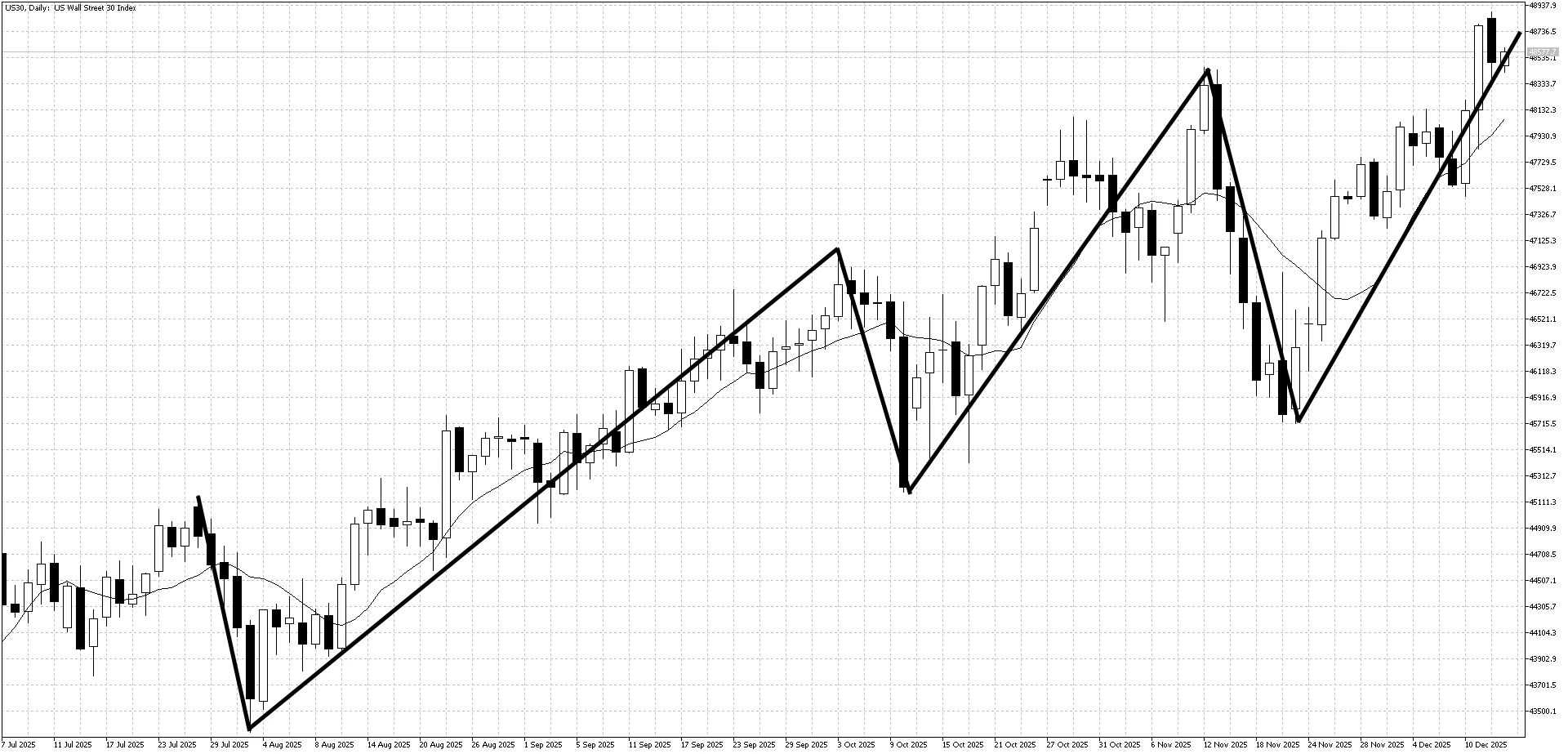
Dow Jones Index daily chart showing higher highs / higher lows, with an upward-sloping 10-day moving average
1) Moving average method
Many traders use a 100-period or 200-period moving average on the daily, weekly, or monthly chart.
How to read it:
- MA sloping up + price above it → Uptrend
- MA sloping down + price below it → Downtrend
- Moving average pointing sideways → Range / choppy market
This method works well because it removes guesswork. You don’t need complex rules—the slope gives you the direction.
2) Higher highs / higher lows
- Uptrend: higher highs and higher lows
- Downtrend: lower highs and lower lows
When the sequence of higher highs and higher lows ends, the uptrend has likely ended.
When the sequence of lower highs and lower lows ends, the downtrend has likely ended.
If there is no clear sequence, the market is usually ranging.
What Actually Drives Long-Term Trends
Charts show what is happening. Fundamentals often explain why it keeps happening.
Long-term trends are usually driven by:
- Interest rates and central bank policy
- Inflation expectations
- USD strength/weakness
- Risk sentiment (fear vs optimism)
- Geopolitical uncertainty
- Big themes (like AI optimism in equities)
Current examples
Gold rising in 2025 has often been supported by
- Safe-haven demand
- A weaker USD
- Falling U.S. interest rates (less “reward” for holding cash vs gold)
U.S. stocks rising in 2025 have often been supported by
- Lower interest rates, making stocks more attractive than bonds
- Reduced fear around trade and tariff issues
- Optimism around AI and future earnings growth
When you understand what is driving a long-term trend, it becomes easier to judge whether it is likely to continue or whether conditions may be starting to change. This helps traders stay on the right side of the market instead of reacting to every short-term move.
Practical Trading Strategies
Strategy 1: Follow the Long-Term Trend
- Long-term trend up → look for buys
- Long-term trend down → look for sells
You trade in one direction only, which removes confusion.
Entry timing:
Wait for a short-term pullback on the short-term chart (daily, 1-hour, or 5-minute).
Enter when price holds support in an uptrend or resistance in a downtrend, often near a short-term moving average.
Risk management:
- Stop below recent swing lows when buying, or above swing highs when selling
- Targets near recent highs or lows
- In strong trends, use a trailing stop to lock in profits as price moves

Strategy 2: Trading the End of the Long-Term Trend
This strategy looks for major trend reversals and is harder to trade.
- After a long uptrend → look for sells
- After a long downtrend → look for buys
You trade against the long-term trend once it shows signs of ending.
Entry timing:
- Sell when price breaks below an upward-sloping moving average on the long-term chart, and breaks support on the short-term chart.
- Buy when price breaks above a downward-sloping moving average on the long-term chart, and breaks resistance on the short-term chart.
Risk management:
- Stop above recent swing highs when selling, or below recent swing lows when buying
- Use small stop-losses
- Targets at recent highs or lows, or a return toward the moving average when the market is overbought or oversold
For most traders, following the long-term trend is simpler and more consistent than trying to trade reversals.
Using the long-term trend is one of the easiest ways to trade more effectively as a day or swing trader. It gives you clear direction and helps you avoid trades that go against the market.
Remember:
- The long-term trend shows you direction
- The short-term chart helps you find timing