
Nick Goold
One of the biggest advantages a trader can have is understanding that FX and stock indices do not behave in the same way. Traders who understand that difference are often better at spotting where the real opportunity is, instead of forcing trades out of habit.
A market may be open, but that does not always mean it is offering a good setup. By learning how different markets behave and taking time to assess conditions properly, traders can make better decisions, stay more focused, and improve the quality of the trades they take.
Time of day: understanding when each market moves
One of the biggest differences between FX and indices is when volatility appears during the day.
Indices: strongest around the open
Even though index CFDs can be traded for long hours, the biggest moves often happen when the cash market is open.
For example:
- Tokyo stocks are most active from 9:00 a.m. to 11:30 a.m. and 12:30 p.m. to 3:30 p.m. Tokyo time
- U.S. stocks are most active from 9:30 a.m. to 4:00 p.m. New York time
In many cases, the best index moves happen:
- in the first 60 to 90 minutes after the open
- in the final hour before the close
- when major news or headlines hit
That is why many index traders focus so much on the open and close. Volume is often highest at these times, and price tends to move more clearly. Outside those periods, the market can slow down and trends may become weaker.
If you like fast, strong moves, indices can be attractive. But you need to be ready at the right time.
FX: opportunity can appear throughout the day
FX works differently because it trades continuously through the week. There is no single market open. Instead, activity moves from one region to another.
For example:
- the Asian session often moves yen and Australian dollar pairs
- the London session often moves euro, pound, and Swiss franc pairs
- the New York session often moves U.S. dollar pairs
This means FX opportunity is more spread out through the day. Some hours are busier than others, but you are not depending on one short opening window. Important news, central bank comments, or geopolitical headlines can move FX at almost any time.
This gives FX traders more flexibility. Even if you miss one active period, another setup may come later.
Use longer-term charts first
When deciding whether to trade FX or indices, checking the longer-term charts can be very helpful.
For day trading, look at the daily chart. For swing trading, look at the weekly and monthly charts as well. The goal is to see whether the market is in a strong trend or stuck in a range.
One simple way to judge the trend is to use a moving average on the longer-term chart. If price is holding above a rising moving average, the market may be in an uptrend. If price is staying below a falling moving average, the market may be in a downtrend. If price keeps moving back and forth around a flat moving average, the market may be ranging.
A few points to check:
- Is FX trending more clearly, or are indices trending more clearly?
- Is the market above or below the moving average?
- Is the moving average rising, falling, or flat?
- Does the market suit your style better as a trend trade or a range trade?
This can help you choose the market that best suits your trading style. Trend traders may prefer the market with the clearest direction, while range traders may prefer a market moving between clear support and resistance levels.
Use ATR on the daily chart to compare volatility
After checking the bigger picture, the next step is to compare volatility on the daily chart.
One simple way to do that is with ATR, or Average True Range. ATR shows how much a market is moving each day on average. It does not show direction, but it does show whether the market is active enough to create trading opportunities.
This matters because if a market is barely moving, it can be harder to find strong setups or good risk-reward.
In the charts below, you can see that the ATR for the Dow index has increased, while the ATR on USD/JPY remains low, suggesting that the Dow may currently offer more trading opportunities.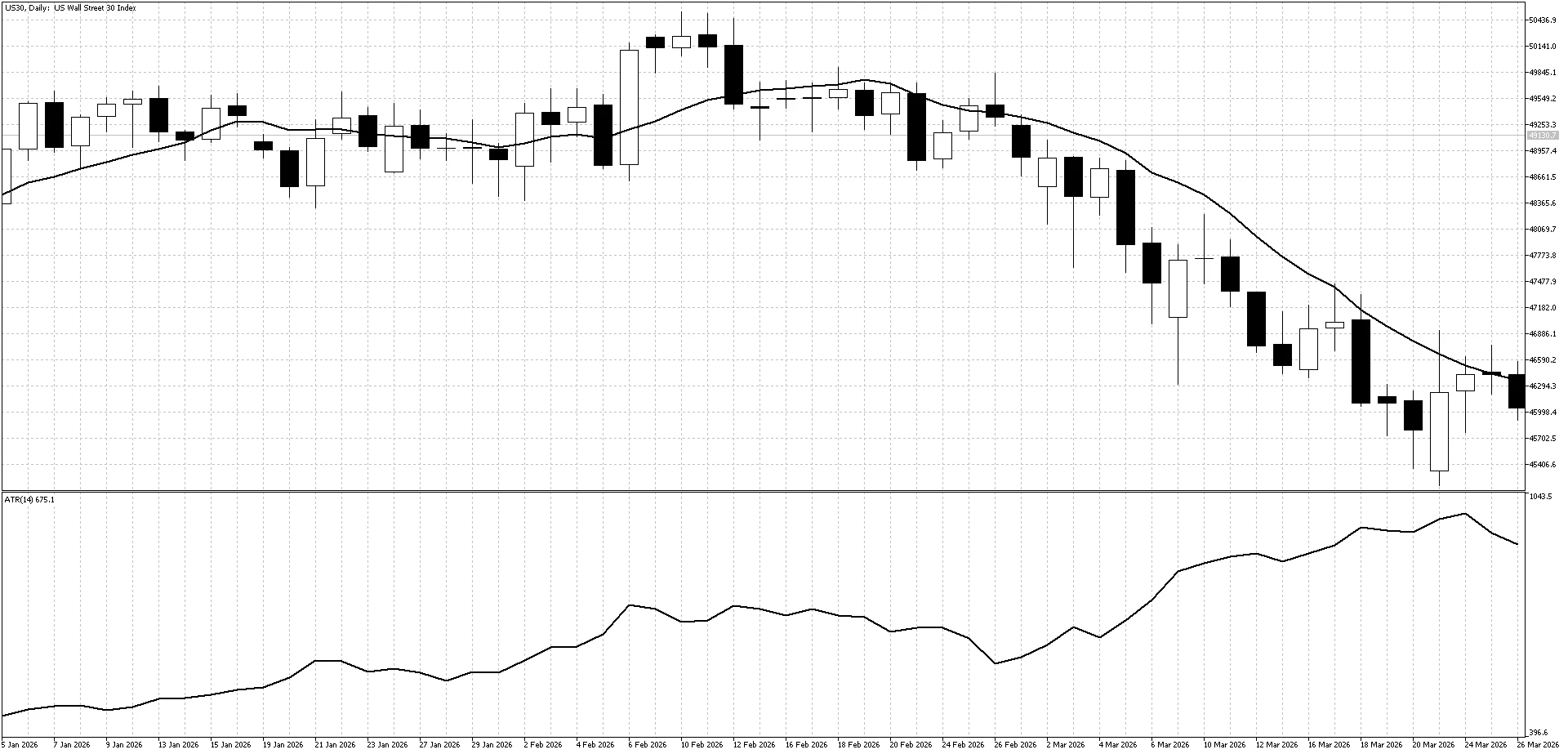 Dow Jones Index Daily Chart with ATR shown below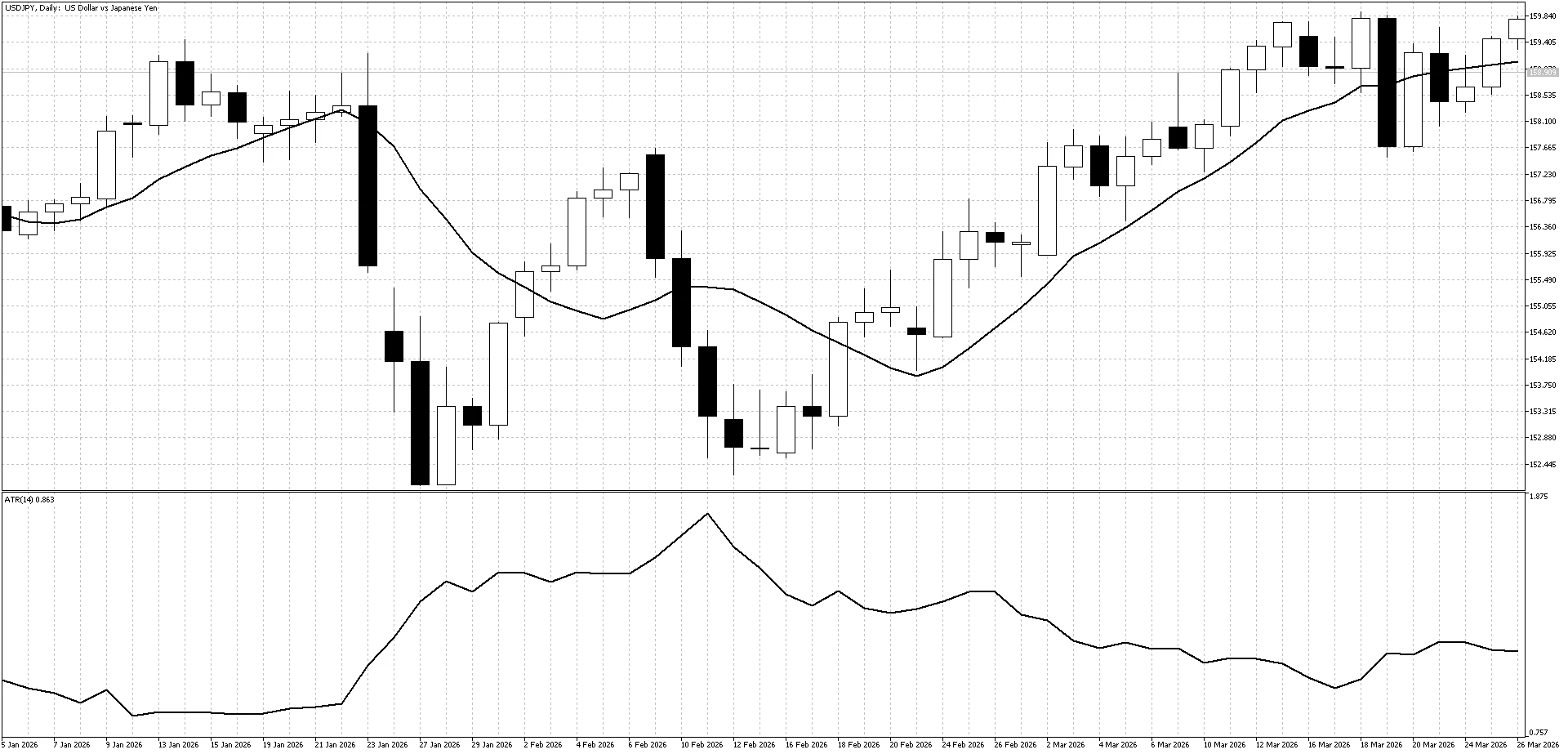
USDJPY Daily Chart with ATR shown below
A higher daily ATR can mean:
- bigger daily price swings
- better momentum
- more room for the trade to move
A useful habit is to compare daily ATR across a few major FX pairs and key indices before the session starts. That can help you see where the strongest movement is likely to be.
Use news to choose the right market
News is one of the main drivers of volatility, so it can help you decide whether FX or indices may offer the better opportunity.
Central bank decisions and inflation data often have a direct impact on FX. For example, a Bank of Japan meeting can move both USD/JPY and the Nikkei, while U.S. CPI can move the U.S. dollar, EUR/USD, and major stock indices.
A useful guide is:
- if the news is mainly about interest rates, inflation, or central banks, start with FX
- if the news is mainly about growth, earnings, or company sectors, start with indices
This is not always exact, because some events move both markets. But it is a useful way to see which market is most likely to react the most that day.

Match the market to your strategy
Choosing between FX and indices is not only about which market is moving more. It is also about which market best fits the way you trade.
Different traders look for different conditions:
- trend traders want clear direction
- range traders want price moving between support and resistance
- scalpers want fast movement, volume, and tight spreads
- swing traders focus more on daily chart structure, ATR, and major news
That is why checking both FX and indices can help you find a market that best matches your preferred strategy.
Should you trade FX and indices at the same time?
For scalpers and day traders, it is usually better to focus on one market at a time. Watching both FX and indices can lead to missed entries, slower decisions, and poor risk control. It is often better to choose the market with the clearest setup and give it your full attention.
For swing traders, trading both can make more sense. Because trades are held longer, it is easier to manage positions in more than one market. This can create more opportunities and spread risk across different market themes.
A simple way to choose the market each day
Before the session starts, take a few minutes to check a few things:
- the clearer trend or range
- higher ATR
- important news coming
- whether that news matters more to FX or indices
- which market fits your strategy
The main difference between FX and indices is when and how the best opportunities appear. FX can move throughout the day, while indices often have their best moves around the market open and close.
The choice should be based on chart structure, volatility, news, and the type of setup that fits your style. Traders can improve trading performance by focusing on whether FX or indices offer the best trading opportunity today.
Take Advantage of Golden Week Trading Opportunities with Titan FX
Golden Week can be an especially good time for FX and indices traders to find good trading opportunities, and Titan FX is running its Golden Week promotion from 20 April 2026 to 10 May 2026, with up to USD 5 cashback per lot on eligible trades. This can be especially attractive for traders looking to make the most of active market conditions during the holiday period.
Full details and registration are available here:
https://titanfx.com/promotions/golden-week-2026